
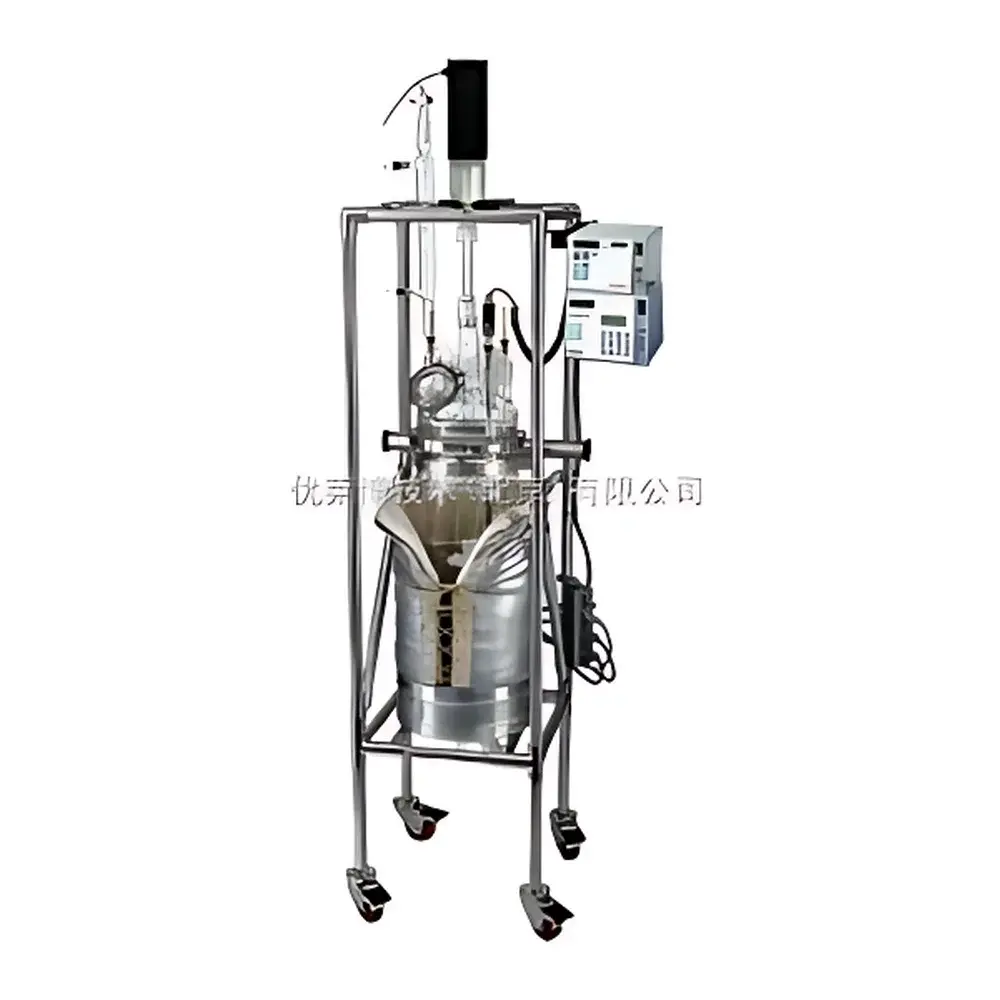
ChemTron Pilot-Scale Glass Chemical Synthesis System
| Brand | ChemTron |
|---|---|
| Origin | USA |
| Model | Pilot-Scale Kit |
| Vessel Capacity | 10–200 L |
| Vessel Materials | Borosilicate Glass, 316L Stainless Steel, Hastelloy®, PTFE-Lined |
| Vessel Configurations | Cylindrical, Spherical, Tubular |
| Jacketing Options | Single-Wall, Single-Jacketed, Double-Jacketed |
| Temperature Control | JULABO Presto Dynamic Temperature Management System |
| Temperature Range | −100 °C to +300 °C (with compatible circulator & bath fluid) |
| Max Operating Temperature (Glass Vessel) | 230 °C |
| Max ΔT (Vessel Wall vs. Contents) | 80 °C |
| Max Pressure (Spherical Lid, Standard Taper) | 5 psi |
| Max Vacuum | 5–200 mmHg (dependent on volume & geometry) |
| Stirring | Top-Mounted High-Torque Mechanical Agitator |
| Software | JULABO EasyTemp Professional & Auto Reactor Central Control Suite |
| User Interface | Integrated LCD Touchscreen + Optional JULABO Wireless Remote (range >100 m) |
| Structural Frame | Modular Stainless Steel with Locking Casters |
| Fluid-Wetted Materials | ASTM E438 Type I, Class A borosilicate glass (e.g., Pyrex®/Duran®) and PTFE |
| Sealing | Precision-Ground ISO KF/ISO-F standard glass joints |
| Drain Options | Bottom discharge valve with chemically resistant elastomeric O-rings (FKM/FFKM/PTFE-composite) |
| Compliance | Designed for GLP/GMP-aligned workflows |
Overview
The ChemTron Pilot-Scale Glass Chemical Synthesis System is an engineered platform for scalable laboratory synthesis under controlled thermal, mechanical, and atmospheric conditions. Built upon a modular architecture integrating high-purity borosilicate glass reaction vessels (10–200 L), precision dynamic temperature control, and top-driven mechanical agitation, this system bridges the gap between benchtop discovery and pre-commercial process development. Its core measurement and control paradigm relies on closed-loop thermoregulation via external JULABO Presto circulators—capable of delivering stable heat transfer across −100 °C to +300 °C—combined with real-time monitoring of vessel wall temperature, internal bulk temperature, and jacket inlet/outlet differentials. The system operates on fundamental principles of conductive and convective heat exchange, governed by Fourier’s law and Newton’s law of cooling, enabling reproducible kinetic profiling, exotherm management, and crystallization control. Designed explicitly for chemists and process engineers conducting route scouting, catalyst screening, or API intermediate synthesis, it supports both ambient-pressure reactions and controlled vacuum or inert-gas environments.
Key Features
- Modular vessel selection: Cylindrical, spherical, and tubular geometries in single-wall, single-jacketed, or double-jacketed configurations—each rated for operation up to 230 °C (glass) and 5 psi gauge pressure.
- Chemically inert wetted path: All fluid-contact surfaces consist exclusively of ASTM E438 Type I, Class A borosilicate glass or PTFE—eliminating metal leaching and ensuring compatibility with aggressive reagents including HF, oleum, and alkali metals.
- Precision ground ISO-KF glass joints: Joint tolerances ≤ ±5 µm enable vacuum integrity down to 5 mmHg (10 L) without silicone grease, while PTFE sleeve inserts prevent cold welding during extended reflux or cryogenic operations.
- Dynamic thermal management: JULABO Presto circulators provide programmable ramp/soak profiles with ±0.1 °C stability; integrated Auto Reactor software enables multi-zone PID tuning and automatic ΔT compensation to prevent thermal shock-induced fracture.
- Top-mounted agitator system: High-torque, sealed mechanical drive (0–300 rpm, adjustable shear profile) with interchangeable impellers (Rushton, pitched-blade, anchor) ensures uniform mass transfer across volumetric scales.
- Mobility and safety integration: Reinforced 304 stainless steel frame with locking casters allows repositioning within fume hoods or dedicated synthesis bays; optional polycarbonate safety shield meets ANSI Z87.1 impact resistance standards.
Sample Compatibility & Compliance
The system accommodates heterogeneous, multiphase, and gas-liquid reactions—including hydrogenations, photochemical transformations (when coupled with UV-transparent quartz accessories), and low-temperature lithiations. Vessel materials comply with USP , ISO 10993-5 (cytotoxicity), and ASTM F899 (medical-grade glass equivalency). When configured with JULABO’s validated Auto Reactor software package—including electronic signatures, role-based access control, and immutable audit trails—the platform satisfies FDA 21 CFR Part 11 requirements for regulated environments. Vacuum ratings are validated per ASTM E554 (vacuum integrity testing), and pressure containment follows ASME B31.3 process piping guidelines for pilot-scale equipment. Maximum allowable ΔT (80 °C) and pressure limits (5 psi) are enforced via hardware interlocks and software-enforced setpoint clamping.
Software & Data Management
JULABO EasyTemp Professional provides local touchscreen control for temperature, stirring, and basic sequence programming. Auto Reactor serves as the central orchestration layer—enabling synchronized control of up to eight independent synthesis stations from a single interface. It logs timestamped parameters (temperature, RPM, pressure, pH if interfaced, feed mass flow) at user-defined intervals (100 ms–5 min resolution), stores data in encrypted SQLite3 databases compliant with ALCOA+ principles, and exports CSV/PDF reports aligned with ICH M7 and Q5 analytical documentation standards. Optional OPC UA integration permits bidirectional communication with LIMS (e.g., LabWare, Thermo SampleManager) and MES platforms.
Applications
- Process chemistry optimization: Screening solvent effects, stoichiometric ratios, and addition rates under reproducible thermal profiles.
- Crystallization process development: Controlled anti-solvent addition with simultaneous cooling ramping to modulate supersaturation and polymorph selectivity.
- Catalyst evaluation studies: Monitoring induction periods and turnover frequencies (TOF) in batch hydrogenation or cross-coupling reactions.
- Thermal hazard assessment: Adiabatic calorimetry support via controlled exotherm triggering and real-time dT/dt calculation.
- Continuous-flow precursor synthesis: Integration with peristaltic pumps and inline FTIR (via optional flow cell) for residence time distribution analysis.
- Regulatory filing support: Generating GMP-compliant batch records for Phase II/III clinical material synthesis.
FAQ
What is the maximum recommended temperature differential between jacket fluid and reactor contents?
The system enforces a hard limit of 80 °C ΔT to mitigate thermal stress in borosilicate glass. This value is monitored continuously and triggers automatic power reduction if exceeded.
Can the system operate under full vacuum without risk of implosion?
Yes—vacuum integrity is geometry-dependent. For example, the 10 L spherical vessel maintains structural stability down to 5 mmHg; larger cylindrical vessels (100–200 L) are rated to 200 mmHg and require optional vacuum reinforcement bands.
Is PTFE used only for seals, or does it contact the reaction mixture directly?
PTFE forms integral linings in valves, stirrer shaft seals, and joint sleeves—all classified as Class VI biocompatible per USP . No metallic components contact process fluids.
How is calibration traceability maintained for temperature sensors?
Each Pt100 sensor is supplied with NIST-traceable calibration certificate (±0.05 °C at 0 °C, ±0.1 °C at 100 °C), and Auto Reactor supports periodic verification via external reference probes.
Does the system support automated reagent addition with mass-based feedback?
Yes—integrated digital peristaltic or syringe pump modules (optional) interface with Auto Reactor to execute gravimetrically triggered additions using METTLER TOLEDO or Sartorius balance inputs.



