
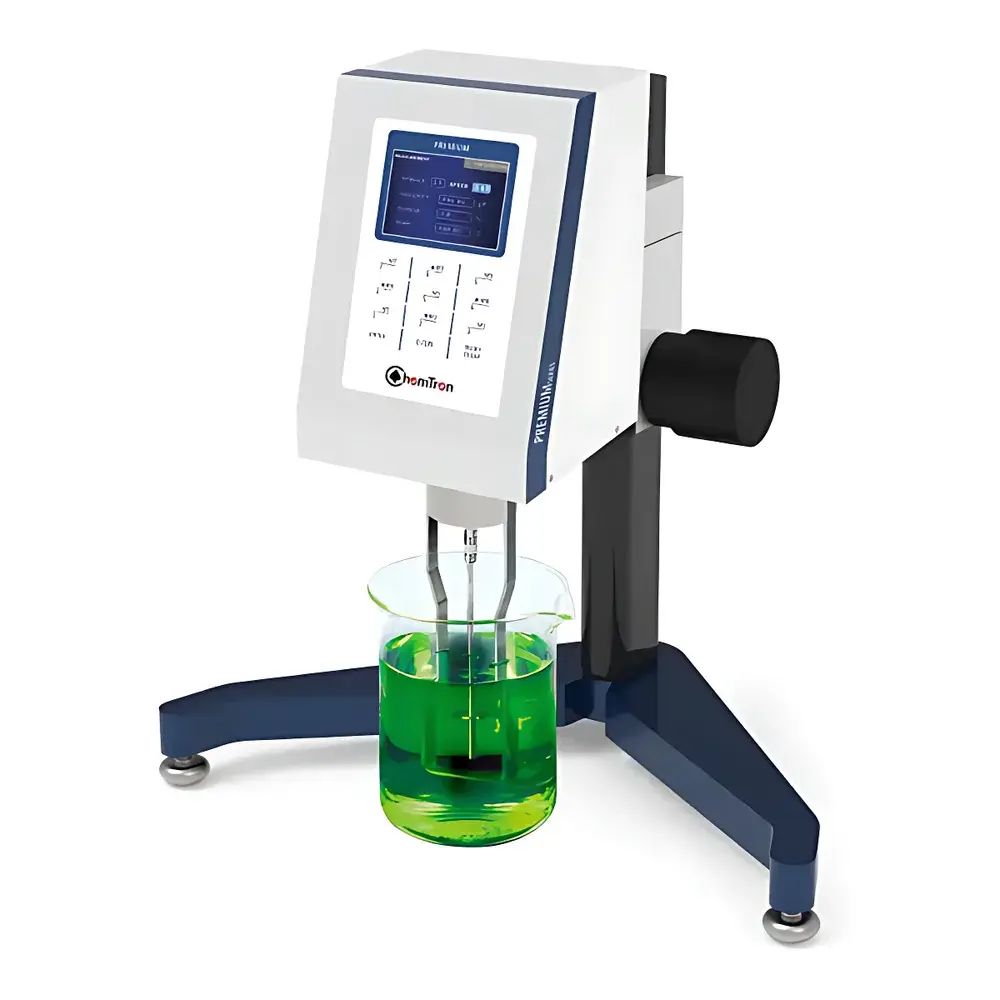
ChemTron PREMIUM Advanced Rotational Viscometer
| Brand | ChemTron |
|---|---|
| Origin | Germany |
| Model | PREMIUM |
| Instrument Type | Benchtop Rotational Viscometer |
| Viscosity Range | 1–320,000,000 mPa·s |
| Temperature Range | −40 to +300 °C |
| Temperature Resolution | 0.1 °C |
| Temperature Accuracy | ±0.2 °C |
| Speed Range | 0.01–250 rpm (2600 selectable speeds) |
| Viscosity Accuracy | ±1% of full scale |
| Repeatability | ±0.2% |
| Compliance Standards | ASTM D1076, D1084, D1286, D1417, D1439, D1638, D1824, D2196, D2336, D2364, D2393, D2556, D2669, D2849, D2983, D2994, D3232, D3236, D3716 |
Overview
The ChemTron PREMIUM Advanced Rotational Viscometer is a benchtop instrument engineered for high-precision dynamic viscosity measurement across an exceptionally broad range—from ultra-low-viscosity liquids (1 mPa·s) to highly structured, non-Newtonian pastes and polymer melts (up to 320 million mPa·s). Based on the Couette principle, it employs torque-sensing rotational mechanics with interchangeable spindles (L-, R-, and H-series) to deliver reproducible shear-dependent rheological data under controlled thermal conditions. Designed for laboratories requiring regulatory compliance and operational flexibility, the PREMIUM platform supports both routine QC testing and advanced material characterization in environments ranging from cryogenic (−40 °C) to high-temperature industrial processing (+300 °C). Its architecture integrates real-time shear rate and shear stress calculation—when used with coaxial cylinder or DIN-type spindles—enabling fundamental rheological analysis beyond single-point viscosity reporting.
Key Features
- Full-range rotational speed control: 2600 discrete settings from 0.01 to 250 rpm, enabling precise shear rate profiling for yield stress, thixotropy, and flow curve analysis.
- Integrated PT100 temperature sensor with ±0.2 °C accuracy and 0.1 °C resolution, supporting ISO/ASTM-compliant thermal validation protocols.
- Auto-ranging and Auto-Test functions with audible and visual alerts for out-of-range measurements, spindle mismatch, or thermal drift.
- Multi-language interface (7 languages, including English, German, French, Spanish, Italian, Chinese, and Japanese) with intuitive color TFT display for rapid parameter navigation and real-time data visualization.
- USB and Bluetooth connectivity for remote operation, automated data logging, and synchronized curve plotting via FGB DATA BOSS software—validated for FDA 21 CFR Part 11 compliance with electronic signature, audit trail, and user access control.
- User-calibratable viscosity and temperature modules, traceable to NIST-certified standard oils and reference thermometers.
- Robust stainless-steel (AISI 316) spindle construction with laser-etched identification and standardized geometry per ASTM D1286 and ISO 2555.
Sample Compatibility & Compliance
The PREMIUM accommodates diverse sample forms—including Newtonian fluids, gels, suspensions, emulsions, molten polymers, and thermosetting resins—via application-specific spindle configurations: L-series for low-viscosity Newtonian liquids (e.g., solvents, fuels); R-series for medium-viscosity materials (e.g., paints, adhesives, food products); and H-series for high-viscosity and non-Newtonian systems (e.g., bitumen, silicone rubber, battery slurries). Optional accessories extend capability: APM (small-volume adapter), LCP (low-viscosity adapter), HELDAL (high-viscosity adapter), and jacketed temperature-controlled cells ensure adherence to ASTM D1076 (paints), D2196 (non-Newtonian fluids), D2983 (low-temp asphalt), and ISO 1652 (polymer solutions). All configurations maintain alignment with GLP/GMP documentation requirements and support full traceability per ISO/IEC 17025.
Software & Data Management
FGB DATA BOSS is the validated desktop application for instrument control, method development, and regulated data handling. It supports multi-step test sequences (TTT/TTS modes), slope-based ramp profiles, and up to nine stored working programs. The software computes derived parameters—including kinematic viscosity (cSt), density-corrected values, and shear-dependent viscosity—while generating compliant reports with embedded metadata (operator ID, timestamp, calibration status, environmental logs). Audit trails record all user actions, parameter changes, and data exports in immutable format. Raw datasets export to CSV, Excel, or PDF with embedded graphs, satisfying analytical data integrity (ALCOA+) principles required by pharmaceutical, chemical, and automotive QA/QC departments.
Applications
The PREMIUM serves as a primary tool in R&D and production labs for viscosity specification verification, formulation optimization, shelf-life prediction, and process consistency monitoring. Typical use cases include: monitoring polymerization kinetics in resin synthesis; assessing anti-settling performance of pigment dispersions; validating thermal stability of lubricants across operating temperatures; characterizing yield behavior of pharmaceutical gels and ointments; and qualifying electrode slurry rheology for lithium-ion battery manufacturing. Its wide dynamic range and temperature capability make it suitable for ASTM D3232 (bitumen), D2393 (latex), D1824 (adhesives), and USP (rheological testing of semisolid dosage forms).
FAQ
What spindle types are included with each PREMIUM model?
The PREMIUM L includes four L-series spindles (L1–L4); the PREMIUM R includes six R-series spindles (R2–R7); the PREMIUM H includes six H-series spindles (R2–R7), optimized for high-torque, high-viscosity applications.
Is temperature control integrated or external?
The instrument includes a built-in PT100 sensor for accurate sample temperature monitoring. For active temperature regulation, external circulators or Peltier-based baths (e.g., Julabo or Huber units) are recommended and fully compatible via analog/digital I/O interfaces.
Does the system meet FDA 21 CFR Part 11 requirements?
Yes—when operated with FGB DATA BOSS software configured with role-based user accounts, electronic signatures, and enabled audit trail functionality, the system fulfills Part 11 criteria for electronic records and signatures in regulated environments.
Can shear rate and shear stress be calculated in real time?
Yes—when using coaxial cylinder (CC) or DIN-standard spindles with known geometric constants, the instrument computes instantaneous shear rate (s⁻¹) and shear stress (N/m²) based on rotational speed, torque, and spindle dimensions.
What calibration standards are supported?
The system accepts NIST-traceable viscosity standards (e.g., Cannon, Paragon, or Brookfield certified oils) and allows two-point viscosity calibration plus independent temperature calibration using certified reference thermometers.
Related Products



