
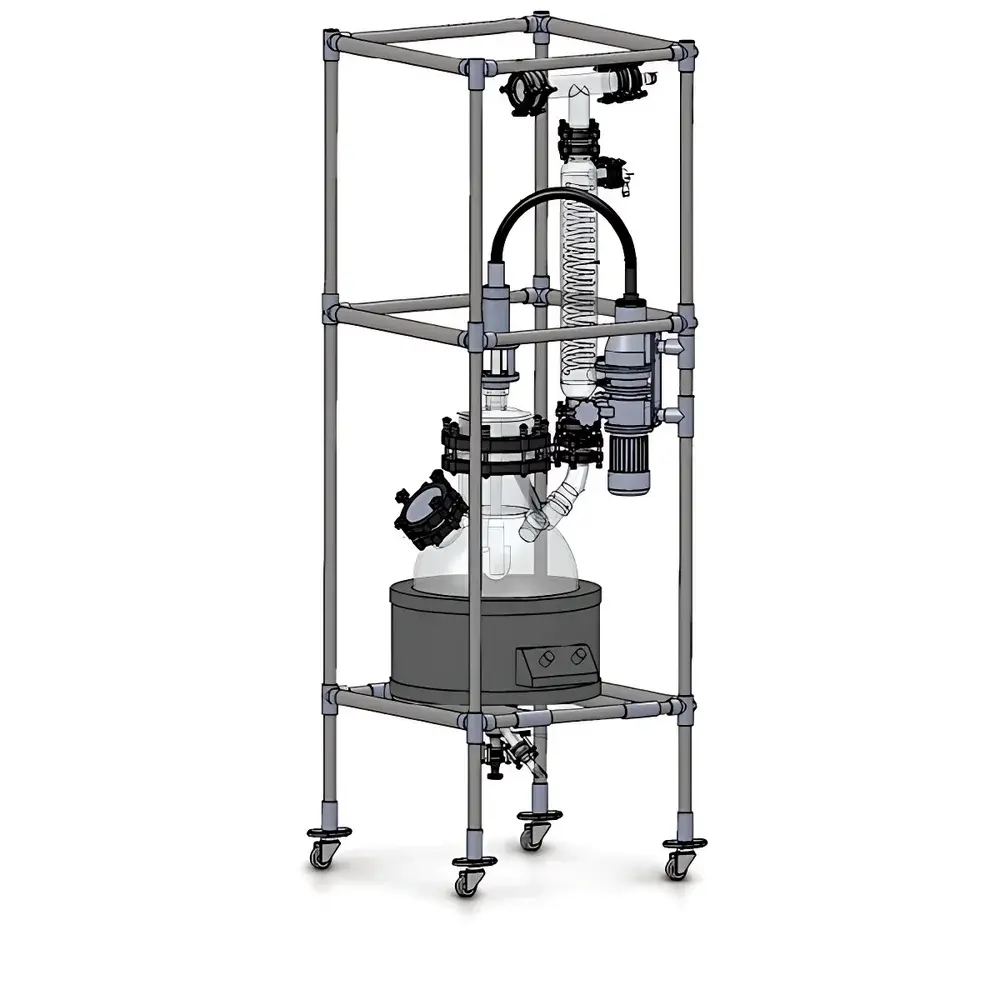
ChemTron SQHK07166 Spherical Pilot-Scale Glass Reactor System
| Brand | ChemTron |
|---|---|
| Origin | Germany |
| Manufacturer Type | Authorized Distributor |
| Product Origin | Imported |
| Model | SQHK07166 |
| Volume Range | 20–200 L |
| Vessel Material | Borosilicate Glass 3.3 (DIN ISO 3585) |
| Operating Pressure | Medium Pressure (up to 6 bar g, depending on configuration and temperature) |
| Structural Frame | Stainless Steel (AISI 316L) |
| Compliance | CE-marked, compliant with PED 2014/68/EU for pressure equipment (where applicable), EN 61000-6-2/-6-4 EMC standards |
| Optional Integration | Julabo-Chemtron PLC-based Central Control System (IEC 61131-3 compliant) |
Overview
The ChemTron SQHK07166 Spherical Pilot-Scale Glass Reactor System is an engineered solution bridging laboratory-scale synthesis and pilot-scale process development. Designed around a geometrically optimized spherical borosilicate glass vessel (DIN ISO 3585), the system leverages uniform curvature to eliminate stagnant zones and promote homogeneous mixing, thermal distribution, and mass transfer—critical parameters in exothermic, catalytic, or multi-phase reactions. Unlike cylindrical reactors, the spherical geometry reduces wall shear gradients and improves volumetric utilization under agitated conditions. The reactor operates within medium-pressure regimes (typically up to 6 bar gauge, validated per PED 2014/68/EU for designated configurations) and supports temperature ranges from –80 °C to +200 °C when paired with compatible Julabo thermostatic circulators and jacketed configurations. Its modular architecture enables seamless transition from feasibility studies to tech-transfer documentation required for GMP-aligned process validation.
Key Features
- Spherical borosilicate glass 3.3 vessel (20–200 L volume options) with zero-dead-volume bottom valve (standard for ≤22 L; jacketed variants available for 3 L, 5 L, and 12 L units)
- Integrated AISI 316L stainless steel support frame with standardized mounting interfaces for rapid reconfiguration and expansion
- Multi-port top plate assembly featuring sealed feed ports for solid dosing (powder inlet), liquid addition (liquid inlet), vapor venting (condenser outlet), and inert gas purging
- High-integrity mechanical stirring system with corrosion-resistant shaft, PTFE-coated impeller options (e.g., pitched blade, anchor, or hollow turbine), and IP65-rated motor with torque monitoring capability
- Dedicated sensor integration ports accommodating industry-standard probes: pH, redox (ORP), conductivity, dissolved oxygen, temperature (Pt100 Class A), and pressure transducers
- CE-compliant electrical architecture with reinforced insulation, emergency stop circuitry, and overpressure relief pathways aligned with EN ISO 13850
Sample Compatibility & Compliance
The SQHK07166 system exhibits exceptional chemical resistance to aggressive solvents—including halogenated hydrocarbons, strong acids (e.g., HNO₃, H₂SO₄), alkalis (e.g., NaOH), and peroxides—due to the inert surface and low extractables profile of borosilicate glass 3.3. All wetted elastomers (O-rings, diaphragms) are FDA-compliant FKM or EPDM, selected per USP / cytotoxicity and extractables testing requirements. Pressure-containing components adhere to PED 2014/68/EU Annex I essential safety requirements where rated. For regulated environments, optional audit-trail-enabled PLC control (Julabo-Chemtron firmware v4.2+) supports 21 CFR Part 11 compliance via electronic signatures, user access tiers, and immutable operation logs. The system meets GLP documentation standards for raw material traceability and calibration record retention.
Software & Data Management
When integrated with the Julabo-Chemtron PLC Central Control System, the SQHK07166 supports deterministic real-time process orchestration. The IEC 61131-3 compliant platform enables synchronized control of agitation speed (0–300 rpm, ±0.5% setpoint accuracy), jacket temperature (±0.2 °C stability), feed rates (via peristaltic or mass-flow-controlled dosing), and gas flow (N₂, Ar, O₂). All sensor inputs are timestamped at 100 ms intervals and stored in SQLite-based local databases, exportable as CSV or ASTM E2500-compliant .xslx packages. Alarm management follows ISA-18.2 guidelines, with configurable severity levels, notification routing (email/SMS), and automatic event-triggered data capture. Remote monitoring is supported via TLS 1.2-secured OPC UA server (UA Profile: Embedded Device Server), enabling integration into enterprise MES or SCADA infrastructures.
Applications
- Pharmaceutical intermediate synthesis under controlled stoichiometry and residence time
- Catalyst screening and kinetic profiling for heterogeneous hydrogenation or oxidation reactions
- Polymerization reaction optimization (e.g., step-growth polycondensation, free-radical emulsion polymerization)
- Crystallization process development with in-situ FBRM or PVM compatibility
- Electrochemical synthesis requiring precise potential control and gas evolution management
- Biocatalytic transformations operating at ambient-to-moderate temperatures with enzyme immobilization support
FAQ
What pressure ratings apply to the SQHK07166 series, and how are they validated?
Maximum allowable working pressure (MAWP) is determined per vessel volume, jacket configuration, and temperature. Standard 20–200 L spherical vessels are rated to 4 bar g at 100 °C and 2.5 bar g at 150 °C, certified by third-party Notified Body assessment under PED 2014/68/EU.
Can the system be operated under vacuum, and what is the minimum achievable pressure?
Yes—the glass vessel and sealing system support continuous operation down to 10 mbar abs, verified via helium leak testing (≤5×10⁻⁹ mbar·L/s). Vacuum-rated variants include reinforced viewports and dual-stage mechanical seal assemblies.
Is the bottom discharge valve suitable for abrasive slurries or crystalline suspensions?
For volumes ≤22 L, the zero-dead-volume diaphragm valve features ceramic-coated seat and PTFE-lined stem, rated for particles up to 200 µm. Larger systems (50–200 L) utilize pneumatically actuated ball valves with hardened stainless steel trunnions and replaceable sapphire seats.
How does the spherical geometry impact heat transfer efficiency compared to cylindrical reactors?
Spherical geometry provides ~18% higher surface-area-to-volume ratio than equivalent cylindrical vessels, reducing thermal lag during ramp-and-soak cycles. Computational fluid dynamics (CFD) modeling confirms 22–30% improvement in overall heat transfer coefficient (U-value) under identical agitation and jacket flow conditions.
What documentation is provided for regulatory submissions (e.g., CMC sections in IND/NDAs)?
ChemTron supplies DQ/IQ/OQ protocols, material certificates (EN 10204 3.1), glass composition reports (ICP-MS trace element analysis), and FAT/SAT test records—including pressure hold tests, stirrer torque calibration, and sensor linearity verification—formatted per ICH M4(Q5) and ASTM E2500.



