
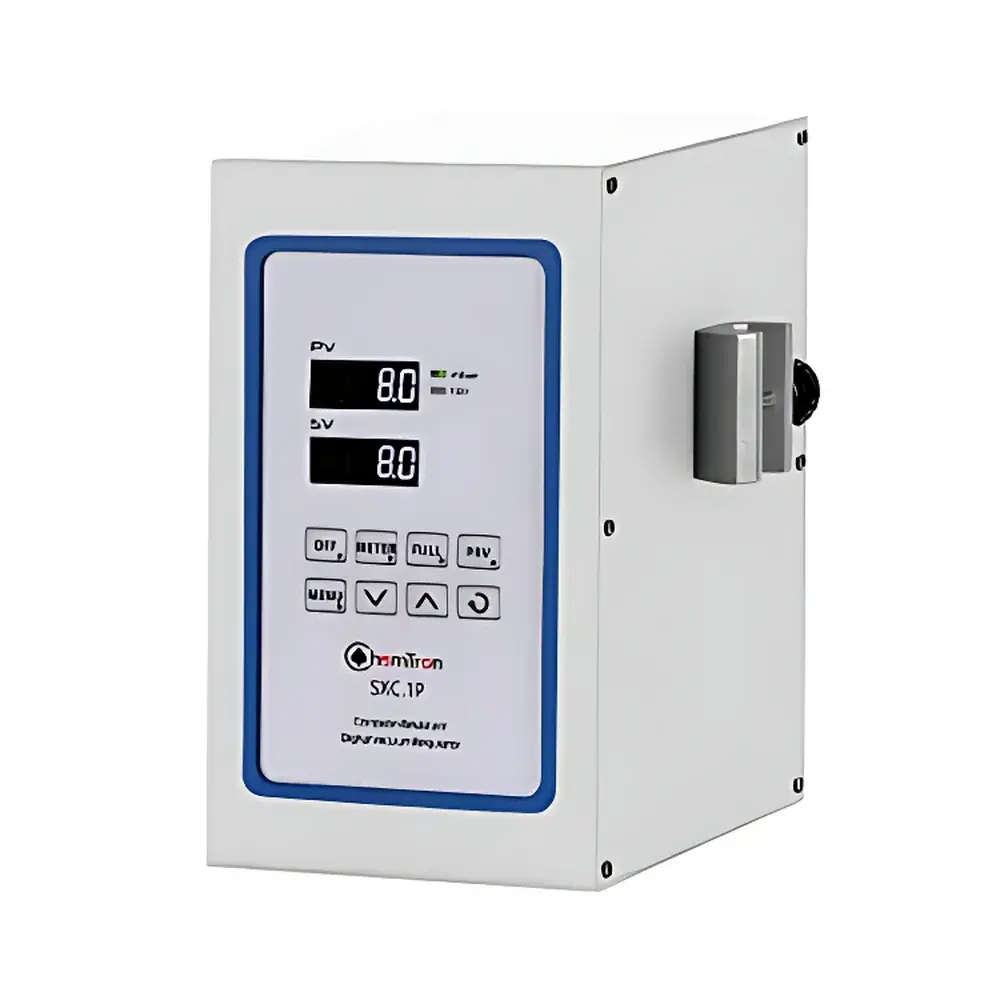
ChemTron SXC.1 / SXC.1P Corrosion-Resistant Vacuum Controller
| Brand | ChemTron |
|---|---|
| Origin | Germany |
| Model | SXC.1 / SXC.1P |
| Display | High-Brightness LED |
| Pressure Resolution | 0.1 mbar |
| Setpoint Range | 0.1–1000 mbar |
| Sensor Accuracy | ±0.25% F.S. (SXC.1) / ±0.1% F.S. (SXC.1P) |
| Programmable Stages | 5-segment vacuum ramping & hold |
| Controlled Vent Function | Yes |
| Ingress Protection | IP40 |
| Wetted Materials | PTFE, high-performance ceramics (chemically inert to strong acids, bases, and organic solvents) |
Overview
The ChemTron SXC.1 and SXC.1P Corrosion-Resistant Vacuum Controllers are precision-engineered digital instruments designed for stable, repeatable, and chemically robust vacuum regulation in demanding laboratory and pilot-scale applications. Unlike generic vacuum switches or analog controllers, the SXC series integrates a high-stability pressure transducer with closed-loop PID control logic to actively maintain user-defined setpoints—regardless of pump speed variation, gas load fluctuation, or system outgassing. These controllers operate independently of pump type and are fully compatible with ChemTron’s range of oil-free diaphragm vacuum pumps (e.g., Vario, Vacuubrand MD series), as well as third-party dry scroll, diaphragm, and claw pumps. Their core function is not merely on/off switching but dynamic pressure modulation—enabling controlled evacuation, stepwise degassing, timed venting, and process-critical hold phases under corrosive atmospheres where conventional sensors would degrade or drift.
Key Features
- Chemically inert wetted path constructed exclusively from PTFE and advanced technical ceramics—validated for continuous exposure to HCl, HF, HNO₃, NaOH, THF, acetone, chlorinated hydrocarbons, and other aggressive media per ASTM D543 and ISO 17469-2 corrosion resistance protocols.
- Dual-model architecture: SXC.1 delivers ±0.25% full-scale accuracy suitable for general-purpose vacuum processes; SXC.1P features an enhanced ceramic capacitive sensor with ±0.1% F.S. accuracy and improved long-term zero stability for GLP-compliant method validation.
- Five-stage programmable vacuum profile capability—including ramp rates (mbar/min), dwell times (0.1–999 min), and final setpoint hold—enabling automated multi-step procedures such as solvent removal, freeze-drying pre-cooling, or catalyst activation sequences.
- Integrated controlled vent function with adjustable flow restriction, preventing sample disturbance during atmospheric re-entry—critical for lyophilization, vacuum filtration, and glovebox interface operations.
- IP40-rated enclosure with front-panel sealed membrane keys and high-brightness LED display ensures legibility under low-light hoods and resistance to incidental splashes and vapors.
Sample Compatibility & Compliance
The SXC series imposes no inherent sample restrictions beyond those defined by the connected vacuum system and vessel materials. Its non-metallic, halogen-free fluid path eliminates catalytic interference and metal ion leaching—making it suitable for trace-metal analysis workflows (e.g., ICP-MS sample prep), pharmaceutical crystallization under inert atmosphere, and semiconductor wafer drying. The controller complies with EU RoHS Directive 2011/65/EU and meets CE marking requirements for electromagnetic compatibility (EN 61326-1) and low-voltage safety (EN 61010-1). While not intrinsically rated for hazardous areas, its design supports integration into Class A/B cleanrooms and ISO 14644-1 compliant environments when installed with appropriate tubing and isolation valves.
Software & Data Management
The SXC.1 and SXC.1P operate as standalone hardware units without proprietary software dependencies. All configuration—including setpoints, program steps, alarm thresholds, and vent parameters—is performed locally via intuitive key navigation and confirmed via real-time pressure readout. For laboratories requiring audit-ready documentation, optional RS-232 or analog 0–10 V output (available on request) enables connection to SCADA systems, LIMS, or data loggers supporting Modbus RTU or ASCII protocol. When integrated into validated environments, the controller supports 21 CFR Part 11-compliant electronic records when paired with appropriate system-level access controls, electronic signatures, and audit trail generation at the host data acquisition layer.
Applications
- Controlled solvent evaporation in rotary evaporators handling aggressive solvents (e.g., TFA, pyridine, brominated compounds)
- Vacuum-assisted filtration of corrosive filtrates in chemical synthesis and metallurgical leaching
- Staged degassing of polymer precursors prior to casting or injection molding
- Pressure-regulated drying of battery electrode slurries and MOF frameworks
- Automated vacuum cycling in accelerated stability chambers per ICH Q1A(R3)
- Interface control between vacuum ovens and inert-gas purged transfer lines
FAQ
Can the SXC controller be used with non-ChemTron vacuum pumps?
Yes—the SXC series accepts standard 0–10 V or 4–20 mA pump speed input signals and provides relay or analog output for pump modulation, making it compatible with most industrial-grade oil-free vacuum sources.
Is calibration traceable to national standards?
Each unit ships with a factory calibration certificate referencing DKD/DAkkS-accredited pressure standards; field recalibration is supported using NIST-traceable deadweight testers or certified reference transducers.
Does the controller support remote monitoring via Ethernet or USB?
No native Ethernet or USB interface is included; however, RS-232 communication allows integration with PC-based control platforms using terminal emulation or custom LabVIEW/Python scripts.
What maintenance is required for long-term reliability?
No scheduled maintenance is required—no moving parts are exposed to process gas. Periodic verification of sensor zero point (annually or after exposure to condensable vapors) is recommended per ISO 9001 internal calibration procedures.
Can the SXC replace a mechanical vacuum gauge in existing systems?
It functions as a controller—not a direct replacement for passive gauges—but may eliminate the need for separate vacuum meters when used with its built-in display and programmable logic.



