
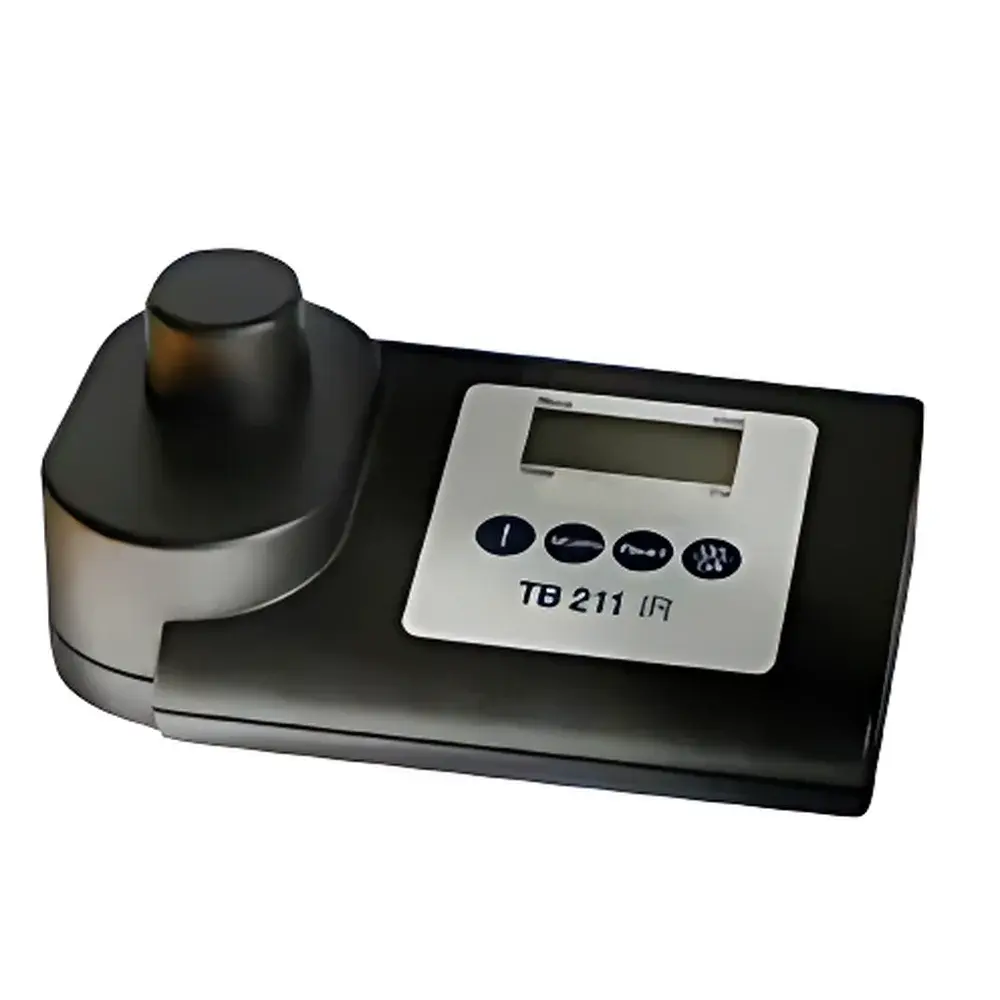
ChemTron TB 211 Portable Infrared Turbidimeter
| Brand | ChemTron |
|---|---|
| Origin | Germany |
| Model | TB 211 |
| Measurement Principle | ISO 7027-compliant 90° infrared light scattering (λ = 860 nm) |
| Range | 0.01–1100 NTU (auto-ranging) |
| Resolution | 0.01 NTU (0.01–9.99), 0.1 NTU (10.0–99.9), 1 NTU (100–1100) |
| Accuracy | ±2.5% or ±0.01 NTU (whichever is greater) for <500 NTU |
| Response Time | ~8 s per measurement |
| Display | Backlit LCD (button-activated) |
| Data Storage | 125 measurements |
| Interface | USB |
| Temperature Compensation | Yes |
| IP Rating | Waterproof cuvette compartment |
| Units | NTU, FNU, TE/F (equivalent per EN ISO 7027) |
Overview
The ChemTron TB 211 Portable Infrared Turbidimeter is an engineered field-deployable instrument designed for rapid, reliable turbidity quantification in diverse aqueous matrices—from potable water distribution systems and wastewater treatment effluents to process water in food & beverage or pharmaceutical manufacturing. It operates on the principle of 90° scattered light detection using a stable, temperature-compensated infrared LED source (λ = 860 nm), fully compliant with EN ISO 7027:2016. This optical configuration eliminates interference from sample coloration—unlike visible-light turbidimeters—and ensures high specificity for suspended particulate matter regardless of chromophore presence. The device employs a calibrated photodiode amplifier and a sealed, waterproof cuvette chamber to maintain optical path integrity under variable environmental conditions. Its compact, battery-powered form factor supports real-time decision-making at sampling points without requiring laboratory infrastructure.
Key Features
- ISO 7027-compliant infrared (860 nm) nephelometric measurement with integrated temperature compensation for consistent performance across ambient thermal gradients.
- Wide dynamic range: 0.01–1100 NTU with automatic range switching and context-sensitive resolution (0.01 NTU in low-range, 1 NTU in high-range).
- High-sensitivity detection limit of 0.01 NTU, enabling compliance verification against WHO drinking water guidelines (≤1 NTU) and EPA Method 180.1 thresholds.
- Robust mechanical design featuring an IP-rated cuvette compartment, shock-absorbing housing, and sealed optical path to withstand field handling and humidity exposure.
- Backlit LCD display activated by button press—optimized for low-power operation and legibility in shaded or low-light environments.
- Onboard memory stores up to 125 measurement records with timestamp and unit metadata (NTU/FNU/TE-F), supporting traceable field data capture.
- Standard USB interface enables direct data export to Windows/macOS platforms for integration into LIMS or QA/QC reporting workflows.
Sample Compatibility & Compliance
The TB 211 accepts standard 25-mm round glass or disposable plastic cuvettes (10 mm path length). Its infrared excitation wavelength renders it insensitive to natural organic matter (NOM)-induced absorbance, making it suitable for colored surface waters, treated effluents, and industrial process streams where visible-light turbidimeters exhibit spectral interference. The instrument meets EN ISO 7027:2016 requirements for method validation, including linearity verification, repeatability assessment (<2% RSD at 100 NTU), and inter-laboratory reproducibility benchmarks. While not certified for GLP/GMP environments out-of-the-box, its data logging architecture supports audit-trail-ready documentation when paired with validated USB transfer protocols and timestamped CSV exports—facilitating alignment with FDA 21 CFR Part 11 expectations for electronic records in regulated water quality monitoring.
Software & Data Management
No proprietary software is required. Measurement data is exported as plain-text CSV files via USB mass-storage mode, ensuring compatibility with Excel, Python pandas, LabVIEW, or enterprise LIMS platforms. Each record includes measured value, unit designation, date/time stamp (device RTC), and auto-applied range identifier. The absence of cloud dependency or vendor-locked firmware enhances long-term data sovereignty and simplifies IT security validation in controlled facilities. Optional batch export scripting (e.g., PowerShell or Bash) enables automated ingestion into SQL databases or statistical control charting tools used in Six Sigma or ISO 9001-certified QA systems.
Applications
- Drinking water quality verification at intake, filtration, and distribution points per WHO/EPA regulatory limits.
- Wastewater treatment plant monitoring: influent screening, clarifier performance assessment, and final effluent compliance testing.
- Pharmaceutical water system validation (PW, WFI) where color-corrected turbidity serves as a surrogate for particulate load in pre-filter integrity checks.
- Environmental field surveys of rivers, lakes, and reservoirs—particularly in tannin-rich or algal bloom-affected waters.
- Food & beverage production line QC for rinse water clarity, syrup dilution consistency, and CIP return stream cleanliness.
- Educational laboratories requiring ISO-standardized nephelometry instruction without benchtop instrument overhead.
FAQ
Does the TB 211 require calibration with formazin standards?
Yes—routine calibration using NIST-traceable formazin or polymer-based primary standards (e.g., StablCal®) is required per ISO 7027 Section 8.2. The device supports single-point or two-point calibration routines accessible via menu navigation.
Can the TB 211 measure samples with high dissolved solids or salinity?
Yes—provided the sample remains optically homogeneous (no phase separation), the 860 nm IR wavelength minimizes refractive index artifacts common in saline or brackish waters. However, verification against matrix-matched standards is recommended for critical applications.
Is the USB interface compatible with modern operating systems?
Yes—the device enumerates as a standard USB Mass Storage Class (MSC) device and requires no drivers on Windows 10/11, macOS 12+, or Linux kernel ≥5.4.
What is the battery life under typical field use?
With alkaline AA batteries, continuous operation exceeds 2,000 measurements (~12 months standby); rechargeable NiMH variants are supported but may reduce total cycle count due to voltage regulation sensitivity.
How is temperature compensation implemented?
An integrated thermistor adjacent to the detector measures cuvette temperature in real time; compensation coefficients are applied per ISO 7027 Annex B to correct for scattering efficiency drift between 5 °C and 40 °C.






