
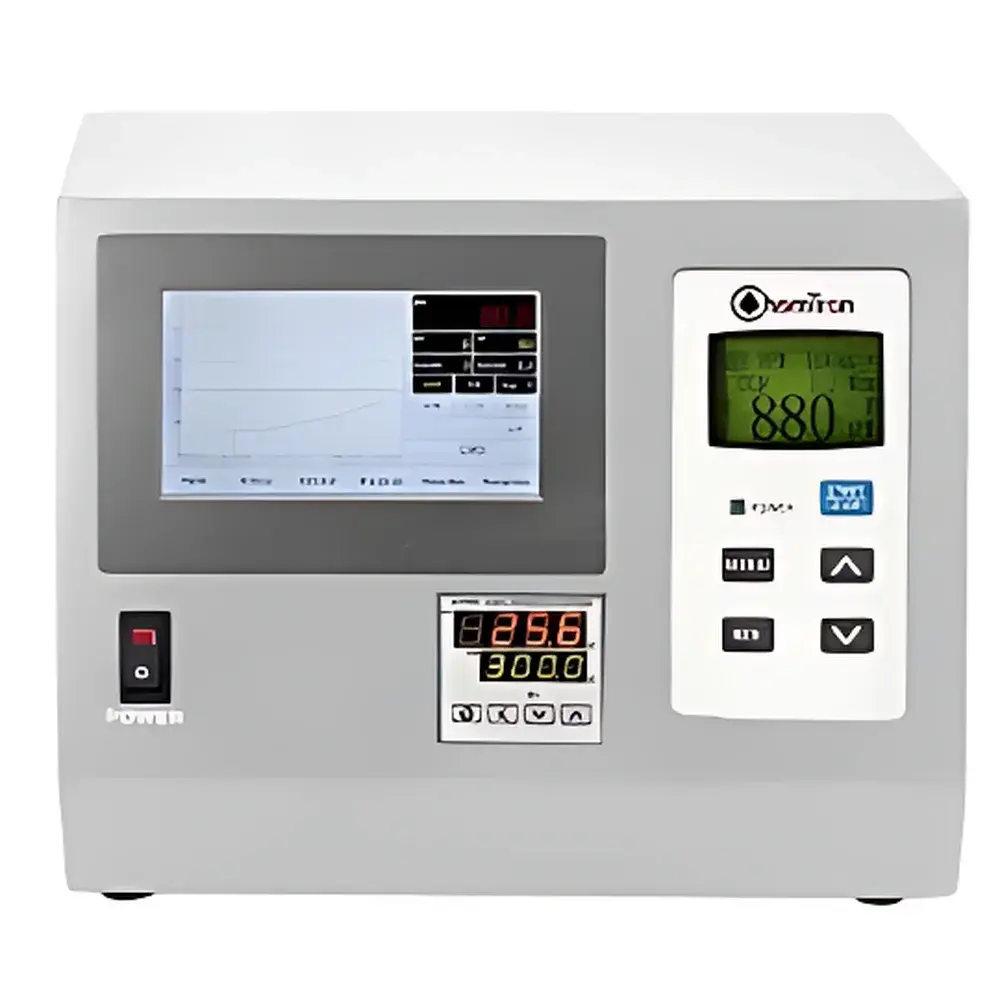
ChemTron TCSS Programmable Temperature and Stirring Controller
| Brand | ChemTron |
|---|---|
| Origin | Germany |
| Model | TCSS |
| Control Accuracy | ±0.1 °C (Class 0.1) |
| Display | 5" TFT Touchscreen |
| Programmable Segments | 30-step |
| Sensor Compatibility | Pt100, Thermocouples (Type J/K/T/E/B/R/S/N), RTDs |
| Control Algorithm | AI-enhanced PID with Adaptive Learning |
| Communication Interfaces | RS232, RS485, Ethernet, USB-A |
| Safety Features | Over-temperature Cut-off, Alarm Output, 4 kV EFT Immunity |
| Power Architecture | Dual-CPU (ARM for HMI & Data Logging |
Overview
The ChemTron TCSS is a high-integrity programmable temperature and stirring controller engineered for precision thermal management in laboratory and pilot-scale process environments. It operates on the principle of closed-loop feedback control, integrating real-time temperature sensing, adaptive PID regulation, and synchronized mechanical agitation to maintain thermally stable and homogenized reaction conditions. Unlike basic thermostats, the TCSS implements an AI-enhanced logic PID algorithm specifically tuned for systems exhibiting significant thermal inertia and transport lag—such as jacketed reactors, glass vessels with viscous media, or multi-phase synthesis setups. Its dual-CPU architecture ensures deterministic response times: a dedicated microcontroller handles analog input sampling, heater/cooler actuation, and safety interlocks at sub-second intervals, while a separate ARM processor manages the graphical user interface, data logging, and network communication—enabling concurrent operation without compromising control fidelity. Designed and assembled in Germany, the TCSS complies with IEC 61000-4-4 for electrical fast transient (EFT) immunity up to 4 kV, confirming its suitability for electromagnetically noisy industrial laboratories.
Key Features
- 30-segment programmable temperature profile with ramp/soak functionality, supporting complex thermal protocols such as crystallization annealing, polymer curing cycles, or enzymatic reaction optimization.
- Class 0.1 temperature control accuracy (±0.1 °C) validated across sensor types—including Pt100 RTDs and J/K/T/E thermocouples—with automatic cold-junction compensation and linearization.
- Integrated stirring control with configurable speed range (0–1200 rpm typical, dependent on motor selection), torque monitoring, and phase-synchronized start/stop relative to temperature events.
- 5-inch industrial-grade TFT touchscreen with intuitive, single-screen parameter configuration—designed for glove-compatible operation and rapid setup without menu nesting.
- Dual-CPU hardware architecture: real-time MCU core for deterministic control loop execution (100 ms update rate), and ARM-based HMI subsystem supporting CSV data export, event logging, and firmware updates via USB-A or Ethernet.
- Comprehensive alarm system with configurable thresholds, latching/non-latching modes, visual/audio alerts, and dry-contact relay outputs for external shutdown integration.
Sample Compatibility & Compliance
The TCSS supports direct interfacing with a wide range of thermal and mechanical peripherals, including immersion heaters, Peltier coolers, jacketed reactor systems, magnetic stirrers (e.g., WB201C, WB181D), and heating mantles. Sensor inputs are galvanically isolated and auto-identified upon connection, eliminating manual calibration steps. The device meets CE marking requirements under the EU Electromagnetic Compatibility Directive (2014/30/EU) and Low Voltage Directive (2014/35/EU). Its control architecture aligns with GLP and GMP documentation practices: all setpoint changes, alarm triggers, and safety events are time-stamped and stored locally with audit-trail capability. While not inherently 21 CFR Part 11 compliant, optional software packages support electronic signature, user access levels, and encrypted data archiving for regulated environments.
Software & Data Management
Local data logging captures temperature, stirring speed, power output, and alarm status at user-defined intervals (1 s to 60 min), storing up to 1 million records internally. Export is supported via USB-A flash drives in CSV format for post-processing in MATLAB, Python, or LIMS platforms. Optional Ethernet connectivity enables Modbus TCP server functionality for SCADA integration and remote supervision via standard web browsers. Firmware updates are performed over-the-air or via USB, with version rollback protection and SHA-256 integrity verification. No proprietary cloud platform is required—data remains fully under user control at all times.
Applications
- Controlled-rate thermal cycling in polymer synthesis and cross-linking studies.
- Reproducible crystallization experiments requiring precise supersaturation management via coupled temperature–stirring profiles.
- Enzyme kinetics assays where both thermal stability and mixing uniformity critically affect Vmax and Km determination.
- Pilot-scale API manufacturing under ICH Q5A/Q5B environmental control guidelines.
- Calibration traceability for reference baths and secondary temperature standards in metrology labs.
FAQ
Does the TCSS support external PLC integration?
Yes—via Modbus RTU (RS485) or Modbus TCP (Ethernet), enabling bidirectional setpoint synchronization and status reporting within larger automation frameworks.
Can multiple TCSS units be daisy-chained on one RS485 bus?
Yes—up to 32 units with individually configurable Modbus addresses and termination resistor support.
Is the touchscreen compatible with gloved operation in cleanroom environments?
Yes—the projected capacitive panel responds reliably to latex, nitrile, and surgical gloves without stylus dependency.
What happens during a power interruption?
The unit retains all program data and logs in non-volatile memory; upon restart, it defaults to safe mode with temperature hold and stirring disabled until manual confirmation.
Are calibration certificates available for traceable use?
Factory calibration reports (ISO/IEC 17025-accredited third-party optional) are provided with each unit, covering sensor input linearity, temperature accuracy, and timing resolution.



