
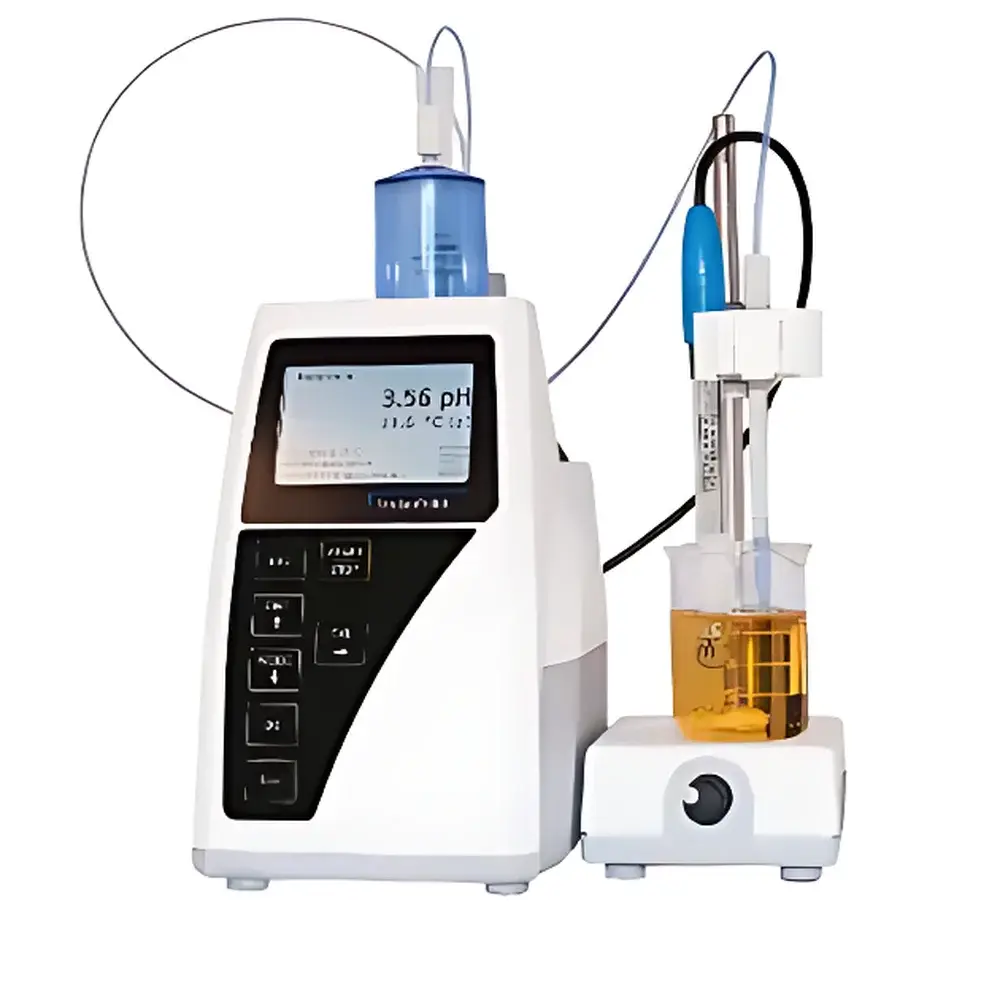
ChemTron TL 5000 Standard Automatic Potentiometric Titrator
| Brand | ChemTron |
|---|---|
| Origin | Germany |
| Model | TL 5000 |
| Instrument Type | General-purpose Potentiometric Titrator |
| Display | 3.5" 1/4VGA TFT touchscreen |
| pH Range | -3.0 to 17.00 |
| mV Range | -1900 to +1900 mV |
| Temperature Range | -30 to +115 °C |
| pH Resolution | 0.01 |
| mV Resolution | 1 mV |
| Temp Resolution | 0.1 °C |
| pH Accuracy | ±0.05 ±1 digit |
| mV Accuracy | ±1.0 ±1 digit |
| Temp Accuracy | ±0.5 K ±1 digit |
| Burette Options | 20 mL or 50 mL |
| Burette Drive | 8000-step precision piston |
| Electrode Interfaces | DIN 19262 and BNC |
| Temperature Sensor Support | Pt1000 and NTC 30 |
| Titration Modes | DET (Dynamic Equivalence Point), MET (Fixed Increment), SET (Set Endpoint), pH/mV Endpoint, Manual Dosing, Precise Dispensing |
| Preloaded Methods | FOS/TAC, Total Alkalinity, Total Acidity, Chloride, COD, Permanganate Index, Kjeldahl Nitrogen, Iodometry, Peroxide Value, Ascorbic Acid, Protein (via Kjeldahl), Ammonia-N |
| Connectivity | RS-232 for balance, USB-A for printer |
| Compliance | Designed for GLP-compliant workflows per ISO/IEC 17025 and ASTM E2029 guidelines |
Overview
The ChemTron TL 5000 Standard Automatic Potentiometric Titrator is a compact, CE-marked benchtop instrument engineered in Germany for high-reproducibility potentiometric titrations in regulated laboratory environments. It operates on the fundamental principle of measuring potential change (mV) or hydrogen ion activity (pH) across a redox or acid–base reaction, enabling precise identification of equivalence points via first-derivative analysis (DET), fixed-increment dosing (MET), or user-defined endpoint thresholds (SET). Its architecture integrates dual electrode input standards—DIN 19262 and BNC—supporting conventional glass pH electrodes, silver/silver chloride reference electrodes, platinum redox electrodes, and ion-selective sensors. The system’s real-time curve visualization, coupled with temperature-compensated measurements using Pt1000 or NTC 30 sensors, ensures thermodynamic consistency across diverse sample matrices—from aqueous environmental extracts to viscous food homogenates.
Key Features
- 3.5-inch 1/4VGA TFT touchscreen interface with intuitive icon-driven navigation and real-time titration curve overlay
- High-resolution measurement capability: 0.01 pH unit, 1 mV, and 0.1 °C—calibrated against traceable NIST-certified standards
- Dual-mode titration engine supporting both dynamic equivalence point detection (DET) and fixed-volume incremental addition (MET)
- Preconfigured method library compliant with ISO 9963-1 (alkalinity), ISO 9297 (chloride), ISO 8694 (COD), and AOAC 981.10 (Kjeldahl nitrogen)
- 8000-step micro-stepping burette drive ensuring volumetric repeatability ≤0.2% RSD at full scale (20 mL or 50 mL options)
- Integrated temperature compensation logic applying the Nernst equation correction in real time during titration
- RS-232 serial port for direct integration with analytical balances meeting OIML R76 Class II specifications
- USB-A host port supporting certified thermal or impact printers for GLP-compliant hard-copy reporting
Sample Compatibility & Compliance
The TL 5000 accommodates liquid, semi-liquid, and dissolved solid samples within viscosity limits typical of standard laboratory reagents (<500 mPa·s). It is routinely deployed in water/wastewater laboratories for FOS/TAC ratio monitoring per VDI 4630, total alkalinity (p+v-value) determination per DIN 38409-H2, and chloride quantification via argentometric titration per ISO 9297. In food testing, it supports AOAC Official Methods for salt content (NaCl), total acidity in beverages (AOAC 942.15), ascorbic acid (AOAC 967.21), and protein estimation via Kjeldahl distillate titration (AOAC 981.10). All operational parameters—including method selection, electrode calibration logs, and raw titration data—are timestamped and stored locally without cloud dependency, satisfying audit requirements under ISO/IEC 17025:2017 Clause 7.7 and FDA 21 CFR Part 11 predicate rules for electronic records.
Software & Data Management
While the TL 5000 operates autonomously via its embedded firmware—requiring no external PC or proprietary software—it generates structured ASCII-based data files (.CSV) exportable via USB storage. Each file contains metadata headers (date, time, operator ID, method name, electrode IDs, temperature, and calibration status), raw mV/pH vs. volume vectors, first-derivative peaks, and calculated results with uncertainty propagation per GUM (JCGM 100:2008). The instrument maintains an internal event log tracking power cycles, calibration events, method modifications, and error codes—retained for ≥10,000 entries. For laboratories implementing LIMS integration, the RS-232 interface supports ASCII command protocols compatible with common middleware platforms, enabling automated result ingestion without manual transcription.
Applications
- Environmental Analysis: Total alkalinity (p+v-value), FOS/TAC ratio in anaerobic digesters, permanganate index (Oxidizability), COD determination (closed-reflux dichromate), ammonia-nitrogen by selective electrode titration
- Food & Beverage Quality Control: Salt content (AgNO₃ titration), titratable acidity in wine and soft drinks, vitamin C (iodometric back-titration), peroxide value in edible oils, protein content via Kjeldahl distillate neutralization
- Pharmaceutical & Chemical QC: Assay of sodium bicarbonate, hydrochloric acid standardization, assay of iodine-containing compounds, purity verification of sodium thiosulfate solutions
- Education & Research: Teaching stoichiometric concepts, buffer capacity studies, pKa determination of weak acids, redox potential mapping in multi-step reactions
FAQ
Does the TL 5000 support GLP-compliant data integrity requirements?
Yes—the instrument stores all raw data, calibration records, and method parameters with immutable timestamps and operator identifiers. No data can be edited post-acquisition; deletion requires administrator-level physical access and generates an auditable log entry.
Can the TL 5000 perform thermometric or photometric titrations?
No—it is exclusively configured for potentiometric detection (pH/mV) and does not support optical or thermal endpoint sensing modules.
Is remote control or PC-based software available?
No—the TL 5000 is a standalone instrument with no Ethernet, Wi-Fi, or dedicated PC software. Data export is limited to USB mass storage and RS-232 ASCII output.
What electrode standards does it accept?
It provides dual physical interfaces: DIN 19262 (common in European pH electrodes) and universal BNC (standard in North American and research-grade sensors).
How is temperature compensation implemented during titration?
The system reads Pt1000 or NTC 30 sensor inputs continuously and applies automatic Nernst slope correction to the measured potential, ensuring accurate equivalence point detection across 5–40 °C operating ranges.






