
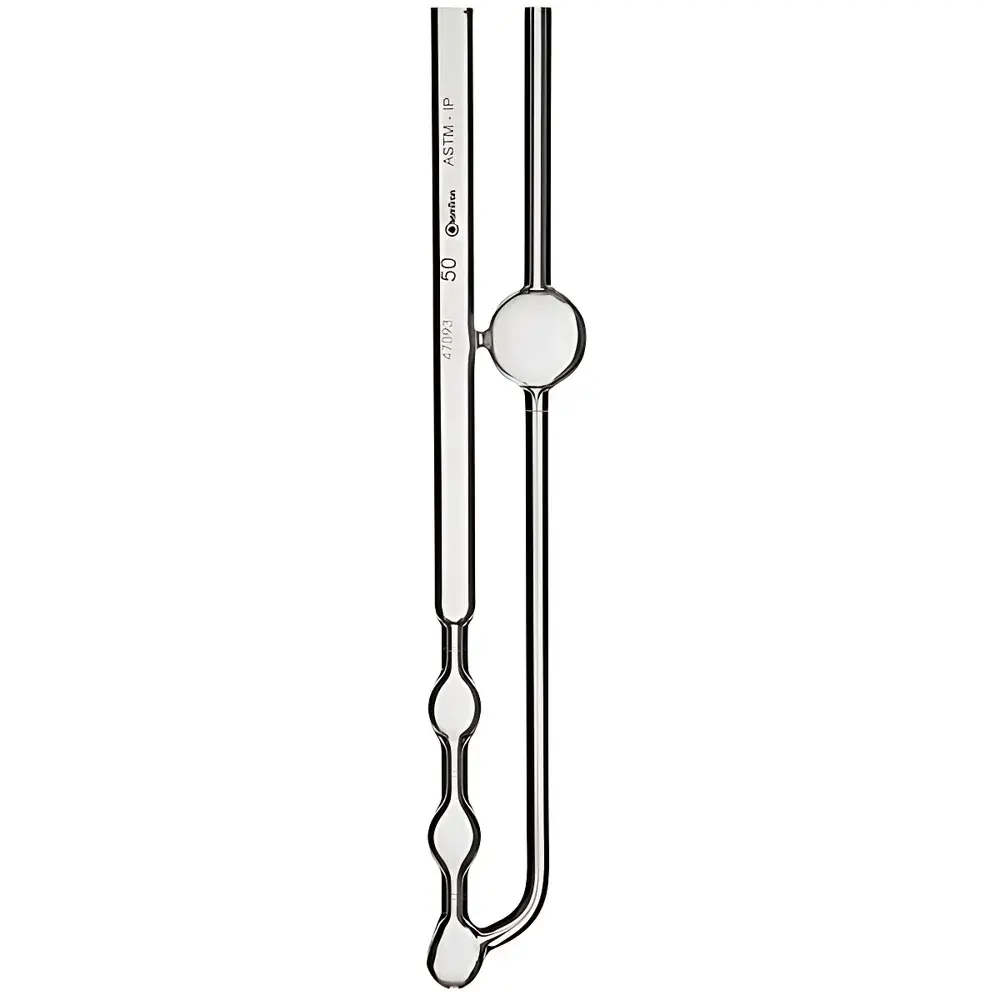
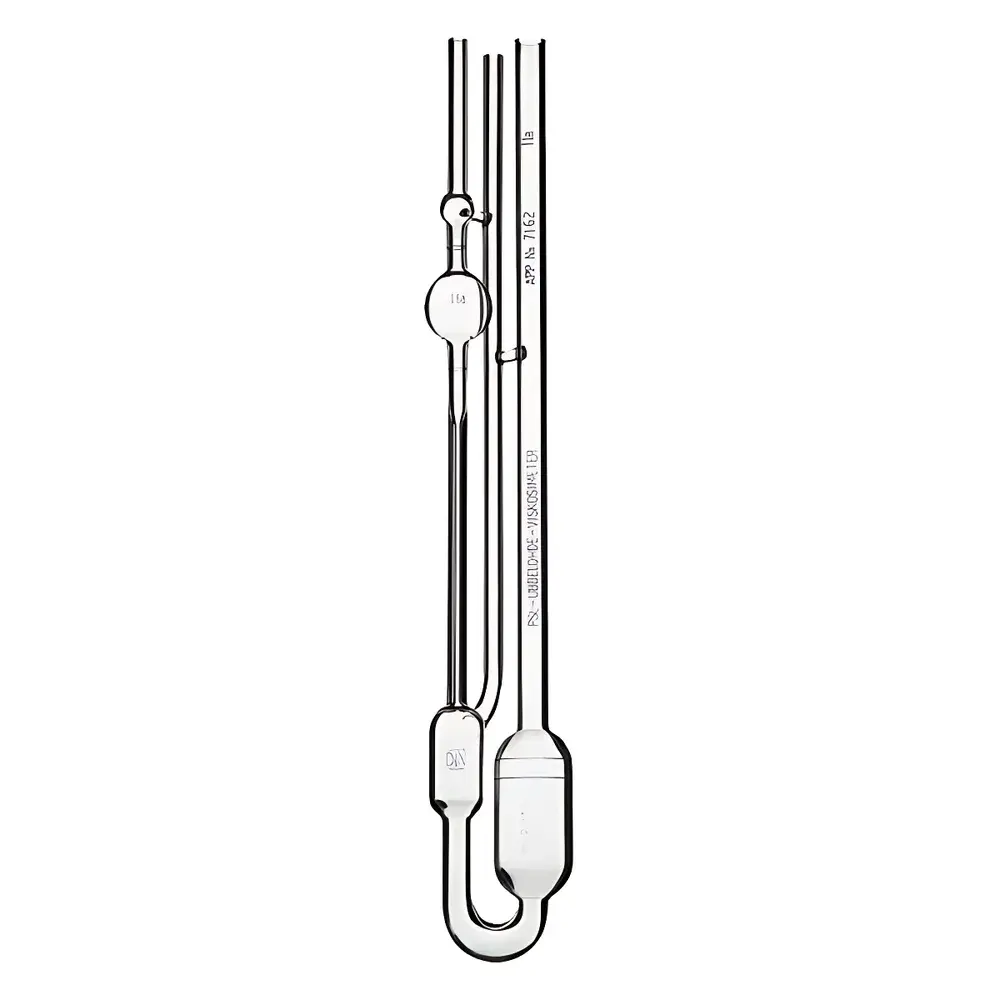
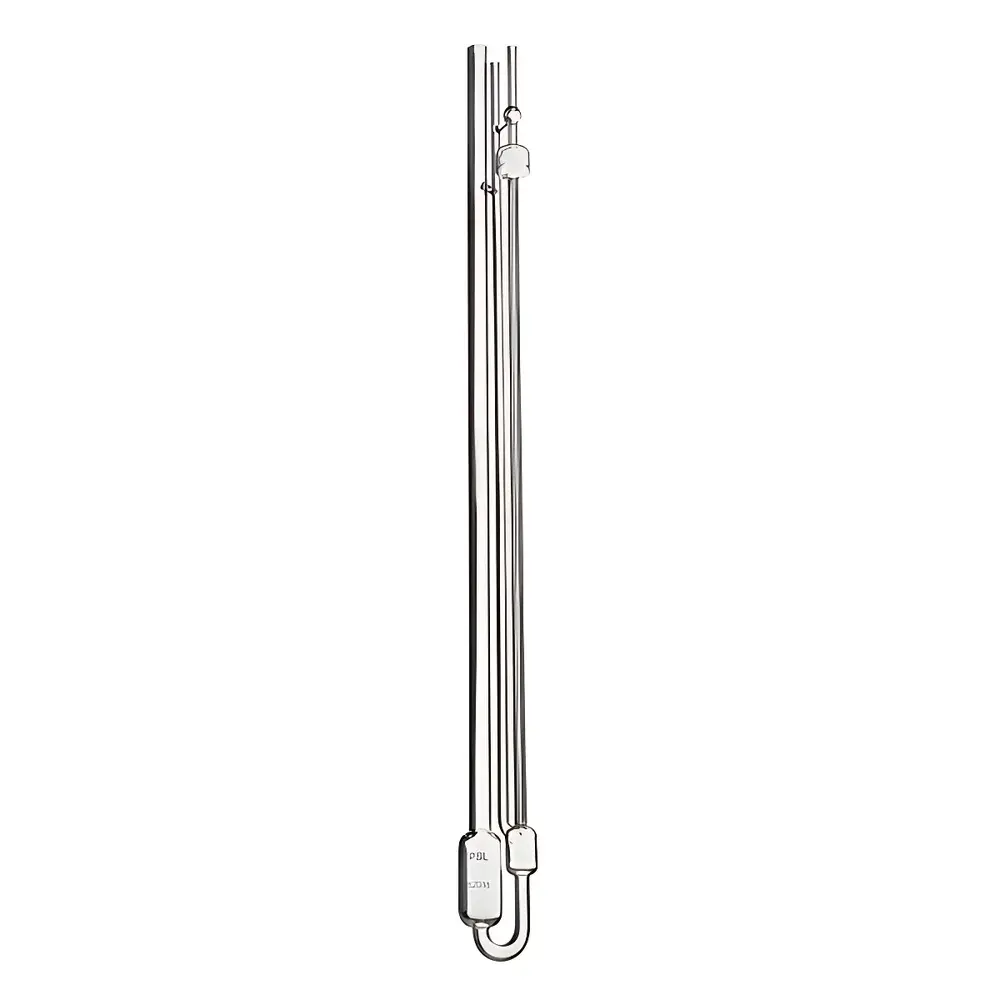
ChemTron Ubbelohde Viscometer Series 1643 / 1671 / 1690
| Brand | ChemTron |
|---|---|
| Origin | Germany |
| Model | 1643 / 1671 / 1690 |
| Viscometer Type | Capillary (Ubbelohde) |
| Portability | Portable |
| Operating Environment | Ambient Temperature |
| Kinematic Viscosity Range | 0.3 – 100,000 mm²/s |
| Calibration Standard | ISO/IEC 17025 |
| Accreditation | UKAS (for 1690 series) |
| Capillary Constant (K) | 0.001 – 100 mm²/s² |
| Fill Volume | 18 mL |
| Total Length | 283 mm (1643), 580 mm (1690) |
Overview
The ChemTron Ubbelohde Viscometer Series—including models 1643, 1671, and 1690—represents a family of precision capillary viscometers engineered for accurate, repeatable measurement of kinematic viscosity in transparent Newtonian and near-Newtonian liquids. Based on the classical Ubbelohde principle, these instruments operate under gravity-driven laminar flow through a precisely dimensioned capillary suspended in a thermostatically controlled bath. The design eliminates dependence on hydrostatic head by incorporating a separate reservoir arm open to atmospheric pressure, ensuring that measured efflux time correlates directly with kinematic viscosity via the relation ν = K × t, where K is the instrument constant (in mm²/s²) and t is the outflow time (in seconds). This fundamental hydrodynamic relationship, grounded in the Hagen–Poiseuille equation, enables traceable, first-principles-based viscosity determination without electronic transducers or moving parts.
Key Features
- Three distinct product lines optimized for different accuracy tiers and application scopes: the general-purpose 1643 series, the DIN-compliant 1671 series (conforming to DIN 51562-1), and the metrologically certified 1690 series accredited to ISO/IEC 17025 by UKAS.
- Modular capillary constant (K-value) selection across 16 calibrated ranges—from 0.001 to 100 mm²/s²—enabling coverage of kinematic viscosity from 0.3 to 100,000 mm²/s with optimal resolution per range.
- Standardized ASTM D445 and ISO 3104 compliance in geometry and dimensional tolerances; all units supplied with documented K-values and individual calibration certificates.
- Robust borosilicate glass construction (Duran® or equivalent), resistant to thermal shock and chemical exposure typical in solvent, polymer, lubricant, and pharmaceutical QC labs.
- Integrated timing interface compatible with manual stopwatch operation or automated digital timers (e.g., ChemTron Timer Pro or third-party ISO 17025-compliant chronometers).
- Two universal mounting brackets (1842/A1 and 1842/A2) supporting full ASTM Ubbelohde size compatibility (No. 0–5, including C-variants), facilitating seamless integration into existing bath systems.
Sample Compatibility & Compliance
Designed exclusively for homogeneous, particle-free, transparent liquids—including hydrocarbons, organic solvents, mineral oils, synthetic lubricants, polymer solutions (e.g., polystyrene in toluene), and pharmaceutical excipients—the ChemTron Ubbelohde viscometers require samples free of suspended solids or air bubbles to ensure laminar flow integrity. Non-Newtonian or highly viscous samples (>50,000 mm²/s) may necessitate elevated bath temperatures or dilution protocols per ASTM D2161 and ISO 1628-1. All models meet essential requirements for GLP and GMP environments: each 1690 unit carries UKAS accreditation (certificate number traceable to NPL), while 1643 and 1671 units are supplied with ISO/IEC 17025-aligned calibration reports issued by ChemTron’s certified metrology lab. Full compliance with ASTM D445, ISO 3104, DIN 51562-1, and USP is validated during factory certification.
Software & Data Management
While the Ubbelohde principle is inherently analog, ChemTron provides optional digital workflow support via its ViscoLink™ software suite (sold separately), which interfaces with USB- or Bluetooth-enabled timers to record efflux times, apply temperature corrections (per ASTM D445 Annex A1), compute kinematic viscosity using certified K-values, and generate audit-ready PDF reports compliant with FDA 21 CFR Part 11. Raw data files (.csv/.xlsx) include timestamps, operator ID, bath temperature logs (±0.01 °C), and instrument metadata—enabling full traceability and retrospective review. All calibration certificates include uncertainty budgets expressed at k=2, consistent with ISO/IEC 17025 Clause 6.5.
Applications
- Quality control of base oils and finished lubricants per ASTM D445 and ISO 3104.
- Relative molecular weight estimation of synthetic polymers (e.g., PET, PVC, PMMA) using intrinsic viscosity correlations per ISO 1628-1 and ASTM D1243.
- Stability assessment of fuel formulations and biodiesel blends under varying thermal conditions.
- Pharmaceutical excipient characterization (e.g., PEG, propylene glycol) in accordance with USP and EP 2.2.33.
- Academic rheology instruction and method validation studies requiring primary-standard reference instrumentation.
FAQ
What distinguishes the 1643, 1671, and 1690 series?
The 1643 series is designed for routine industrial QC with ASTM-aligned geometry and factory-calibrated K-values. The 1671 series conforms strictly to DIN 51562-1 dimensional specifications and includes tighter capillary tolerance controls. The 1690 series undergoes full UKAS-accredited calibration per ISO/IEC 17025, with documented measurement uncertainty and traceability to national standards.
Can these viscometers be used for non-Newtonian fluids?
No—they are intended only for Newtonian or low-shear-rate pseudoplastic liquids where viscosity remains constant across shear rates. For non-Newtonian behavior, rotational rheometry (e.g., Brookfield or Anton Paar systems) is required.
Is temperature control included with the instrument?
No—temperature regulation is achieved externally using a calibrated liquid bath (e.g., Julabo F25 or similar), maintained within ±0.02 °C as specified in ASTM D445.
How often should recalibration be performed?
Per ISO/IEC 17025, recalibration is recommended annually or after mechanical impact, exposure to aggressive solvents, or observed drift exceeding ±0.5% of K-value; UKAS-certified 1690 units include a recalibration due date on the certificate.
Are cleaning protocols standardized?
Yes—ChemTron supplies detailed SOPs for solvent rinsing (e.g., toluene → acetone → isopropanol), ultrasonic bath use, and nitrogen drying, aligned with ASTM D445 Section 8.1 and ISO 3104 Clause 7.2.
Related Products



