
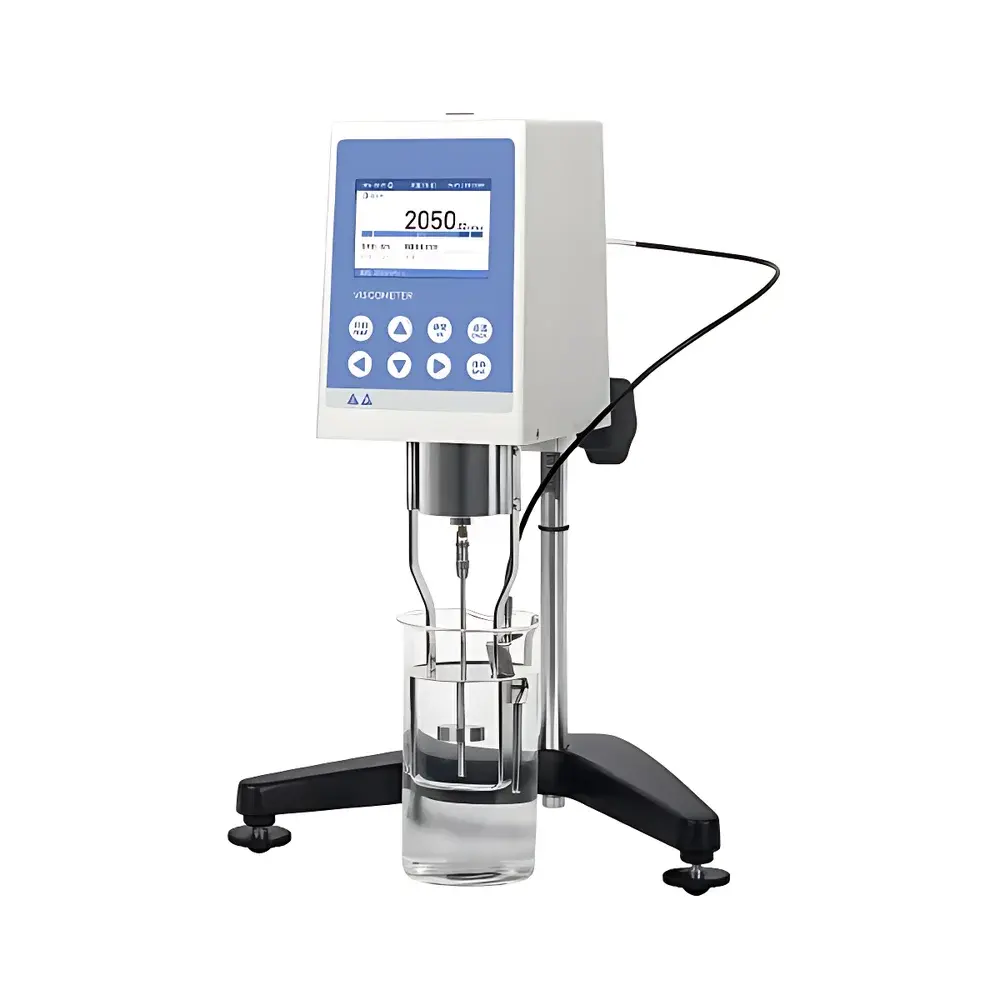
Chengmeng NDJ-8ST Advanced Color-TFT Rotational Viscometer
| Brand | Chengmeng |
|---|---|
| Origin | Shanghai, China |
| Model | NDJ-8ST |
| Instrument Type | Benchtop Rotational Viscometer |
| Viscosity Range | 10–2,000,000 mPa·s |
| Temperature Range | 0–40 °C |
| Temperature Resolution | 0.1 °C |
| Temperature Accuracy | ±0.5 °C |
| Speed Settings | 0.3, 0.6, 1.5, 3, 6, 12, 30, 60 rpm |
| Standard Spindles | #1–#4 (L-type) |
| Display | 3.5″ IPS color TFT LCD |
| Torque Measurement Accuracy | ±2% (Newtonian fluids) |
| Repeatability | ±1% (Newtonian fluids) |
| Data Storage | 50 measurement records |
| Interface | USB + RS232 |
| Power Supply | 100–240 VAC, 50/60 Hz |
| Dimensions (W×D×H) | 280 × 260 × 395 mm |
| Net Weight | ~5.6 kg |
Overview
The Chengmeng NDJ-8ST Advanced Color-TFT Rotational Viscometer is a precision benchtop instrument engineered for reliable and repeatable viscosity characterization of both Newtonian and non-Newtonian fluids. Based on the Couette principle—where torque generated by fluid resistance to rotational shear between concentric cylindrical surfaces (spindle and sample cup) is measured—the NDJ-8ST delivers absolute dynamic viscosity (in mPa·s) under controlled shear conditions. Its modular spindle system, combined with eight programmable rotational speeds ranging from 0.3 to 60 rpm, enables flexible shear rate selection across a broad dynamic range (10–2,000,000 mPa·s). Designed for routine QC laboratories, R&D facilities, and production environments, the viscometer operates at ambient temperature (0–40 °C) and integrates a calibrated PT1000A temperature probe for real-time thermal monitoring—critical for temperature-dependent rheological assessments per ISO 2555 and ASTM D2196.
Key Features
- 3.5-inch high-resolution IPS color TFT display providing simultaneous readouts of viscosity, rotational speed, real-time temperature, % torque, spindle identification, and maximum measurable viscosity for the selected spindle/speed combination
- Eight-step speed control (0.3 / 0.6 / 1.5 / 3 / 6 / 12 / 30 / 60 rpm) with fine resolution for low-shear and high-shear regime analysis
- Standard L-type spindles (#1–#4) optimized for medium-to-high viscosity ranges; optional #0 spindle available for ultra-low-viscosity applications (1–100 mPa·s)
- Integrated temperature sensing with ±0.5 °C accuracy and 0.1 °C resolution, supporting viscosity–temperature correlation studies
- Multiple operational modes: standard single-point measurement, timed acquisition, and automatic multi-speed scanning for flow curve generation
- Dual communication interfaces (USB and RS232) for data export, remote control, and integration into laboratory information management systems (LIMS)
- Onboard storage for up to 50 measurement records with timestamp and parameter metadata
- Compliance-ready design: supports audit trails when connected to validated software; compatible with GLP/GMP documentation workflows
Sample Compatibility & Compliance
The NDJ-8ST accommodates a wide spectrum of industrial and research-grade samples—including lubricating oils, polymer melts, pharmaceutical suspensions, food emulsions, architectural coatings, adhesives, and resin formulations—using standard 400 mL tall-form beakers (included). Its robust mechanical architecture ensures stable spindle immersion and minimal vibration-induced noise during measurement. The instrument conforms to fundamental metrological requirements outlined in ISO 3219 (rotational viscometers), ASTM D1084 (viscosity of asphaltic materials), and USP (rheological properties of semisolid dosage forms). While not intrinsically 21 CFR Part 11 compliant, its digital output and timestamped data logs support traceability when paired with validated third-party software for regulated environments.
Software & Data Management
Data acquisition and reporting are facilitated via USB or RS232 connectivity to Windows-based PCs. Exported datasets include viscosity (mPa·s), temperature (°C), spindle ID, rotational speed (rpm), torque (%), and measurement timestamp. Raw CSV files are fully compatible with Excel, MATLAB, and statistical process control (SPC) platforms. Optional PC software provides graphical visualization of viscosity vs. shear rate curves, yield point estimation (via Bingham or Casson model fitting), and batch report generation. All stored measurements retain full parameter context, enabling retrospective analysis without manual annotation.
Applications
- Quality control of edible oils, margarines, and dairy products per AOAC 967.17 and ISO 16679
- Batch release testing of paint and ink formulations to verify consistency against specification limits
- Rheological profiling of topical pharmaceutical gels and ointments under USP guidelines
- Process optimization of thermosetting resins and uncured elastomers during formulation development
- Evaluation of thixotropic recovery behavior using sequential low–high–low speed protocols
- Stability assessment of colloidal dispersions and nanoparticle suspensions over time
FAQ
What spindle configurations are supported, and how do I select the appropriate one?
The NDJ-8ST ships with L-type spindles #1–#4. Spindle selection follows ISO 2555 guidance: choose the largest spindle and lowest speed that yields torque readings between 10–90% of full scale to maximize accuracy.
Can the instrument perform temperature-controlled measurements?
It includes a PT1000A temperature probe for ambient monitoring (0–40 °C), but does not feature active heating/cooling. For isothermal testing outside ambient, external thermostatic baths are recommended.
Is calibration traceable to national standards?
Factory calibration uses NIST-traceable silicone oil standards. Users may perform verification checks using certified reference fluids (e.g., Cannon-Manning series) per ASTM D445 procedures.
How is measurement repeatability ensured across operators?
Consistent spindle immersion depth (fixed via mechanical lift column with 250 mm travel), standardized beaker geometry (400 mL tall-form), and automated speed/torque synchronization minimize inter-operator variability.
Does the device support regulatory compliance for pharmaceutical labs?
While the hardware itself lacks built-in electronic signatures or audit trail functions, its structured data export and timestamping enable integration into validated software environments meeting FDA 21 CFR Part 11 and EU Annex 11 requirements.
Related Products



