
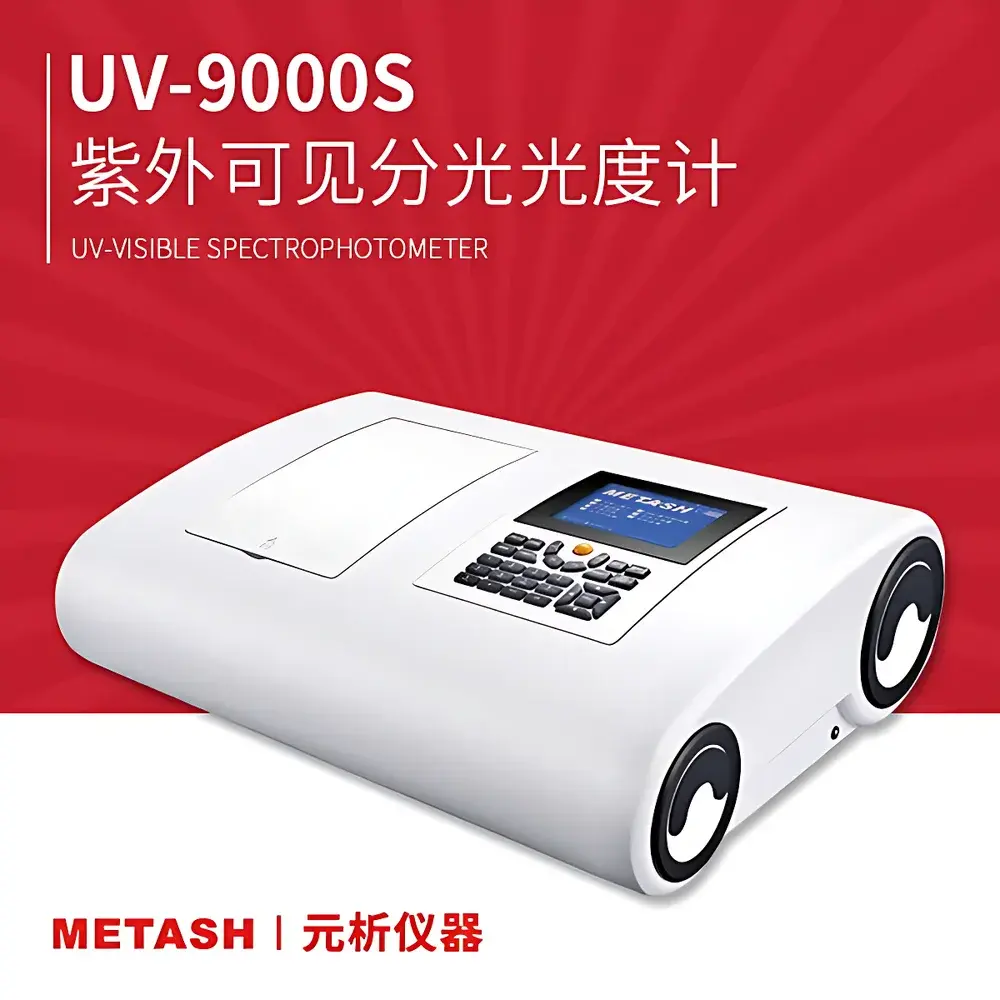
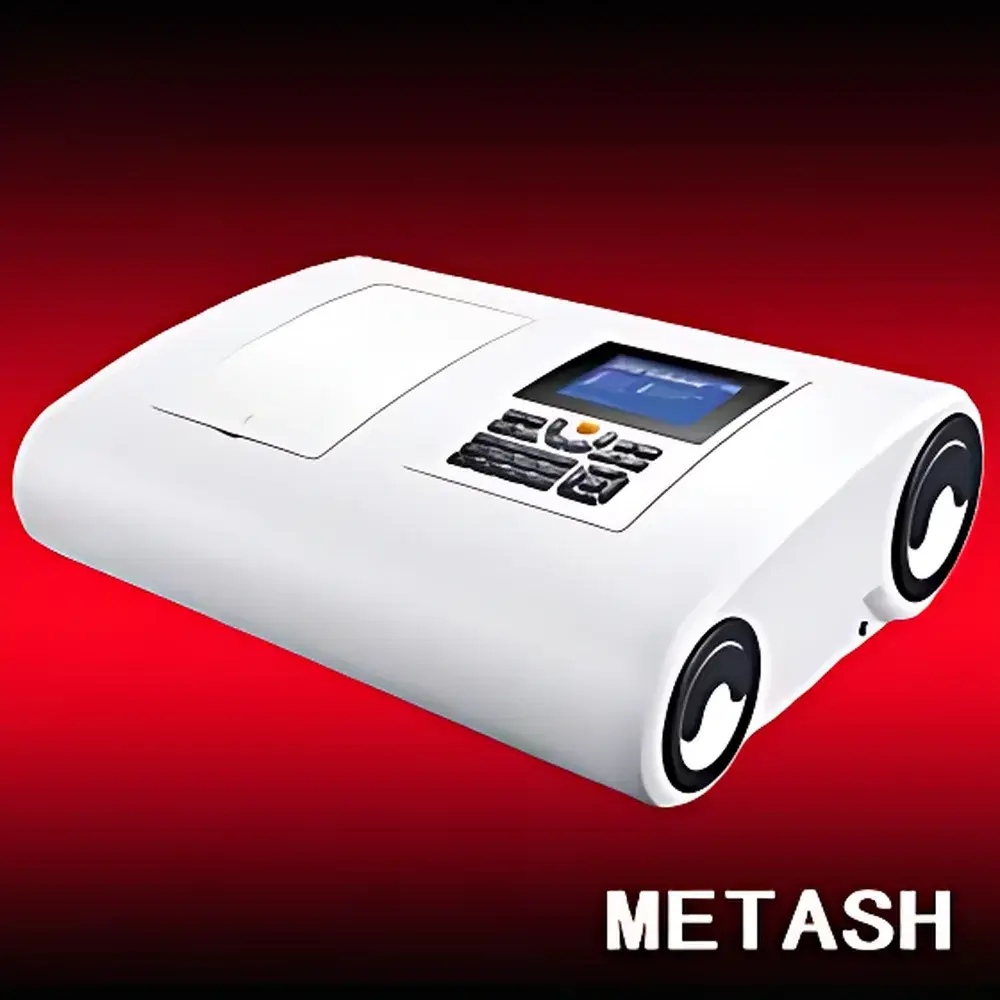
Metash UV-9000S Dual-Beam Ultraviolet-Visible Spectrophotometer
| Brand | Metash Instruments |
|---|---|
| Origin | Shanghai, China |
| Manufacturer Type | Original Equipment Manufacturer (OEM) |
| Product Category | Domestic |
| Model | UV-9000S |
| Optical System | Dual-beam |
| Detector Type | Photocell |
| Wavelength Range | 190–900 nm |
| Wavelength Scanning Mode | Automatic |
| Spectral Bandwidth | Selectable (0.1 / 0.2 / 0.5 / 1.0 / 2.0 / 4.0 nm) |
| Wavelength Accuracy | ±0.1 nm at D₂ line (656.1 nm), ±0.3 nm across full range |
| Stray Light | ≤0.05% T |
Overview
The Metash UV-9000S is a high-performance dual-beam ultraviolet-visible (UV-Vis) spectrophotometer engineered for precision absorbance and transmittance measurements across a broad spectral range (190–900 nm). Its dual-beam optical architecture continuously splits the light path into sample and reference channels, enabling real-time compensation for source intensity drift, lamp aging, and environmental fluctuations—critical for long-duration kinetic assays or temperature-sensitive analyses. The instrument employs a robust suspended optical design, with all optical components rigidly mounted on a 16-mm-thick aerospace-grade aluminum baseplate to isolate the system from mechanical vibration and thermal-induced frame deformation. This structural integrity directly contributes to superior photometric stability (<0.001 A/h at 500 nm) and wavelength repeatability—key performance attributes required in regulated environments.
Key Features
- Dual-beam optical configuration with real-time background correction, ensuring high baseline stability and measurement reproducibility over extended acquisition periods.
- Selectably adjustable spectral bandwidth (0.1–4.0 nm in six discrete steps), allowing users to optimize resolution versus signal-to-noise ratio based on analyte specificity and matrix complexity.
- High-fidelity optical train incorporating imported diffraction grating (enhancing UV throughput) and premium-grade deuterium and tungsten-halogen lamps, delivering consistent radiant flux across the full operational range.
- 6-inch full-color LED touchscreen display enabling standalone operation—supporting photometric mode, quantitative analysis (single/multi-point calibration), spectral scanning, time-based kinetics, DNA/protein A260/A280 ratio calculation, multi-wavelength quantitation, and direct thermal printing.
- Modular accessory compatibility—including automated 8-cell changer, micro-volume cuvette holder (down to 50 µL), Peltier-controlled temperature-regulated autosampler, integrating sphere for diffuse reflectance, and specular reflection stage—extending applicability to solid-state, turbid, and low-volume samples.
Sample Compatibility & Compliance
The UV-9000S accommodates standard 10-mm pathlength quartz or glass cuvettes, as well as specialized formats including ultra-micro cells, flow cells, and Petri dish adapters. Its optical design meets essential requirements for routine QC/QA in pharmaceutical, food, environmental, and academic laboratories. The system supports compliance with internationally recognized analytical standards, including ASTM E275 (spectrophotometer performance verification), ISO 6425 (optical instrument validation), and USP (UV-Vis spectrophotometry). Software functionality includes user role-based access control, electronic signature support, audit trail logging, and secure data archiving—all aligned with GLP and GMP documentation expectations per FDA 21 CFR Part 11.
Software & Data Management
The bundled PC software provides a comprehensive platform for method development, instrument control, and regulatory-compliant data handling. It enables full spectral acquisition (up to 3200 data points per scan), derivative spectroscopy, peak identification and integration, comparative overlay of multiple spectra, and customizable report generation (PDF, CSV, XML). All user actions—including parameter changes, calibration events, and data exports—are timestamped and logged in an immutable audit trail. Data files are stored with embedded metadata (instrument ID, operator, date/time, method name, versioned calibration coefficients), facilitating traceability during internal audits or regulatory inspections.
Applications
The UV-9000S serves diverse analytical workflows: quantification of nucleic acids and proteins via extinction coefficient-based calculations; determination of enzyme kinetics (e.g., NADH/NADPH oxidation at 340 nm); colorimetric assay validation (e.g., Bradford, Lowry, BCA); impurity profiling in active pharmaceutical ingredients (APIs); water quality assessment (nitrate, phosphate, COD); and thin-film optical characterization using transmission/reflection modes. Its low stray light (<0.05% T at 220 nm) ensures reliable measurement of highly absorbing samples without nonlinear deviation, while the selectable bandwidth allows optimization for narrow absorption bands (e.g., transition metal complexes) or broad features (e.g., polymer degradation products).
FAQ
What wavelength accuracy specifications apply across the full range?
Wavelength accuracy is ±0.1 nm at the deuterium lamp emission line (656.1 nm) and ±0.3 nm across the entire 190–900 nm range, verified per manufacturer’s factory calibration protocol using NIST-traceable holmium oxide and didymium filters.
Is the instrument compliant with 21 CFR Part 11 requirements?
Yes—the software implements electronic signatures, role-based permissions, tamper-evident audit trails, and encrypted data storage, fulfilling core technical controls outlined in FDA 21 CFR Part 11 for electronic records and signatures.
Can the UV-9000S perform kinetic measurements over extended timeframes?
Yes—its dual-beam architecture and thermally stabilized optical base enable stable absorbance monitoring for up to 24 hours without recalibration, supporting enzymatic reaction profiling and stability-indicating assays.
What accessories are validated for use with this model?
Factory-validated accessories include the automatic 8-position sample changer, 1-mm and 5-mm micro-cuvette holders, Peltier-cooled 6-position autosampler (-5 °C to 100 °C), 60-mm integrating sphere (for % reflectance), and variable-angle specular reflectance stage.
How is photometric linearity verified?
Linearity is confirmed using neutral density filters certified to ISO 9022-12, with typical performance exceeding ±0.002 A (0–3.0 A) under default 1.0 nm bandwidth conditions.




