
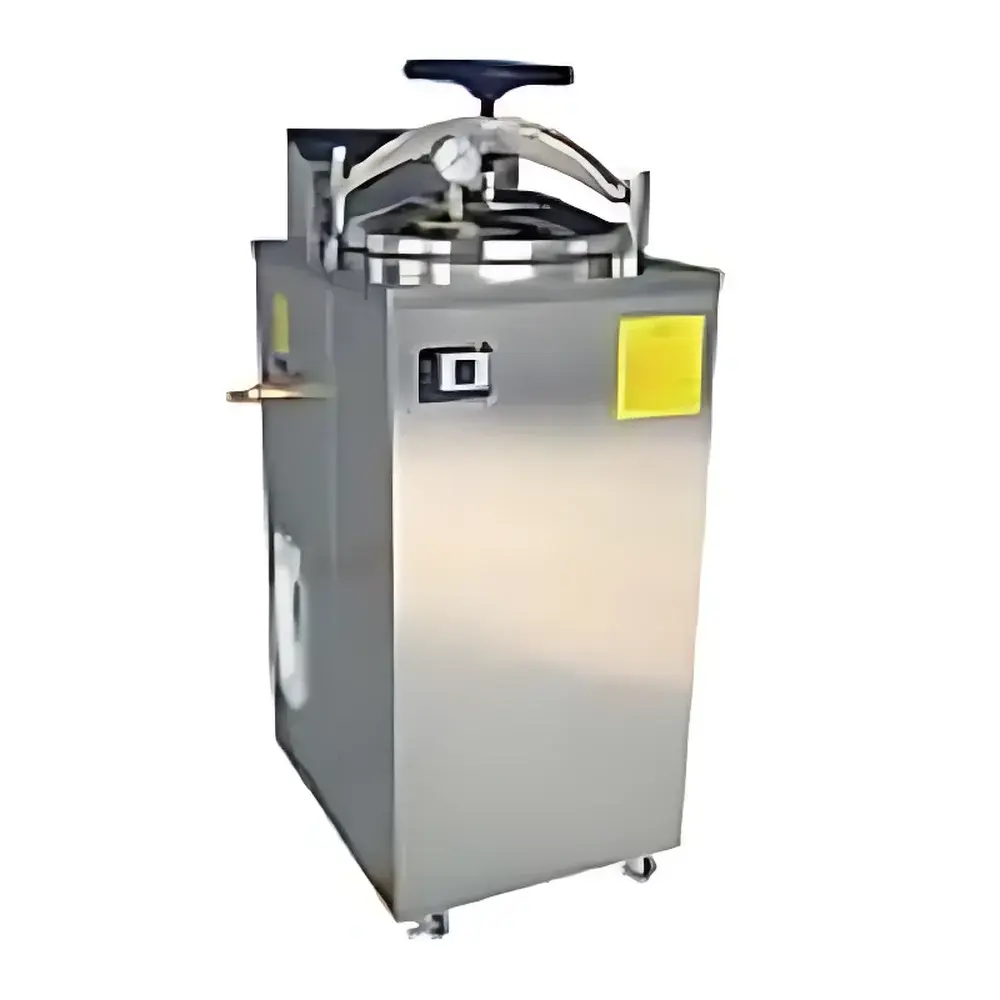
Vertical Steam Sterilizer YXQ-LS-100G
| Origin | Shanghai, China |
|---|---|
| Manufacturer Type | Authorized Distributor |
| Origin Category | Domestic (PRC) |
| Model | YXQ-LS-100G |
| Capacity | 100 L |
| Max. Operating Temperature | 135 °C |
| Max. Operating Pressure | 0.22 MPa |
| Sterilization Power | 3.5 kW |
| Drying Power | 0.8 kW |
| Voltage/Frequency | 220 V ±10% / 50 Hz ±2% |
| External Dimensions (mm) | 600 × 500 × 1280 |
| Chamber Dimensions (mm) | Ø400 × 725 |
| Basket Dimensions (mm) | Ø360 × 240 × 3 units |
| Temperature Range | 109–135 °C |
| Sterilization Time Range | 4–120 min |
| Drying Time Range | 30–240 min |
| Safety Compliance | Meets PRC Pressure Vessel Safety Technical Supervision Regulations (Article 49) |
Overview
The Vertical Steam Sterilizer YXQ-LS-100G is a fully automated, gravity-displacement, steam-saturated pressure sterilization system engineered for routine and high-throughput sterilization of heat-stable laboratory and pathology materials. It operates on the principle of saturated steam under controlled pressure to achieve microbial inactivation—including bacterial spores—via protein denaturation and nucleic acid disruption. Designed for use in pathology laboratories, histology core facilities, clinical microbiology labs, and biomedical research settings, this 100 L chamber unit supports three operational modes: sterilization-only, sterilization-with-drainage, and full-cycle sterilization-drying. Its vertical orientation optimizes floor space utilization while maintaining ergonomic loading/unloading access. The system conforms to fundamental sterilization process requirements defined in ISO 17665-1 (Sterilization of health care products — Moist heat — Part 1: Requirements for the development, validation and routine control of a sterilization process for medical devices) and aligns with national regulatory expectations for Class II pressure equipment per PRC Special Equipment Safety Law.
Key Features
- Microprocessor-based intelligent control system with digital PID temperature regulation and real-time pressure monitoring
- Handwheel-type quick-opening door equipped with dual interlock safety mechanism compliant with Article 49 of the PRC Pressure Vessel Safety Technical Supervision Regulations
- Full stainless-steel construction: inner chamber and outer casing fabricated from corrosion-resistant SUS304 austenitic stainless steel (acid/alkali resistant, non-porous, easy to clean)
- Self-sealing silicone gasket with auto-expansion design ensures leak-tight integrity during pressurization
- Integrated cold-air purge function using gravity displacement; automatic air removal prior to steam saturation phase
- Multi-stage safety protection: overpressure relief valve (set at 0.25 MPa design limit), low-water-level alarm, dry-run prevention, overtemperature cutoff (≥140 °C), and automatic power cutoff upon cycle completion
- Internal steam circulation exhaust configuration with 3 L condensate collection bottle for controlled vapor management
- Three-phase operational logic: sterilization → post-cycle venting & drainage → optional drying phase (30–240 min)
- Acoustic end-of-cycle alert and automatic heater deactivation ensure operator awareness and energy efficiency
Sample Compatibility & Compliance
The YXQ-LS-100G accommodates standard pathology and labware including stainless-steel instrument trays, glassware, textile packs, autoclave bags, culture media bottles (up to 1 L), and porous loads such as gauze and surgical drapes. Its chamber geometry (Ø400 × 725 mm) and triple-tier basket configuration (Ø360 × 240 mm each) support uniform steam penetration and thermal equilibration across heterogeneous loads. While not certified to EN 285 or ANSI/AAMI ST79 out-of-the-box, the unit’s process parameters (e.g., F0 traceability via time–temperature logging, reproducible 135 °C/3 min or 121 °C/15 min cycles) enable validation under institutional quality systems aligned with GLP and GMP frameworks. Users are advised to perform installation qualification (IQ), operational qualification (OQ), and performance qualification (PQ) per local SOPs and ISO 13485– or CAP-accredited protocols.
Software & Data Management
This model features an embedded microcontroller with non-volatile memory capable of storing up to 99 programmable cycle profiles. Cycle logs—including start time, setpoint temperature/pressure, actual chamber temperature history, duration, and fault codes—are retained for ≥1,000 cycles and exportable via USB interface (optional module). Timestamped event records support audit readiness for internal QA reviews and regulatory inspections. Though lacking native 21 CFR Part 11-compliant electronic signatures or network connectivity, the system supports manual logbook correlation and meets baseline data integrity expectations for non-critical sterilization applications in academic and diagnostic environments.
Applications
- Routine sterilization of reusable surgical instruments and biopsy forceps in pathology departments
- Preparation of agar plates, broth media, and buffer solutions in microbiology and cell culture labs
- Decontamination of biohazardous waste (non-sharp, non-liquid) prior to disposal
- Processing of paraffin-embedded tissue cassettes and embedding molds where moisture-sensitive downstream steps follow
- Validation substrate sterilization for biological indicators (e.g., Geobacillus stearothermophilus spore strips)
- Steam sterilization of filtration apparatus, pipette tips, and centrifuge tubes in molecular biology workflows
FAQ
What sterilization standards does the YXQ-LS-100G comply with?
It adheres to PRC national pressure equipment safety regulations (TSG 21) and provides process conditions compatible with ISO 17665-1. Full compliance with EN 285 or AAMI ST79 requires site-specific validation.
Can this unit be used for liquid media sterilization?
Yes—its gravity-displacement mechanism and programmable slow-cool phase minimize boil-over risk; however, liquid loads require dedicated cycle parameters and must not exceed 75% chamber volume.
Is the drying function suitable for moisture-sensitive instruments?
The forced-air drying mode (0.8 kW) achieves residual moisture reduction appropriate for stainless-steel tools but is not intended for optics, electronics, or polymer components.
Does the system include calibration documentation?
Factory calibration certificates for temperature and pressure sensors are provided; users must perform periodic verification using NIST-traceable references per ISO/IEC 17025 guidelines.
What maintenance intervals are recommended?
Daily: chamber wipe-down and gasket inspection; quarterly: safety valve testing and drain line descaling; annually: full sensor recalibration and door seal replacement.



