
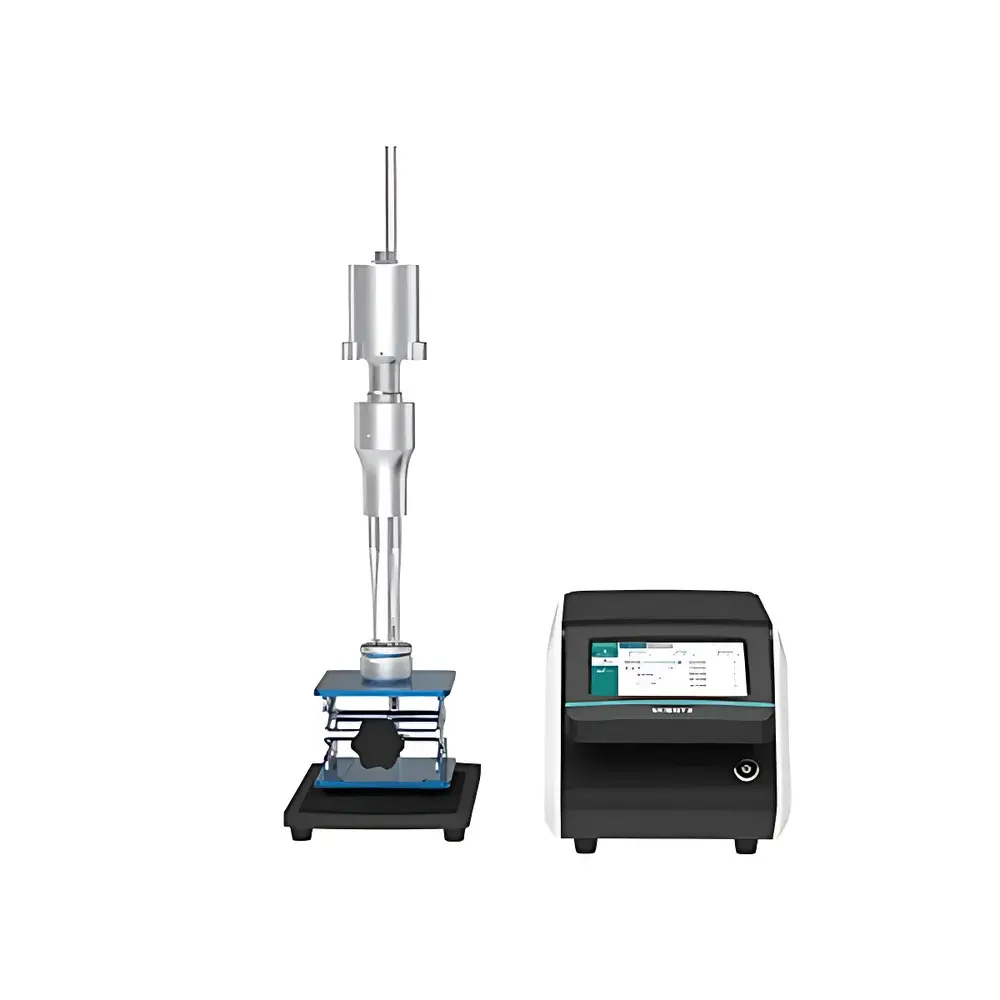
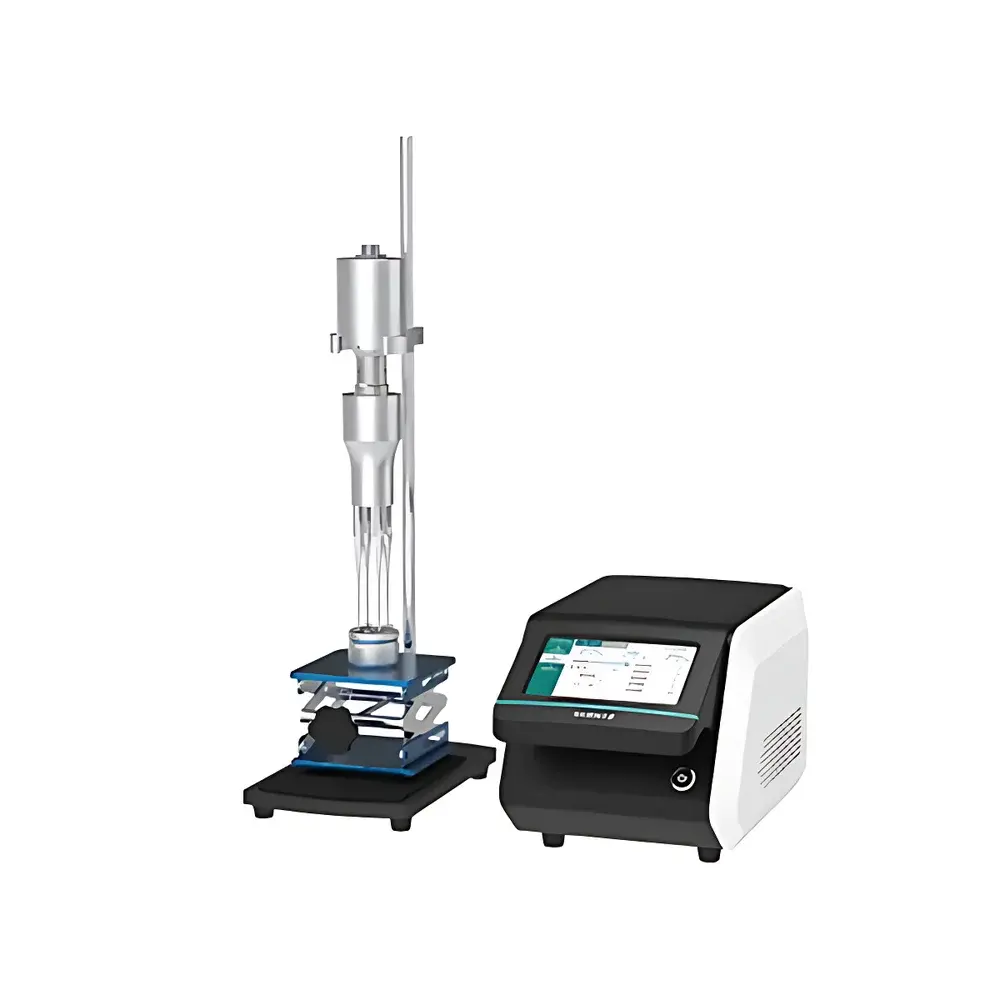
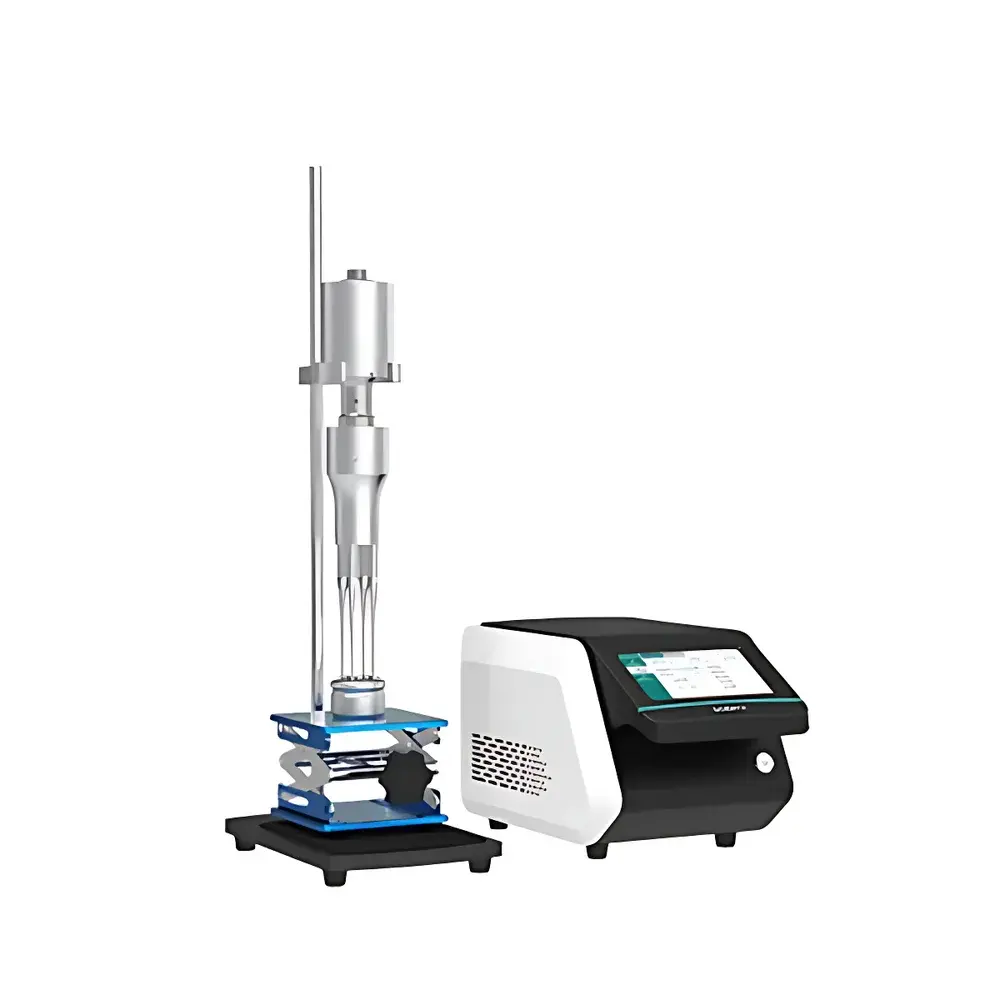
New Chi SCIENTZ-4TDL Multi-Channel Ultrasonic Cell Disruptor
| Brand | New Chi / SCIENTZ |
|---|---|
| Origin | Zhejiang, China |
| Manufacturer Type | Direct Manufacturer |
| Instrument Type | Ultrasonic Cell Disruptor |
| Model | SCIENTZ-4TDL |
| Operating Frequency | 20 kHz ± 0.5 kHz |
| Ultrasonic Output Power | 2400 W |
| Sample Volume per Channel | 0.5–15 mL |
| Number of Simultaneous Channels | 4 |
| Cooling Compatibility | Ice-bath or pre-chilled adapter (1.5–2 mL × 4 wells) |
| Control Mode | Programmable pulsed/continuous operation |
| Memory Capacity | Up to 50 user-defined protocols |
| Safety Features | Real-time temperature monitoring, overload protection, auto-diagnostic error reporting |
| Compliance | Designed for GLP-compliant labs |
Overview
The New Chi SCIENTZ-4TDL Multi-Channel Ultrasonic Cell Disruptor is an engineered solution for high-throughput, reproducible lysis of biological samples in research and quality control laboratories. It operates on the principle of acoustic cavitation—where high-intensity ultrasonic waves (20 kHz ± 0.5 kHz) propagate through a liquid medium, generating transient microbubbles that collapse violently, producing localized shockwaves, microstreaming, and shear forces exceeding 10⁴ Pa. This physical disruption mechanism enables efficient rupture of cell membranes, nuclear envelopes, and viral capsids without chemical or enzymatic intervention. Unlike single-probe systems, the SCIENTZ-4TDL integrates four independently driven titanium alloy probes mounted on a rigid aluminum frame, ensuring synchronized energy delivery across all channels while minimizing cross-contamination risk and inter-sample variability. Its architecture is optimized for applications requiring strict thermal management, including nucleic acid isolation, protein extraction, and preparation of lysates for downstream qPCR, Western blotting, or mass spectrometry.
Key Features
- Four-channel parallel processing: Enables simultaneous lysis of up to four samples (0.5–15 mL each), reducing batch processing time by >70% compared to sequential single-probe operation.
- Precisely controllable ultrasonic output: Adjustable power (0–100% of 2400 W full scale) and programmable pulse duration (on/off cycles from 0.1 s to 99.9 s), supporting both continuous and duty-cycle modes for heat-sensitive targets.
- Thermal mitigation design: Includes a standard 1.5–2 mL × 4 well pre-chilled adapter compatible with ice-water baths or refrigerated circulators; real-time temperature feedback triggers automatic power reduction if thermal thresholds are approached.
- Protocol-driven operation: Stores up to 50 user-defined methods with parameters including amplitude, pulse ratio, total duration, and probe ID—enabling method traceability and operator-independent repeatability.
- Embedded diagnostics: Self-check at startup and during runtime monitors transducer impedance, coolant flow (if external chiller connected), and thermal load; displays error codes and halts operation upon overtemperature or overload detection.
Sample Compatibility & Compliance
The SCIENTZ-4TDL accommodates diverse biological matrices—including mammalian cell suspensions (e.g., HEK293, CHO), bacterial cultures (E. coli, Bacillus spp.), yeast (S. cerevisiae), plant tissues (leaf homogenates), and viral particles (inactivated influenza, lentiviral vectors). Its non-contact, mechanical lysis approach avoids protease or nuclease contamination associated with bead-beating or enzymatic digestion. The system meets essential requirements for ISO/IEC 17025-accredited testing environments and supports documentation practices aligned with FDA 21 CFR Part 11 when integrated with compliant LIMS or ELN platforms. All electronic controls log timestamped parameter sets and execution records, fulfilling GLP/GMP data integrity expectations for regulated biopharmaceutical development workflows.
Software & Data Management
No proprietary software installation is required—the SCIENTZ-4TDL features an intuitive front-panel LCD interface with tactile keypad navigation. Each stored protocol retains full parameter metadata (amplitude %, cycle count, total sonication time, cooling status) and can be recalled, edited, or duplicated directly on-device. For laboratory-wide integration, RS-232 and optional USB-to-serial interfaces enable ASCII-based command-line communication with custom scripts or third-party automation frameworks (e.g., Python-controlled batch sequencing). Audit trails—including user ID (via PIN entry), date/time stamps, and deviation flags—are retained in non-volatile memory for ≥12 months and exportable as CSV for review during internal audits or regulatory inspections.
Applications
- Molecular Biology: High-yield genomic DNA, plasmid, and total RNA extraction from cultured cells or clinical isolates; preparation of sheared chromatin for ChIP-seq.
- Biopharmaceutical Development: Lysis of recombinant E. coli or Pichia pastoris expressing therapeutic proteins; solubilization of inclusion bodies under controlled thermal conditions.
- Nanomaterial Processing: Exfoliation of graphene oxide dispersions; deagglomeration of metal-organic frameworks (MOFs) and quantum dot suspensions.
- Food & Agricultural Science: Homogenization of fruit pulp for metabolite profiling; microbial cell disruption for rapid pathogen detection in dairy or juice matrices.
- Environmental Microbiology: Extraction of extracellular polymeric substances (EPS) from activated sludge biofilms; lysis of cyanobacterial blooms for toxin quantification.
FAQ
What sample volumes are supported per channel?
Each of the four channels accepts tubes ranging from 0.5 mL to 15 mL, with optimal efficiency observed between 1.5–5 mL using the included conical microtubes or standard 15-mL centrifuge tubes.
Is external cooling mandatory?
While not strictly mandatory, active thermal management is strongly recommended for heat-labile targets (e.g., native protein complexes or labile post-translational modifications); the instrument’s built-in thermal cutoff activates at ≥45°C.
Can the SCIENTZ-4TDL be integrated into automated liquid handling workflows?
Yes—via TTL-compatible trigger input and serial command set, it synchronizes with robotic arms or deck-mounted handlers for unattended multi-step lysis protocols.
Does it comply with electromagnetic compatibility (EMC) standards for laboratory use?
The device conforms to IEC 61326-1:2013 for laboratory equipment emissions and immunity, with CE marking valid for EU member states and UKCA recognition.
How is probe wear monitored and managed?
Titanium alloy probes exhibit minimal erosion under standard operating conditions; users are advised to inspect tip geometry visually after every 200 hours of cumulative use and replace if pitting or diameter reduction exceeds 5% of nominal 3-mm tip dimension.
Related Products



