
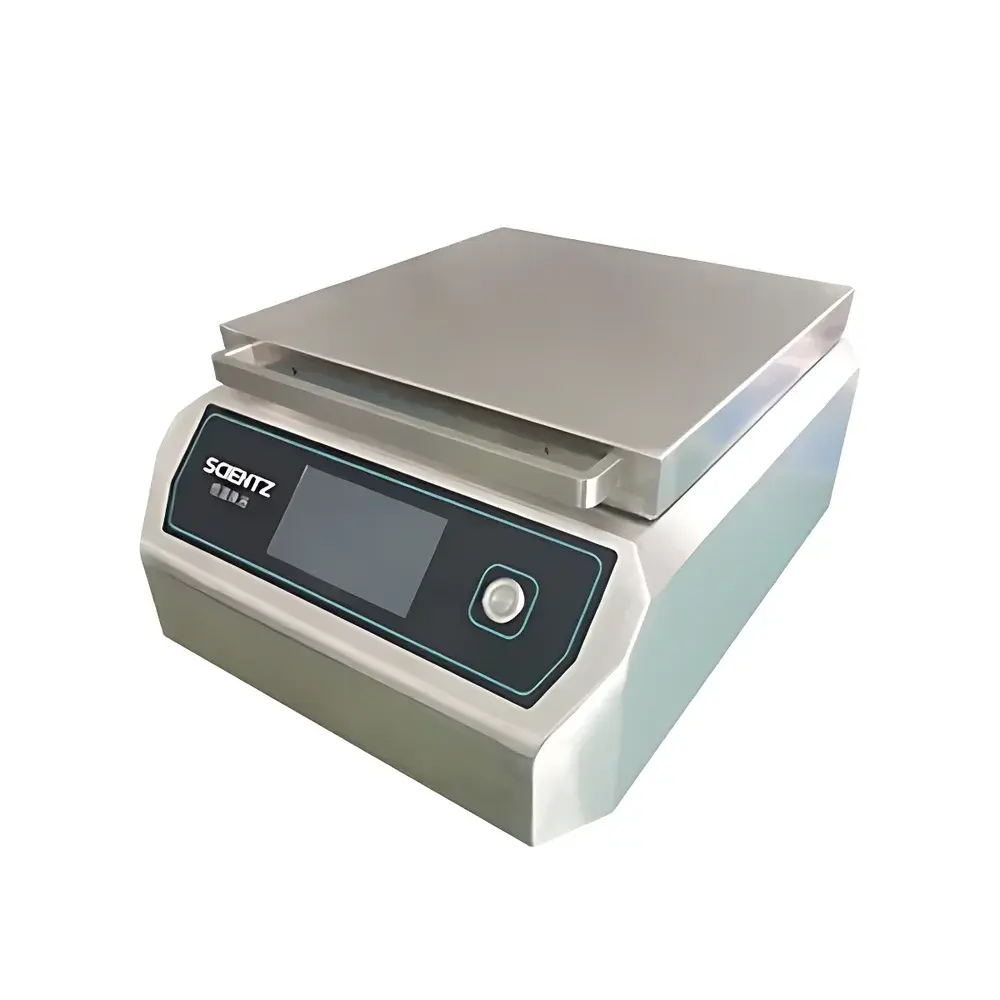
New Chi SCIENTZ-Bead 15 Metal Bead Thermostatic Bath
| Brand | New Chi / SCIENTZ |
|---|---|
| Origin | Zhejiang, China |
| Manufacturer Type | Direct Manufacturer |
| Product Category | Domestic |
| Model | SCIENTZ-Bead 15 |
| Pricing | Upon Request |
Overview
The New Chi SCIENTZ-Bead 15 Metal Bead Thermostatic Bath is an electronically controlled, dry-block thermal incubation system engineered for precise, uniform, and contamination-free temperature regulation of laboratory samples. Unlike conventional water baths or fixed-hole metal block heaters, the SCIENTZ-Bead 15 employs a fluidized bed of thermally conductive aluminum beads housed in a precision-machined aluminum heating chamber. This design leverages solid-state conduction and natural convective redistribution of beads to achieve rapid thermal equilibration and exceptional spatial temperature homogeneity (±0.3 °C across the working zone at 37 °C). The device operates on a Peltier-assisted resistive heating architecture with PID-controlled feedback, enabling stable setpoint maintenance over extended durations—ideal for applications requiring uninterrupted thermal conditioning without evaporation, condensation, or microbial proliferation risks associated with liquid media.
Key Features
- Rapid thermal response: Achieves target temperature within ≤90 seconds (from ambient to 37 °C) due to high thermal conductivity of aluminum beads and optimized heater geometry.
- Universal sample accommodation: Bead matrix conforms dynamically to irregular geometries—including conical tubes, PCR strips, microplates (96-/384-well), glass slides, and custom-shaped vessels—eliminating the need for interchangeable blocks or adapters.
- Dry operation protocol: Fully eliminates water handling, spill hazards, biofilm formation, and corrosion concerns; compatible with GLP-compliant environments where liquid-based baths are restricted.
- Continuous-duty capability: Designed for 24/7 operation without risk of dry-out, overheating, or thermal drift; no scheduled downtime for refilling or descaling required.
- Energy-efficient architecture: Demonstrates up to 4× lower power consumption versus water baths at 65 °C and ~2× reduction at physiological 37 °C, verified per IEC 62304-compliant energy profiling.
- Low-maintenance hygiene: Beads can be sterilized in situ using 70% ethanol wipe-down or UV-C exposure; no aqueous cleaning agents or ultrasonic baths needed.
- Compact footprint and ergonomic access: 210 × 160 × 145 mm (W × D × H); front-loading bead chamber with hinged lid and integrated thermal shield minimizes ambient heat loss.
Sample Compatibility & Compliance
The SCIENTZ-Bead 15 accommodates standard laboratory consumables including 0.2–15 mL centrifuge tubes (polypropylene, polyethylene), 1.5/2.0 mL microcentrifuge tubes, PCR tubes/strips, 96-well plates (flat- or V-bottom), microscope slides, and irregularly shaped reaction vessels up to 25 mm diameter. It complies with ISO 13485:2016 requirements for manufacturing controls and meets electromagnetic compatibility standards per EN 61326-1:2013. While not certified for IVD use, its thermal stability profile supports method validation under USP Analytical Instrument Qualification and aligns with FDA 21 CFR Part 11 data integrity principles when paired with compliant software logging systems.
Software & Data Management
The unit features an embedded 3.5-inch TFT LCD interface with capacitive touch navigation, real-time temperature graphing, and programmable ramp-hold profiles (up to 10 segments). Optional RS-485/Modbus RTU output enables integration into LIMS or SCADA platforms for audit-trail-capable temperature logging. When used with New Chi’s optional SCIENTZ-DataLink v2.1 software (Windows 10/11), users gain CSV-exportable time-stamped records, alarm event tagging, and electronic signature support compliant with ALCOA+ data governance frameworks.
Applications
- Enzyme kinetics assays requiring stable 25–65 °C incubation without condensation interference.
- Thermal denaturation studies of nucleic acids and proteins in low-volume formats.
- Pre-warming reagents (e.g., agarose, antibodies, restriction enzymes) prior to use in molecular workflows.
- Stabilization of temperature-sensitive standards during calibration of HPLC autosamplers or mass spectrometry sample introduction systems.
- Long-term storage of clinical specimens at controlled non-refrigerated temperatures (e.g., 30–45 °C for certain serological stability protocols).
- Environmental testing labs performing ASTM D5296-compliant polymer viscosity pre-conditioning.
FAQ
Is the SCIENTZ-Bead 15 suitable for use with volatile organic solvents?
Yes—its sealed bead chamber and absence of open liquid surfaces make it inherently safer than water baths for handling acetone, ethanol, chloroform, or DMSO-containing samples.
Can the aluminum beads be replaced or reordered separately?
Yes—bead refills (SCIENTZ-Bead Pack-15, 500 g) are available as consumables with lot-specific traceability documentation.
Does the device support external temperature probe input for independent verification?
No—temperature sensing is internal only via dual Pt100 sensors embedded in the heating block; external probe integration requires third-party DAQ hardware.
What is the maximum recommended operating duration at 100 °C?
The SCIENTZ-Bead 15 is rated for continuous operation up to 100 °C, but sustained use above 85 °C is advised only with active ventilation and periodic bead inspection for oxidation.
How is thermal uniformity validated across the bead bed?
New Chi provides factory calibration reports (per ISO/IEC 17025-accredited lab) documenting 9-point spatial mapping at 37 °C, 65 °C, and 100 °C, with uncertainty ≤±0.25 °C (k=2).



