
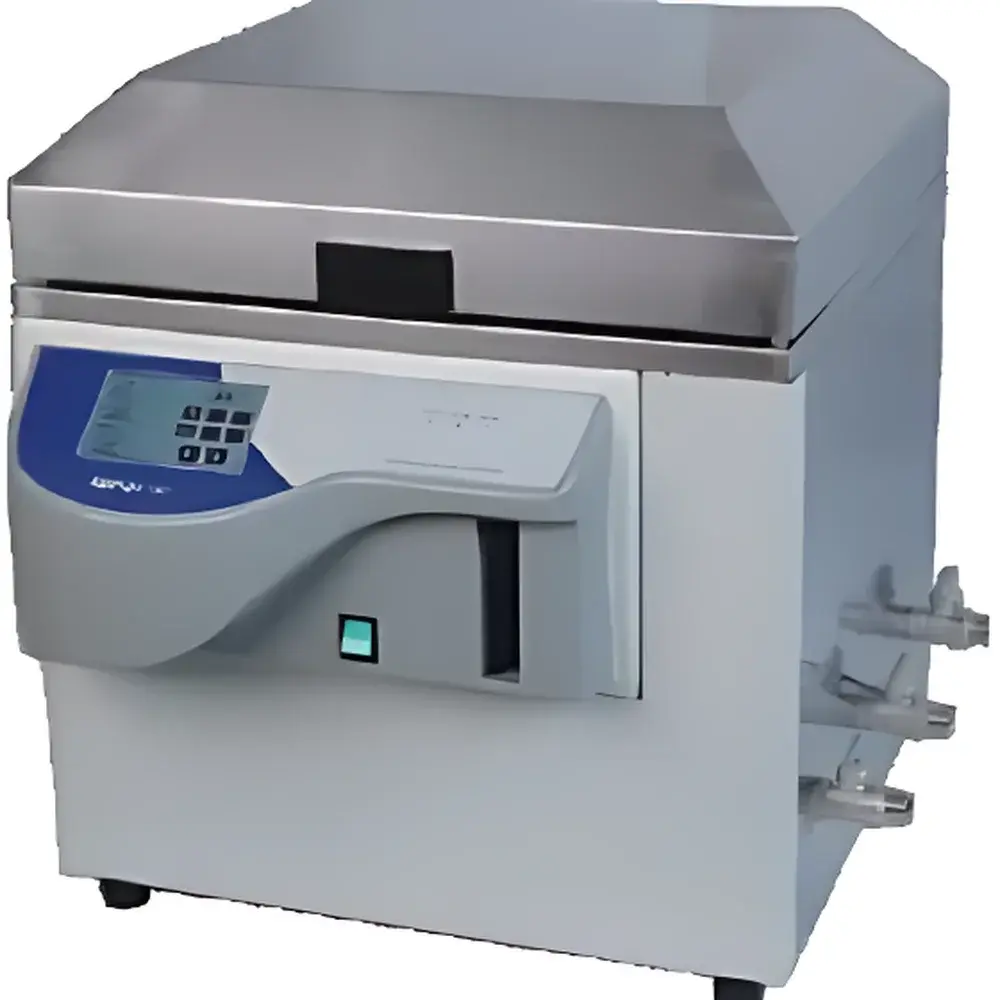
Chu Ding HMP-01 Automated Culture Medium Preparation System
| Brand | Chu Ding |
|---|---|
| Origin | Shanghai, China |
| Manufacturer Type | Authorized Distributor |
| Country of Origin | China |
| Model | HMP-01 |
| Quotation | Upon Request |
| Sterilization Temperature Range | 90–125 °C |
| Sterilization Time Range | 1–99 min |
| Vessel Capacity | 10 L |
| Heating Power | 2000 W |
| Stirring Speed | 1–80 rpm |
| Operating Pressure Range | 1.2–1.5 bar |
| Safety Valve Activation Pressure | 1.7 bar |
| Sample Loading Temperature Range | Ambient to 80 °C |
| Temperature Accuracy | ±1 °C |
| Dimensions (W×D×H) | 500 × 560 × 590 mm |
| Net Weight | 20 kg |
Overview
The Chu Ding HMP-01 Automated Culture Medium Preparation System is an integrated laboratory instrument engineered for precise, reproducible, and contamination-controlled preparation of microbiological culture media. It combines vacuum-assisted high-temperature steam sterilization, programmable thermal control, magnetic stirring, and active cooling within a single closed-cycle workflow. Unlike conventional autoclave-based or manual media preparation methods, the HMP-01 operates on the physical principle that saturated steam under controlled vacuum pressure elevates the boiling point of water—enabling sterilization at temperatures up to 125 °C while minimizing thermal degradation of heat-sensitive nutrients (e.g., vitamins, carbohydrates, and selective inhibitors). The system is designed to meet core requirements of Good Laboratory Practice (GLP) and Good Manufacturing Practice (GMP) environments, supporting validated workflows in pharmaceutical QC labs, clinical microbiology departments, environmental testing facilities, food safety laboratories, and academic research settings where traceability, sterility assurance, and batch consistency are critical.
Key Features
- Integrated process control: Simultaneous coordination of vacuum generation, steam sterilization, heating, magnetic stirring, cooling, and dispensing—all programmable via intuitive touchscreen interface.
- Vacuum-enhanced steam sterilization: Achieves reliable microbial inactivation (including spores) at 90–125 °C under 1.2–1.5 bar operating pressure; safety valve activates at 1.7 bar for overpressure protection.
- Precision temperature management: Dual-sensor monitoring (vessel wall + medium core) ensures real-time feedback control with ±1 °C accuracy across the full 90–125 °C range.
- Non-aerated mixing architecture: Vacuum environment prevents bubble formation during heating/stirring, eliminating need for post-sterilization degassing and ensuring homogeneous nutrient distribution.
- Modular, cleanable vessel design: Removable 10 L stainless-steel container with quick-release clamps; external ports compatible with flame sterilization (e.g., Bunsen burner) for aseptic connection to downstream tubing or filling stations.
- Single-hand lid actuation with thermal interlock: Electromechanical lock engages automatically above 130 °C; dual-mode pressure release (automatic venting + manual screw valve) enhances operator safety during depressurization.
- Up to 10 user-defined protocols: Each program stores sterilization temperature, duration, stirring speed (1–80 rpm), cooling setpoint, and dispensing volume—supporting diverse media formulations (e.g., TSB, PCA, MacConkey, Sabouraud Dextrose).
Sample Compatibility & Compliance
The HMP-01 accommodates liquid, semi-solid, and powdered culture media—including agar-based, selective, differential, and enriched formulations—without clogging or cross-contamination. Its sealed processing chamber and steam-saturated internal environment comply with ISO 11134 (moist heat sterilization validation) and ASTM E2755 (standard guide for microbiological media preparation). All temperature, pressure, and time parameters are logged with timestamped metadata, enabling full audit trail generation per FDA 21 CFR Part 11 requirements when connected to compliant LIMS or PC-based software. The system supports routine verification using biological indicators (e.g., Bacillus stearothermophilus spore strips) and thermocouple mapping per ISO/IEC 17025 calibration guidelines.
Software & Data Management
The embedded controller records all process variables—including real-time temperature curves, pressure profiles, stir speed history, and cycle completion timestamps—with automatic assignment of unique batch IDs. Data export is supported via USB interface to standard CSV format for integration into laboratory information management systems (LIMS) or electronic lab notebooks (ELN). Optional PC software provides graphical visualization of thermal profiles, deviation alerts, and automated report generation (including media lot number, operator ID, sterilization date/time, and pass/fail status per USP bacterial endotoxins test prerequisites). Audit trails are immutable and include user login logs, parameter change history, and electronic signatures where enabled.
Applications
- Pharmaceutical microbiology: Preparation of growth promotion test media per USP , , and ; sterility test media for membrane filtration and direct inoculation methods.
- Clinical diagnostics: Standardized production of blood agar, chocolate agar, and selective isolation media for hospital and public health laboratories.
- Food & beverage testing: AOAC-validated media preparation for Listeria, Salmonella, and E. coli enumeration per ISO 6579 and ISO 11290.
- Environmental monitoring: Media for water analysis (e.g., mEndo, R2A, Legionella BCYE) in compliance with EPA Method 1603 and ISO 9308-1.
- Academic & industrial R&D: High-throughput formulation screening, stability studies, and custom media development with full parameter reproducibility.
FAQ
What sterilization standards does the HMP-01 support?
It meets ISO 11134 requirements for saturated steam sterilization and supports validation protocols aligned with EN 554 and ANSI/AAMI ST79.
Can the HMP-01 handle agar-containing media without clogging?
Yes—the optimized vacuum-heating sequence prevents premature agar gelation, and the magnetic stirrer maintains suspension integrity throughout the cycle.
Is remote monitoring or network connectivity available?
The system supports local USB data export; Ethernet or Wi-Fi modules are available as optional accessories for integration into facility-wide monitoring networks.
How is calibration verified and maintained?
Temperature sensors are calibrated traceably to NIST standards; users may perform routine checks using certified reference thermometers per ISO/IEC 17025 Section 6.5.
What maintenance intervals are recommended?
Daily visual inspection of seals and gaskets; quarterly verification of pressure sensor linearity and annual full-system performance qualification (PQ) per manufacturer’s SOP.



