
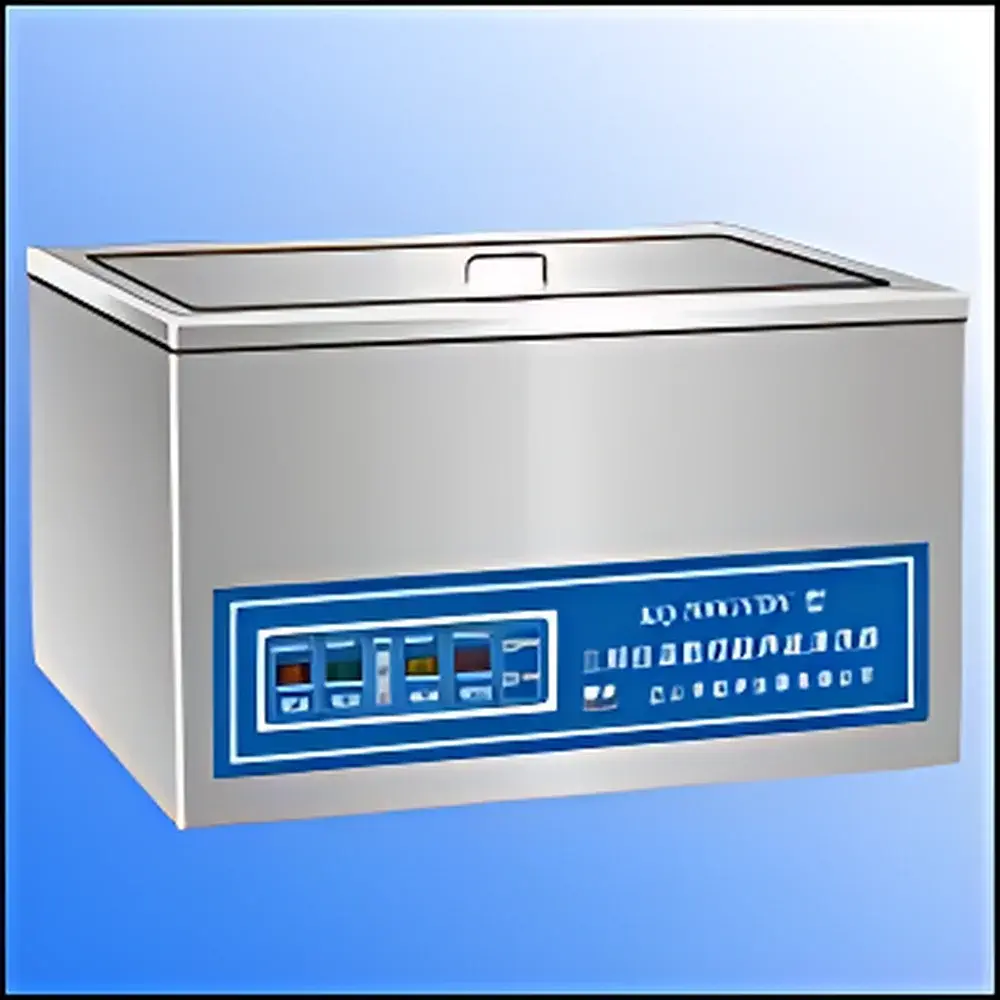
Chu Ding KQ-300GTDV / KQ-500GTDV / KQ-600GTDV Benchtop Dual-Frequency Programmable Temperature-Controlled Ultrasonic Cleaner
| Brand | Chu Ding |
|---|---|
| Origin | Shanghai, China |
| Model | KQ-300GTDV / KQ-500GTDV / KQ-600GTDV |
| Tank Capacity | 13 L / 27 L / 27 L |
| Ultrasonic Frequency | 80 kHz |
| Ultrasonic Power | 300 W / 500 W / 600 W |
| Power Adjustment Range | 40–100% |
| Heating Power | 600 W / 1000 W / 1000 W |
| Cooling Power | 300 W |
| Temperature Control Range | 0–80 °C |
| Timer Range | 1–480 min |
| Internal Tank Dimensions (L×W×H) | 300×240×180 mm / 500×300×180 mm / 500×300×180 mm |
| External Dimensions (L×W×H) | 640×350×400 mm / 840×410×400 mm / 840×410×400 mm |
| Transducer Output per Unit | 50 W |
| Display | Digital LED with Memory Function for Frequency, Time, Set/Actual Temperature, and Power |
Overview
The Chu Ding KQ-300GTDV, KQ-500GTDV, and KQ-600GTDV are benchtop dual-frequency programmable ultrasonic cleaners engineered for laboratories requiring precise thermal management during ultrasonic processing. Unlike conventional single-mode ultrasonic systems—where solution temperature rises uncontrollably due to acoustic energy dissipation—these models integrate active heating and thermoelectric cooling modules within a unified control architecture. This enables stable, user-defined bath temperatures across extended operation cycles (up to 480 minutes), eliminating thermal drift that compromises reproducibility in critical applications such as nanoparticle dispersion, cell lysis, or solvent degassing. The system operates at a fixed 80 kHz frequency, optimized for high cavitation density and uniform energy distribution in aqueous and low-viscosity organic media. Its closed-loop temperature regulation meets the operational prerequisites of ASTM D2621 (Standard Test Method for Ultrasonic Cleaning Efficiency) and supports GLP-compliant workflows where thermal stability directly affects analytical validity.
Key Features
- Dual-mode thermal regulation: Simultaneous Peltier-based cooling (300 W) and resistive heating (600–1000 W) ensure ±0.5 °C temperature stability across 0–80 °C range
- Programmable ultrasonic output: Adjustable power from 40% to 100% of nominal rating (300 W / 500 W / 600 W), enabling method optimization for delicate substrates or aggressive contaminant removal
- Memory-enabled digital interface: LED display retains user-defined parameters—including set temperature, elapsed time, actual bath temperature, and power level—between power cycles
- Robust stainless-steel construction: Deep-drawn tank with argon-welded stainless mesh basket; sound-dampening lid with corrosion-resistant EPDM gasket
- Integrated filtration-ready design: Built-in port for external recirculating filtration systems to maintain particulate-free cleaning baths during long-duration protocols
- Drain valve assembly: 304 stainless steel ball valve with threaded outlet for rapid, residue-free tank evacuation
- Intelligent transducer array: Multiple 50 W piezoelectric elements distributed across tank bottom ensure uniform cavitation field without hot spots
Sample Compatibility & Compliance
These units accommodate standard laboratory vessels—including beakers, vials, crucibles, and custom fixtures—within their respective tank volumes (13 L or 27 L). The 80 kHz frequency delivers optimal energy transfer for sub-micron particle detachment from metal, glass, ceramic, and polymer surfaces while minimizing erosion risk to soft materials such as silicon wafers or biological tissues. All models comply with IEC 61000-6-3 (EMC emission standards) and IEC 61000-6-2 (immunity requirements). For regulated environments, the programmable timer and temperature logging capability support audit trails aligned with FDA 21 CFR Part 11 principles when paired with validated external data capture software. No hazardous refrigerants are used in the cooling module, satisfying RoHS Directive 2011/65/EU and REACH Annex XVII restrictions.
Software & Data Management
While the KQ-GTDV series operates via embedded microcontroller firmware (no PC connectivity required), its parameter memory function provides traceability essential for SOP-driven labs. Each unit logs the last-used settings—including start time, duration, target temperature, and power level—accessible via front-panel navigation. For integration into centralized lab informatics platforms, optional RS-232 or USB-to-serial adapters enable serial command transmission (ASCII protocol) for remote start/stop, real-time temperature polling, and event-triggered data export. Raw temperature and timer values can be timestamped and archived in CSV format, supporting ISO/IEC 17025 clause 7.7 (result reporting) and USP Analytical Instrument Qualification frameworks.
Applications
- Pre-analytical sample preparation: Removal of organic residues from HPLC vials, GC autosampler trays, and ICP-MS nebulizer components
- Materials science: Deburring of MEMS devices, dispersion of carbon nanotubes in surfactant solutions, and surface activation of graphene oxide films
- Pharmaceutical R&D: Solvent exchange in lyophilization pre-treatment, cleaning of tablet punch tools, and extraction of botanical actives under controlled thermal conditions
- Life sciences: Gentle dissociation of adherent cell monolayers, homogenization of tissue lysates prior to proteomic analysis, and degassing of cell culture media
- Quality control laboratories: Validation of cleaning efficacy per ISO 15883-1 for reusable medical device reprocessing equipment
FAQ
What is the maximum allowable operating temperature for continuous ultrasonic operation?
The system maintains stable bath temperatures up to 80 °C indefinitely when heating only is engaged. With simultaneous heating and cooling active, sustained operation is rated for 0–60 °C to preserve thermoelectric module longevity.
Can the unit operate without temperature control enabled?
Yes—users may disable thermal regulation and run ultrasonic cycles in ambient mode, retaining full power adjustability and timing functionality.
Is the cooling system compressor-based or solid-state?
It employs a thermoelectric (Peltier) cooling module with passive heat-sink dissipation, eliminating moving parts, refrigerant handling, and associated maintenance.
How is calibration verified for temperature accuracy?
Each unit ships with a NIST-traceable calibration certificate for the PT100 sensor. Field verification can be performed using a calibrated immersion thermometer meeting ASTM E74 or ISO 17025 requirements.
Are replacement transducers available as spare parts?
Yes—individual 50 W transducer assemblies are supplied with mounting hardware and impedance-matched cabling for field replacement without recalibration.



