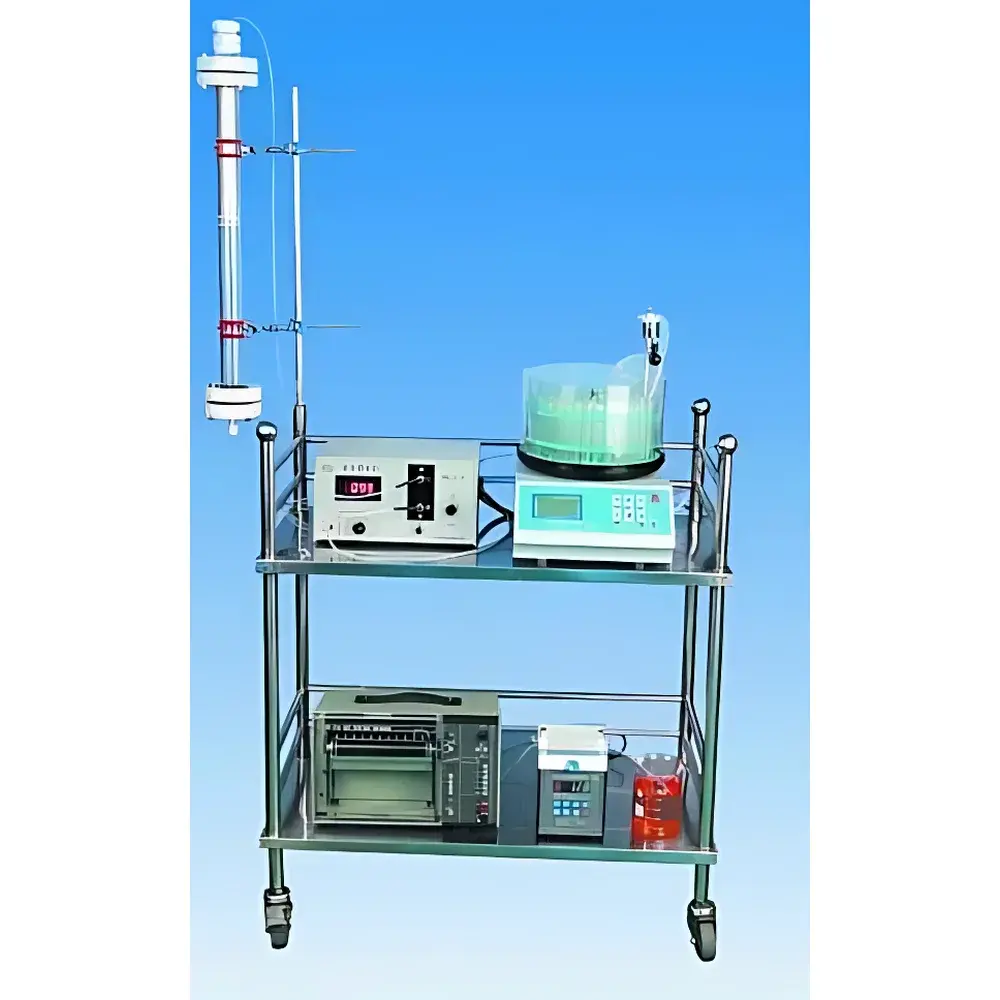
Chu Ding MC99-2 Automated Nucleic Acid & Protein Chromatography System (Standard Modular Configuration)
| Origin | Shanghai, China |
|---|---|
| Manufacturer Type | Authorized Distributor |
| Product Origin | Domestic (China) |
| Model | MC99-2 |
| Price | USD 2,850 (FOB Shanghai) |
| Wavelength | 254 nm / 280 nm |
| Timer Range | 1 s – 100 min |
| Flow Rate | 1–80 mL/min |
| Fraction Capacity | 12 mL × 100 tubes |
| Gradient Volume | 1000 mL (linear profile) |
| Column Set | Φ1.0×40 cm, Φ1.6×50 cm, Φ2.5×60 cm (three columns included) |
| Weight | 30 kg |
| Data Acquisition | Analog output to external recorder (XWT-S desktop chart recorder included) |
| Compliance | Designed for GLP-compliant lab environments |
Overview
The Chu Ding MC99-2 Automated Nucleic Acid & Protein Chromatography System is a modular, benchtop liquid chromatography platform engineered for reproducible purification and analytical separation of nucleic acids, proteins, and other UV-absorbing biomolecules. Based on classical column chromatography principles—employing UV absorbance detection at 254 nm (for nucleic acids) and 280 nm (for aromatic amino acids in proteins)—the system delivers precise, real-time monitoring of elution profiles via analog signal output. Unlike fully integrated HPLC systems, the MC99-2 adopts an open-architecture design optimized for educational laboratories, core facilities, and mid-throughput research groups requiring flexibility, cost efficiency, and hands-on method development. Its operational foundation lies in continuous-flow isocratic or linear gradient elution, driven by a digitally controlled peristaltic pump and monitored through dual-wavelength photometric detection. The system does not incorporate on-board digital data processing; instead, it interfaces with external recording devices—specifically the included XWT-S desktop strip-chart recorder—to generate permanent, time-stamped chromatograms suitable for regulatory review and teaching demonstrations.
Key Features
- Dual-wavelength UV detection (254 nm and 280 nm) with stable LED-based optical path, enabling simultaneous tracking of DNA/RNA and protein elution peaks
- Adjustable peristaltic pump delivering calibrated flow rates from 1 to 80 mL/min with mechanical consistency across extended runs
- Programmable fraction collector supporting timed collection over 1–100 minute intervals, accommodating up to 100 fractions at 12 mL capacity each
- Manual gradient mixer with 1000 mL reservoir capacity, configured for linear solvent composition transitions—ideal for ion-exchange, gel filtration, and affinity chromatography protocols
- Modular column manifold pre-assembled with three standard glass columns (Φ1.0×40 cm, Φ1.6×50 cm, Φ2.5×60 cm), facilitating rapid method screening across pore size and bed volume parameters
- Analog voltage output (0–10 mV or 0–1 V selectable) compatible with third-party chart recorders or DAQ systems, ensuring traceability without proprietary software lock-in
- Robust stainless-steel and acrylic frame (30 kg total mass) designed for vibration-dampened operation on standard laboratory benches
Sample Compatibility & Compliance
The MC99-2 is routinely deployed for the purification of plasmid DNA, PCR products, recombinant proteins, and antibody fragments from clarified lysates or conditioned media. Sample matrices include aqueous buffers (e.g., Tris-HCl, phosphate, imidazole gradients), low-viscosity denaturants (e.g., 6 M guanidine HCl), and mild organic modifiers (≤20% acetonitrile or methanol). It complies with fundamental requirements of ISO/IEC 17025 for equipment suitability in testing laboratories and supports GLP documentation workflows when operated with validated recorder calibration logs and manual run logs. While not certified for GMP manufacturing, its analog signal chain and mechanical repeatability meet the technical expectations for process development and quality control in academic and preclinical settings. All wetted parts—including pump tubing, collection tubes, and column housings—are chemically resistant to common chromatographic solvents and autoclavable (excluding electronics and recorder unit).
Software & Data Management
The MC99-2 operates without embedded firmware or closed-source control software. Data acquisition relies entirely on external analog instrumentation: the bundled XWT-S desktop chart recorder provides continuous thermal-paper output of absorbance (A) and transmittance (%T) signals, with manual annotation of fraction boundaries and peak assignments. For digital archiving, users may integrate the system with commercial DAQ hardware (e.g., National Instruments USB-6009) and open-source platforms such as Python (with PyDAQmx) or LabVIEW for time-synchronized signal logging. When used in regulated environments, laboratories must establish and validate their own electronic record procedures—including metadata tagging (operator ID, date/time stamp, column lot number), raw file retention, and audit trail generation—as the system itself does not implement FDA 21 CFR Part 11-compliant electronic signatures or user access controls.
Applications
- Desalting and buffer exchange of enzymatic digests prior to MALDI-TOF analysis
- Size-exclusion chromatography (SEC) of IgG aggregates and monomers using Φ2.5×60 cm columns
- DEAE- or Q-Sepharose–based anion-exchange purification of His-tagged proteins under native conditions
- Teaching chromatography fundamentals—including retention time, resolution, and peak symmetry—in undergraduate biochemistry labs
- Rapid method scouting for downstream purification scale-up, leveraging interchangeable column geometries
- Preparative isolation of RNA from TRIzol®-extracted samples using oligo(dT)-functionalized resins
FAQ
Does the MC99-2 support multi-wavelength scanning or spectral deconvolution?
No. It provides fixed-wavelength detection only at 254 nm and 280 nm via discrete LED sources and interference filters. Full-spectrum acquisition requires a separate diode-array detector.
Can the system be upgraded to include digital data capture and PC-based analysis?
Yes—by replacing the XWT-S recorder with a calibrated analog-to-digital converter and installing validated chromatography software (e.g., Chromeleon CDS or OpenChrom), provided local IT validation protocols are followed.
What maintenance is required for long-term reliability?
Monthly inspection of pump tubing elasticity and replacement every 3–6 months depending on solvent compatibility; annual recalibration of UV lamp intensity and zero-baseline drift using neutral density filters.
Is the gradient mixer programmable for nonlinear profiles (e.g., concave or sigmoidal)?
No—the mixer generates only linear gradients. Nonlinear profiles require external syringe pumps or third-party gradient programmers interfaced via analog voltage input.
Are replacement columns and consumables supplied with batch-specific QC certificates?
Yes—glass columns and standard resin packs (e.g., Sephadex G-25, DEAE cellulose) are available with CoA documentation upon request, traceable to ISO 9001-certified suppliers.