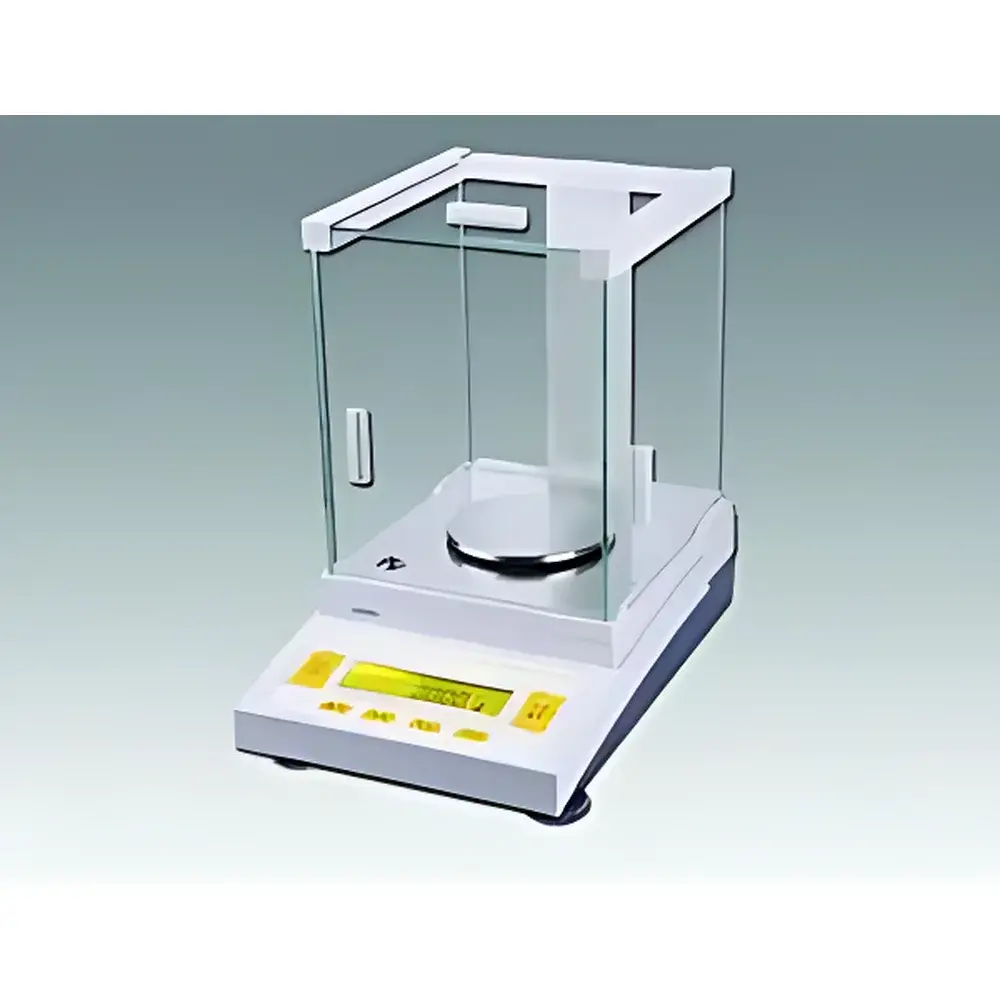
Chu Ding Technology JA1203 Precision Analytical Balance
| Brand | Chu Ding Technology |
|---|---|
| Model | JA1203 |
| Capacity | 120 g |
| Readability | 1 mg |
| Repeatability | ≤1 mg |
| Linearity | ≤±2 mg |
| Pan Diameter | Ø110 mm |
| Draft Shield Dimensions | 198 × 225 × 240 mm |
| Overall Dimensions | 212 × 330 × 323 mm |
| Power Options | AC adapter or 9 V DC battery |
| Display | Backlit LCD |
| Interface | RS232 |
| Compliance | ISO 9001-manufactured |
Overview
The Chu Ding Technology JA1203 Precision Analytical Balance is a high-stability, microprocessor-controlled laboratory balance engineered for accurate mass determination in research, quality control, and educational settings. It employs an ultra-thin electromagnetic force compensation sensor—distinct from strain-gauge-based systems—to eliminate common artifacts such as creep, hysteresis, and nonlinearity associated with resistive load cells. This architecture ensures consistent metrological performance across extended operation cycles and varying ambient conditions. With a maximum capacity of 120 g and readability of 1 mg (0.001 g), the JA1203 meets the definition of a Class II analytical balance per OIML R76 and ANSI/NCSL Z540-1 requirements for routine precision weighing tasks. Its design prioritizes operational robustness, thermal stability, and user-configurable response characteristics—making it suitable for applications where traceable, repeatable mass data are essential under non-climate-controlled lab conditions.
Key Features
- Electromagnetic force restoration sensor delivering high long-term stability and minimal drift
- Backlit LCD display with adjustable contrast for optimal readability in low-light or high-glare environments
- Five-sided transparent draft shield (198 × 225 × 240 mm) providing full lateral and overhead airflow containment while maintaining unobstructed operator visibility
- Adjustable weighing speed setting to optimize settling time for volatile, hygroscopic, or thermally sensitive samples
- Integrated below-balance hook for density determination and magnetic susceptibility measurements
- Four-stage shock absorption system mitigating floor-borne vibrations from nearby equipment or foot traffic
- Dynamic temperature compensation algorithm minimizing thermal drift during warm-up or ambient fluctuations
- Configurable auto-zero tracking range and programmable overload protection with audible/visual alert
- Multi-unit conversion including grams, ounces (avoirdupois), carats, and grains—calibrated per NIST-traceable standards
Sample Compatibility & Compliance
The JA1203 accommodates a broad range of sample types—including powders, granules, liquids in tared containers, and small solid components—within its Ø110 mm stainless-steel weighing pan. Its sealed sensor housing and corrosion-resistant pan surface support use in moderately humid or chemically exposed environments typical of QC labs and university teaching laboratories. While not certified to ISO/IEC 17025 for accredited calibration services, the balance supports GLP documentation workflows through RS232 output of raw weight data, timestamped events, and calibration logs. It complies with CE marking requirements for electromagnetic compatibility (2014/30/EU) and low-voltage safety (2014/35/EU). Routine verification may be performed using Class M2 or better weights per ISO 9001 internal audit protocols.
Software & Data Management
The built-in RS232 serial interface enables direct connection to PCs, LIMS platforms, or label printers without external adapters. ASCII-formatted output includes real-time mass readings, net/gross/tare status flags, unit identifiers, and error codes (e.g., “OVER”, “UNST”, “CAL”). Data transmission supports configurable baud rates (up to 9600 bps), parity, and stop bits to integrate with legacy laboratory informatics systems. No proprietary software is required; standard terminal emulators (e.g., Tera Term, PuTTY) or Excel-based macros can capture and timestamp readings. Audit trail functionality is limited to device-generated event codes; full 21 CFR Part 11 compliance requires integration with validated third-party data acquisition software.
Applications
- Quantitative formulation in pharmaceutical R&D (e.g., active ingredient dosing at 1–100 mg scale)
- Gravimetric analysis in environmental testing labs (e.g., filter weighing for PM2.5/PM10 collection)
- Calibration of volumetric glassware using water density correction methods
- Student experiments in general chemistry and materials science requiring ±1 mg repeatability
- Inventory counting of uniform small parts (e.g., screws, tablets, electronic components) via built-in piece-counting mode
- Density determination of solids using Archimedes’ principle with optional sinker kit
- Preparation of standard solutions in food safety and agricultural testing laboratories
FAQ
What is the recommended calibration frequency for the JA1203 in a regulated environment?
Internal calibration should be performed before each shift or after any significant environmental change (e.g., >2°C temperature shift). External verification with traceable weights is advised daily in GLP/GMP contexts.
Does the JA1203 support internal motorized calibration?
No—the JA1203 requires manual external calibration using certified weights; it does not feature a built-in calibration mass or motorized actuation.
Can the balance operate continuously on battery power?
Yes—it functions on a standard 9 V alkaline battery for up to 40 hours of intermittent use, though AC operation is recommended for continuous high-precision work.
Is the RS232 interface optically isolated?
No—electrical isolation is not provided; users deploying in electrically noisy industrial settings should consider adding an isolated RS232 repeater.
What maintenance procedures are required to sustain metrological accuracy?
Monthly cleaning of the draft shield and pan with lint-free cloth and isopropyl alcohol; annual inspection of leveling feet and draft shield alignment per manufacturer’s service manual.