
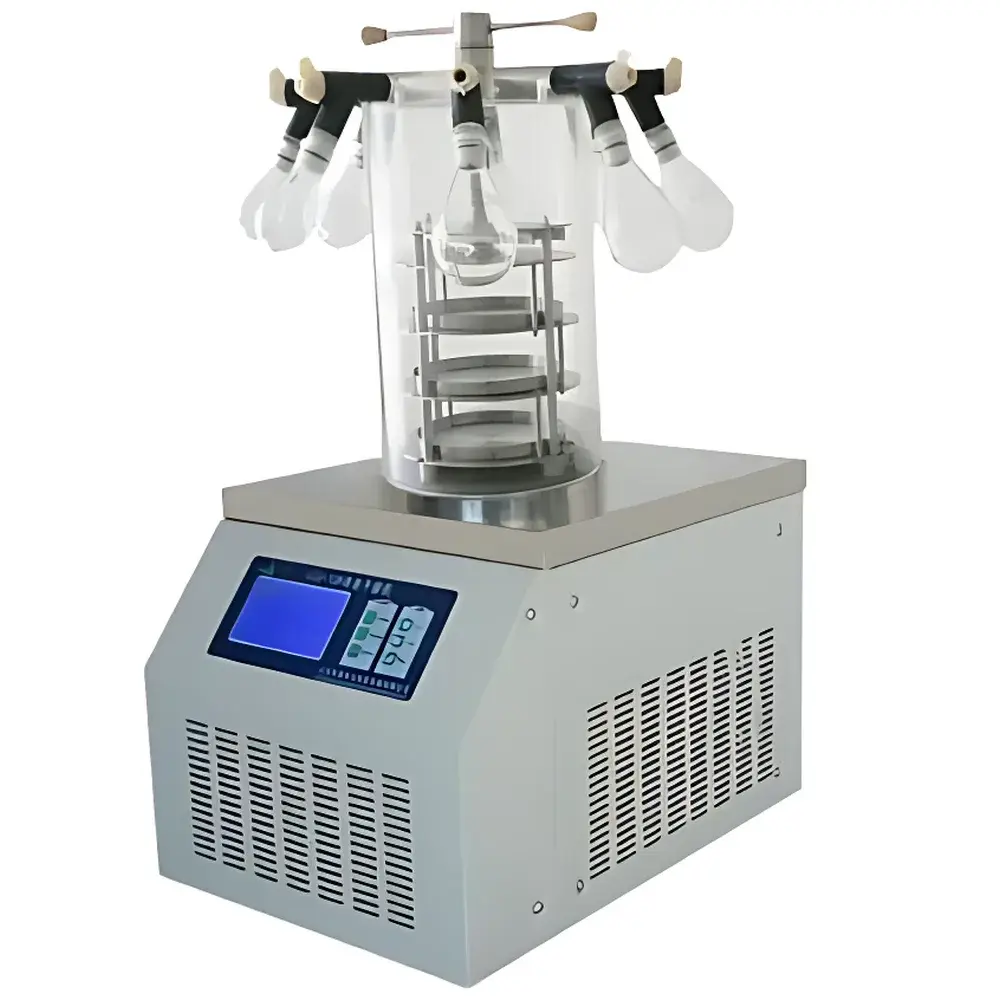
Chu Ding Technology LGJ-12 Vertical Benchtop Freeze Dryer (Standard / Stoppering / Manifold / Manifold-Stoppering Configurations)
| Brand | Chu Ding Technology |
|---|---|
| Origin | Shanghai, China |
| Model | LGJ-12 |
| Cold Trap Temperature | < −55 °C (−80 °C optional) |
| Ultimate Vacuum | < 10 Pa |
| Freeze-Drying Area | 0.09–0.18 m² |
| Water Capture Capacity | 3 kg/24 h |
| Dimensions (W×D×H) | 560 × 460 × (710 + 430) mm |
| Shelf Diameter | Ø200 mm (4–6 shelves, adjustable spacing) or Ø180 mm (3 shelves, bottle-compatible) |
| Sample Volume Capacity | up to 1500 mL (bulk, 10 mm layer thickness) or 155 × Ø22 mm vials |
| Manifold Ports | 8 ports supporting 100/250/500/1000 mL flasks |
| Rotation Pre-Freezing Option | Available |
| Optional N₂ Inlet Valve | Available |
Overview
The Chu Ding Technology LGJ-12 is a vertically oriented, benchtop-scale freeze dryer engineered for rigorous laboratory freeze-drying validation, method development, and low-volume production of thermolabile biologicals, pharmaceuticals, diagnostics, and research-grade materials. It operates on the fundamental principle of lyophilization—sublimation of ice under deep vacuum and controlled low temperature—enabling structural preservation of proteins, enzymes, vaccines, probiotics, and other sensitive compounds without thermal degradation. The system integrates a high-efficiency dual-stage cascade refrigeration unit with an oversized stainless-steel cold trap, enabling rapid primary drying and efficient water vapor condensation. Its modular configuration supports four distinct operational modes: Standard (bulk tray drying), Stoppering (manual stopper compression for vial sealing under vacuum), Manifold (simultaneous drying across multiple flasks), and Manifold-Stoppering (combined flask drying with post-drying vial sealing). This versatility makes the LGJ-12 suitable for R&D labs, QC/QA units, and pilot-scale GMP-aligned environments where reproducibility, traceability, and process documentation are critical.
Key Features
- Stainless-steel construction throughout cold trap, chamber walls, and sample shelves—ensuring corrosion resistance, cleanability, and compliance with ISO 14644-1 Class 5 cleanroom-compatible handling.
- Large-diameter cold trap (Ø200 mm) with pre-freeze capability—facilitating in-situ sample freezing prior to primary drying, eliminating external ultra-low temperature freezer dependency.
- High-capacity dual-stage compressor system (imported) delivering stable cooling performance down to −55 °C standard or −80 °C optional—optimized for high-moisture-load samples and extended batch cycles.
- Transparent acrylic bell-jar chamber with integrated safety interlock—providing real-time visual monitoring while maintaining vacuum integrity and operator protection.
- Adjustable shelf spacing (50 mm or 70 mm intervals) and configurable shelf count (4–6 for Ø200 mm trays; 3 for Ø180 mm vial-compatible trays)—supporting both bulk powder drying and multi-vial processing.
- 8-port stainless-steel manifold with universal KF-16 flange compatibility—enabling simultaneous drying of heterogeneous samples in 100 mL, 250 mL, 500 mL, and 1000 mL lyophilization flasks; individual port isolation valves allow selective flask removal during operation.
- Optional rotary pre-freezing accessory—inducing uniform shell-freezing of liquid samples via controlled rotation at sub-zero temperatures, enhancing ice crystal homogeneity and subsequent sublimation kinetics.
- Integrated N₂ purge inlet (optional)—permitting inert gas backfilling for oxygen-sensitive products or facilitating controlled reconstitution post-drying.
Sample Compatibility & Compliance
The LGJ-12 accommodates a broad range of sample formats: bulk solutions (up to 1500 mL per cycle at 10 mm depth), serum vials (155 × Ø22 mm), and standardized lyophilization flasks. Its design adheres to core engineering requirements outlined in ISO 22042 (freeze-drying equipment—performance testing), ASTM F2375 (lyophilizer qualification), and USP (package integrity testing for sterile products). While not inherently 21 CFR Part 11-compliant out-of-the-box, the system’s analog control architecture permits integration with validated third-party data acquisition systems supporting electronic signatures, audit trails, and secure user access—meeting GLP and basic GMP documentation needs for non-commercial clinical trial material preparation. All wetted surfaces are electropolished 316L stainless steel or food-grade acrylic, fully compatible with VHP (vaporized hydrogen peroxide) decontamination protocols.
Software & Data Management
The LGJ-12 features an embedded LCD interface with Chinese-language menu navigation and real-time graphical display of chamber pressure, cold trap temperature, and shelf temperature (where applicable). Though it does not include onboard data logging or PC connectivity as standard, its analog output signals (0–10 V or 4–20 mA) for vacuum, temperature, and time enable seamless integration with external PLCs, SCADA systems, or validated chart recorders. For laboratories requiring full digital traceability, optional RS485/Modbus RTU communication modules support connection to LIMS or ELN platforms. Process parameters—including hold times, ramp rates, and endpoint criteria—can be manually recorded per ICH Q5C stability protocol requirements. The system supports manual SOP-driven operation aligned with Annex 15 (Qualification and Validation) and WHO TRS 986 Annex 5 (Good Manufacturing Practices for Sterile Pharmaceutical Products).
Applications
- Pre-formulation studies of monoclonal antibodies, recombinant proteins, and mRNA-LNP formulations.
- Stabilization of diagnostic reagents, enzyme standards, and reference materials for clinical assay development.
- Preservation of microbial cultures (bacteria, yeasts, fungi) and cell lines for long-term cryobanking.
- Drying of botanical extracts, nutraceuticals, and functional food ingredients while retaining bioactive profile.
- Small-batch production of sterile veterinary vaccines and topical biologics under quality-controlled conditions.
- Method transfer from analytical-scale to pilot-scale lyophilization processes using identical thermal profiles and mass transfer characteristics.
FAQ
What is the difference between the Standard and Stoppering configurations?
The Standard model uses open stainless-steel trays for bulk drying; the Stoppering model includes a mechanical compression mechanism enabling vacuum-sealing of rubber-stoppered vials post-drying—critical for maintaining sterility and residual moisture control.
Can the LGJ-12 be used for sterile processing?
No—it lacks built-in steam-in-place (SIP), clean-in-place (CIP), or isolator integration; however, it may be operated within a Class A laminar flow hood or Grade A environment when paired with aseptic vial loading techniques.
Is the −80 °C cold trap option necessary for most applications?
It is recommended for high-concentration sucrose or trehalose formulations, viscous biopolymer solutions, or samples with eutectic points below −55 °C to prevent collapse or melt-back during primary drying.
How is endpoint determination performed?
Via pressure rise test (PRT) using the built-in vacuum gauge: after isolating the chamber, a stable pressure increase ≤0.5 Pa/min over 30 seconds indicates complete primary drying; secondary drying endpoints are assessed by weight loss stabilization or Karl Fischer titration of residual moisture.
Does the system support automated cycle programming?
Not natively—the interface is manual setpoint-based; however, external programmable logic controllers (PLCs) can be interfaced via analog I/O to execute multi-step temperature/vacuum ramps with defined dwell times.
Related Products



