
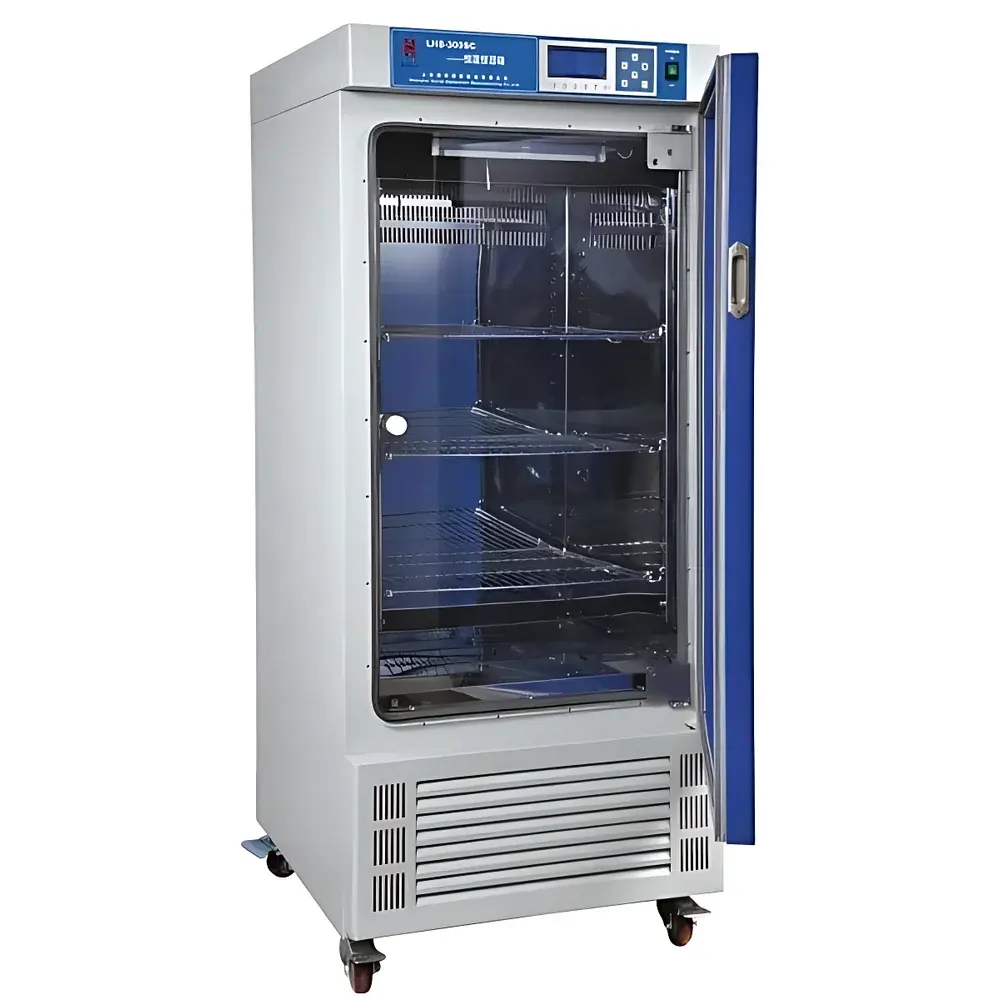
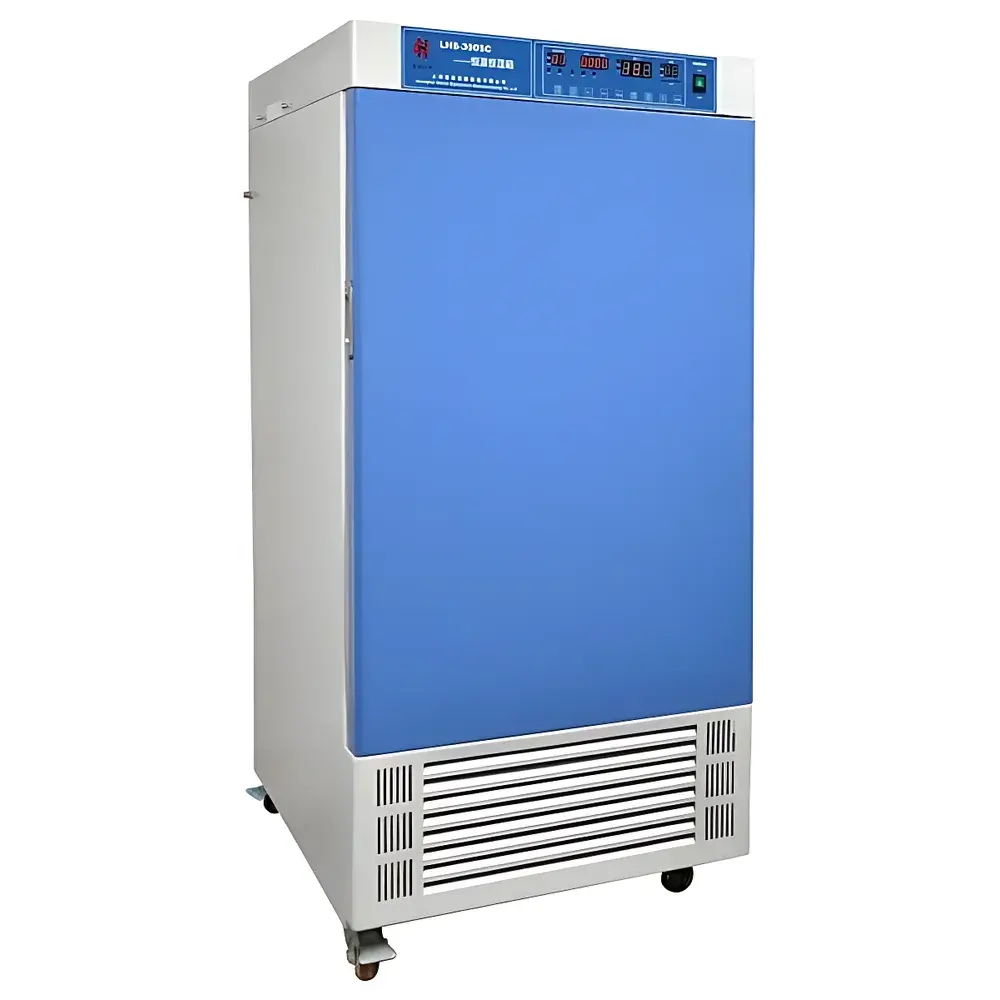
Chu Ding Technology LHS-250SC Temperature and Humidity Controlled Incubator (LCD Display, Eco-Friendly HFC Refrigerant)
| Brand | Chu Ding Technology |
|---|---|
| Origin | Shanghai, China |
| Model | LHS-250SC |
| Capacity | 250 L |
| Temperature Range | RT+10°C to 85°C (with humidity control: 15–45°C |
| without humidity | 10–45°C) |
| Humidity Range | 40–85% RH |
| Temperature Uniformity | ±1.0°C (±0.5°C at high temp, ±1.5°C at low temp) |
| Temperature Resolution | 0.1°C |
| Humidity Control Accuracy | ±3% RH (typical, @25°C/60% RH, empty chamber) |
| Power Supply | AC 220 V, 50 Hz |
| Input Power | 730 W |
| Internal Dimensions (W×D×H) | 580 × 500 × 850 mm |
| External Dimensions (W×D×H) | 705 × 725 × 1525 mm |
| Standard Shelves | 2 pcs |
| Programmable Cycles | 99 cycles × 30 segments × 99 h 59 min per segment |
| Control System | PID-based digital controller with LCD interface |
| Refrigerant | R134a / R406a (CFC-free, ozone-safe) |
| Construction | Mirror-finish stainless steel interior, double-glazed insulated door, adjustable shelf spacing |
| Air Circulation | JAKEL centrifugal fan with optimized duct design |
| Humidification System | Built-in water reservoir with immersed heating element |
| Optional Interfaces | RS485, USB |
| Compliance | Designed for GLP-compliant environmental simulation |
Overview
The Chu Ding Technology LHS-250SC is a precision-engineered temperature and humidity controlled incubator designed for reproducible environmental simulation in life science laboratories, pharmaceutical quality control, and materials stability testing. Operating on the principle of active dual-control thermodynamics—where independent refrigeration (via R134a/R406a vapor-compression cycle) and resistive steam humidification are coordinated through a high-stability PID algorithm—the system maintains tightly regulated thermal and hygrometric conditions across its 250 L working chamber. Its operational envelope spans ambient +10°C to 85°C for dry applications, and 15–45°C with concurrent humidity control from 40% to 85% RH—making it suitable for ICH-aligned long-term stability studies (e.g., 25°C/60% RH, 30°C/65% RH), accelerated aging protocols, and biocompatibility preconditioning per ISO 10993-12. The unit complies with fundamental safety and performance expectations outlined in EN 61000-6-3 (EMC) and IEC 61010-1 (safety of laboratory equipment), and its architecture supports audit-ready documentation when integrated with optional data logging interfaces.
Key Features
- Large backlit LCD display showing real-time temperature, humidity, setpoints, and program status—all visible in a single view with intuitive menu navigation.
- Eco-conscious refrigeration using zero-ozone-depletion-potential (ODP) hydrofluorocarbon (HFC) refrigerants R134a and R406a, delivering energy-efficient cooling with reduced global warming potential (GWP) relative to legacy R22 systems.
- Corrosion-resistant mirror-finish 304 stainless steel interior with seamless quarter-radius corners, facilitating ISO-compliant cleaning and minimizing microbial harborage points.
- Dual-pane tempered glass door with high-efficiency insulation, enabling visual monitoring without measurable thermal perturbation to chamber conditions.
- Optimized air distribution via JAKEL-brand centrifugal circulation fan and engineered airflow ducting—ensuring ≤±1.0°C temperature uniformity (measured per ASTM E145 Annex A4 at nine-point grid in empty chamber).
- Precision humidity control achieved through a sealed internal water reservoir and PTFE-coated immersion heater, paired with a calibrated capacitive humidity sensor (Vaisala HUMICAP®-compatible architecture).
- Advanced programmable logic supporting up to 99 multi-step cycles, each containing 30 segments with individual time (up to 99 h 59 min), temperature, and humidity targets—enabling full compliance with ICH Q1E stepwise stress testing.
- Robust mechanical design including an internationally sourced hermetic compressor, reinforced structural frame, and vibration-damped mounting to ensure longevity under continuous operation.
Sample Compatibility & Compliance
The LHS-250SC accommodates standard laboratory vessels—including Petri dishes, multiwell plates, glass vials, polymer packaging samples, and sterile bioreactor bags—within its adjustable shelf configuration (2 standard shelves, load capacity ≤15 kg per shelf). Its chamber geometry and airflow profile have been validated for uniform exposure of vertically stacked samples per USP environmental qualification guidance. While not certified as a Class II biosafety cabinet, the unit is routinely deployed in non-sterile stability chambers compliant with FDA 21 CFR Part 211 (cGMP) Annex 11 data integrity expectations when equipped with RS485/USB logging and time-stamped audit trails. It satisfies baseline environmental conditioning requirements referenced in ISO 14644-1 (cleanroom classification support), ASTM D4332 (conditioning of plastics), and GB/T 2423.3–2016 (Chinese national standard for damp heat testing).
Software & Data Management
As a standalone instrument, the LHS-250SC features embedded firmware with non-volatile memory for program retention during power loss. Optional connectivity modules enable integration into centralized lab infrastructure: the RS485 port supports Modbus RTU protocol for SCADA or LIMS integration, while the USB interface permits direct export of timestamped CSV logs (temperature/humidity vs. time) to external storage or PC-based analysis tools. When used with the optional dedicated software suite, users can configure alarm thresholds, generate calibration verification reports, and maintain electronic records meeting ALCOA+ principles (Attributable, Legible, Contemporaneous, Original, Accurate, Complete, Consistent, Enduring, Available). All data exports include operator ID, instrument serial number, and environmental metadata required for GLP audits.
Applications
- Pharmaceutical stability testing per ICH Q1A(R3), Q1B, and Q5C guidelines—including real-time, accelerated, and intermediate condition studies.
- Biological sample preconditioning for cell culture media validation, enzyme activity assays, and immunogenicity testing.
- Textile and polymer aging per ISO 2231 and ASTM D7566, assessing colorfastness, tensile strength degradation, and dimensional stability under cyclic humidity exposure.
- Food packaging permeability evaluation (e.g., moisture vapor transmission rate—MVTR) under controlled climatic profiles.
- Electronics component reliability screening (e.g., IPC-J-STD-006, JEDEC JESD22-A110) for moisture sensitivity level (MSL) classification.
- Seed germination and plant tissue culture under defined thermo-hygrometric regimes per OECD TG 208.
FAQ
What refrigerant does the LHS-250SC use, and why is it environmentally compliant?
The unit employs R134a and R406a—both chlorine-free HFC blends with zero ozone depletion potential (ODP = 0) and significantly lower ODP than legacy CFC/HCFC systems. Though GWP remains a consideration, these refrigerants meet current regulatory baselines for laboratory equipment in the EU (F-Gas Regulation No. 517/2014) and China (GB/T 7778-2017).
Can this incubator be validated for GxP environments?
Yes—when configured with optional RS485/USB data logging, independent over-temperature alarm, and user-accessible calibration menus, the LHS-250SC supports IQ/OQ protocols. Full PQ requires site-specific mapping per ISO 14644-3 and documented sensor traceability to NIST-traceable standards.
Is humidity control available across the full temperature range?
No. Humidity regulation is limited to 15–45°C. Below 15°C, condensation risk and sensor accuracy degrade; above 45°C, saturated vapor pressure exceeds the system’s humidification capacity. Dry operation (RT+10°C to 85°C) remains fully functional.
How is temperature uniformity verified in this model?
Uniformity is characterized per ASTM E145 Section 7.3.2 using nine calibrated PT100 probes placed on a 3×3 grid at mid-height. Typical results show ≤±1.0°C deviation under steady-state conditions (25°C/60% RH, no load, 20°C ambient).
Does the unit support remote monitoring or network integration?
Not natively—but the RS485 interface enables third-party integration with building management systems (BMS), LabVantage, or custom Python/Node-RED scripts using open Modbus register maps provided in the technical manual.



