
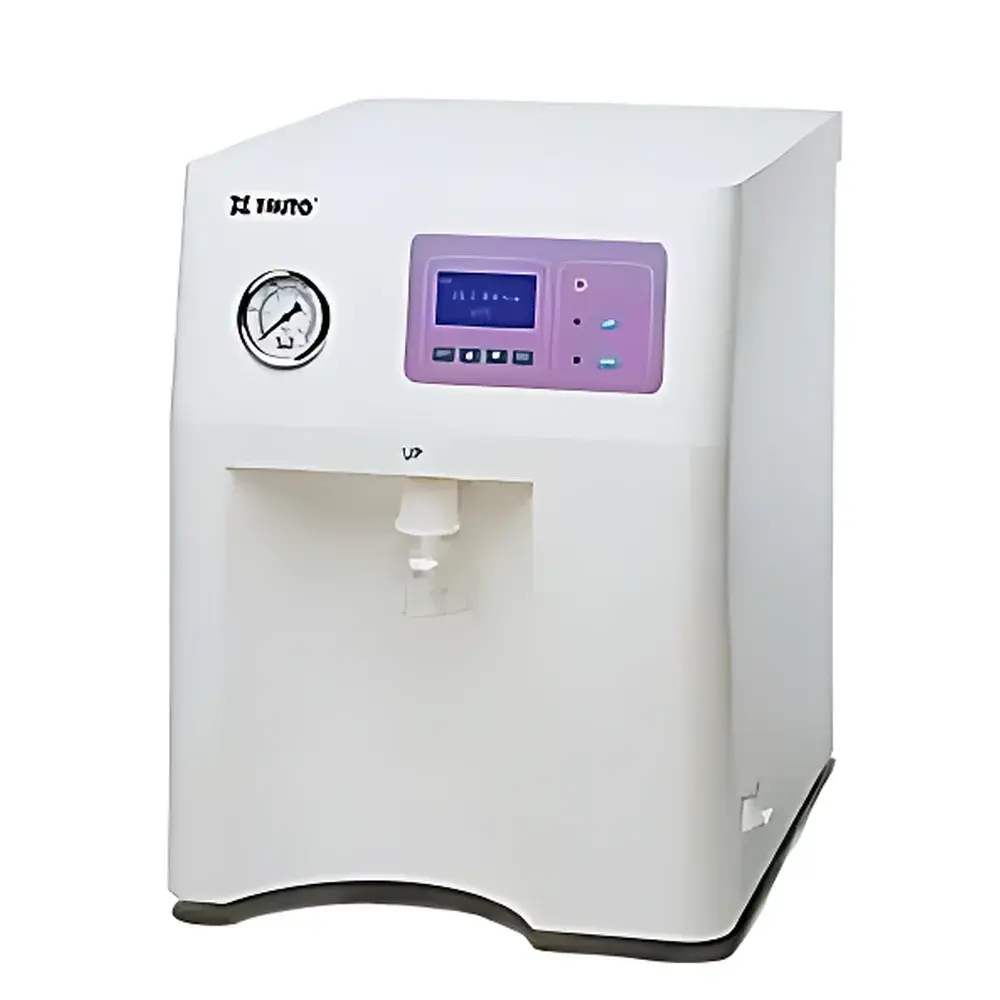
Chu Ding Technology UP-T Ultra-Low TOC Ultra-Pure Water System
| Brand | Chu Ding Technology |
|---|---|
| Origin | Shanghai, China |
| Model | UP-T |
| Type | Ultra-Low Total Organic Carbon (TOC) Ultra-Pure Water System |
| Feed Water | RO water, distilled water, deionized water, or bottled purified water |
| Production Flow Rate (25°C) | 28 L/h or 48 L/h |
| Resistivity | ≥18.2 MΩ·cm at 25°C |
| TOC | <5 ppb |
| Microbial Count | <1 CFU/mL |
| Particles (>0.22 µm) | <1 particle/mL |
| Endotoxin | <0.001 EU/mL |
| Heavy Metals (Cu, Zn, Ni) | <0.1–0.2 ppb |
| Total Silicon | <1 ppb |
| UV Wavelengths | Dual-band (185 nm + 254 nm) |
| Dimensions (L×W×H) | 400 × 460 × 500 mm |
| Operating Temperature | 0–45°C |
| Relative Humidity | ≤85% RH (non-condensing, corrosion-free environment) |
| Compliance | Meets and exceeds GB/T 11446.1-2013 (Chinese Electronic Grade I Ultrapure Water Standard), compatible with ASTM D1193-20, ISO 3696:1987, and USP <1231> Purified Water specifications |
Overview
The Chu Ding Technology UP-T Ultra-Low TOC Ultra-Pure Water System is an engineered laboratory-grade purification platform designed for the continuous on-demand production of ultrapure water meeting stringent analytical and life science application requirements. Based on a multi-stage purification architecture—including dual-wavelength UV photooxidation (185 nm + 254 nm), advanced mixed-bed ion exchange, and ultra-low adsorption final polishing—this system achieves reproducible TOC levels below 5 ppb, resistivity ≥18.2 MΩ·cm at 25°C, and microbial contamination <1 CFU/mL. Its core design principle centers on minimizing organic leaching and photolytic recombination through optimized flow-path geometry, low-extractable materials (e.g., EPDM-free fluidic pathways), and real-time electrochemical monitoring of conductivity and TOC-related oxidation potential. The UP-T is intended for integration into centralized or point-of-use laboratory water networks where feed sources include reverse osmosis (RO) permeate, distilled water, or commercially supplied purified water.
Key Features
- Dual-wavelength UV oxidation module (185 nm for TOC photolysis + 254 nm for microbial inactivation) ensures sustained suppression of organic carbon and bioburden
- Real-time online resistivity and temperature-compensated conductivity monitoring with configurable alarm thresholds
- Intelligent microprocessor control enabling fully automated operation: auto-start/stop, scheduled recirculation, timed UV lamp cycling, and fault diagnostics
- Modular cartridge architecture with RFID-tagged consumables for traceable replacement history and predictive maintenance alerts
- Feed water quality sensor with programmable alerting for elevated conductivity, hardness, or chlorine residuals to prevent premature column fouling
- Recirculating loop with integrated 0.22 µm hydrophilic PES membrane filter and periodic ozone or UV-based sanitization cycles
- Touch-responsive LCD interface supporting multilingual configuration, data logging, and user-defined parameter calibration
Sample Compatibility & Compliance
The UP-T system delivers water compliant with multiple international standards governing ultrapure water for critical applications. Its output satisfies GB/T 11446.1-2013 (Electronic Grade I), ASTM D1193-20 (Type I), ISO 3696:1987 (Grade 1), and USP Purified Water specifications. While not certified to FDA 21 CFR Part 11 out-of-the-box, its embedded audit trail functionality—including timestamped event logs, operator ID tagging, and non-erasable system memory—supports GLP and GMP-aligned validation protocols. The system’s low-metal and low-silicon performance (<0.1–0.2 ppb heavy metals; <1 ppb total silicon) makes it suitable for trace elemental analysis by ICP-MS and GF-AAS. All wetted materials comply with USP Class VI biological safety testing and are free of plasticizers, lubricants, or adhesives known to contribute to TOC or particulate release.
Software & Data Management
The UP-T integrates a local embedded controller with RS232 and optional Ethernet connectivity for remote status monitoring and firmware updates. Logged parameters—including resistivity, TOC surrogate signal (via UV absorbance decay kinetics), UV lamp operating hours, flow rate, and cartridge service intervals—are stored in non-volatile memory for ≥12 months. Exportable CSV reports support IQ/OQ/PQ documentation workflows. Optional PC-based software enables trend analysis of water quality metrics, predictive consumables lifecycle modeling, and export to LIMS-compatible formats (ASTM E1384, HL7). All system events—including alarms, manual overrides, and maintenance actions—are time-stamped and cryptographically signed to meet ALCOA+ data integrity principles.
Applications
This system serves as a primary water source for high-sensitivity analytical instrumentation requiring minimal background interference, including HPLC, UHPLC, LC-MS, GC-MS, and TOC analyzers. Its ultra-low TOC and endotoxin content (<0.001 EU/mL) supports cell culture media preparation, monoclonal antibody purification, and CRISPR-Cas9 transfection workflows. In semiconductor R&D and precision optics manufacturing, the sub-particulate (0.22 µm) and low-silicon effluent enables defect-free rinsing of photomasks, MEMS devices, and optical coatings. It is also deployed in environmental labs performing ultra-trace pesticide residue analysis and isotopic ratio mass spectrometry where reagent blank contributions must be minimized.
FAQ
What feed water quality is required for optimal UP-T performance?
RO permeate with conductivity <5 µS/cm and free chlorine <0.05 ppm is recommended; distilled or deionized water may be used but requires verification of low TOC and silica content.
Does the UP-T support regulatory compliance for pharmaceutical QC laboratories?
Yes—its data logging, alarm history, and modular validation-ready design align with Annex 11 and USP expectations; full 21 CFR Part 11 compliance requires optional secure authentication and electronic signature modules.
How frequently must consumables be replaced under typical usage?
At 28 L/h throughput and average feed water quality, the UP-T’s polishing cartridge lasts approximately 6–9 months; UV lamps are rated for 9,000 hours and display remaining life on the interface.
Can the UP-T be integrated into an existing central water distribution system?
Yes—its pressure-regulated inlet and recirculation-ready outlet allow seamless connection to stainless steel or PVDF distribution loops with validated loop circulation rates ≥1.5 m/s.
Is remote monitoring supported without third-party middleware?
Basic status telemetry (resistivity, flow, alarms) is available via Modbus RTU over RS232; full SCADA integration requires optional Ethernet gateway firmware and OPC UA configuration.



