
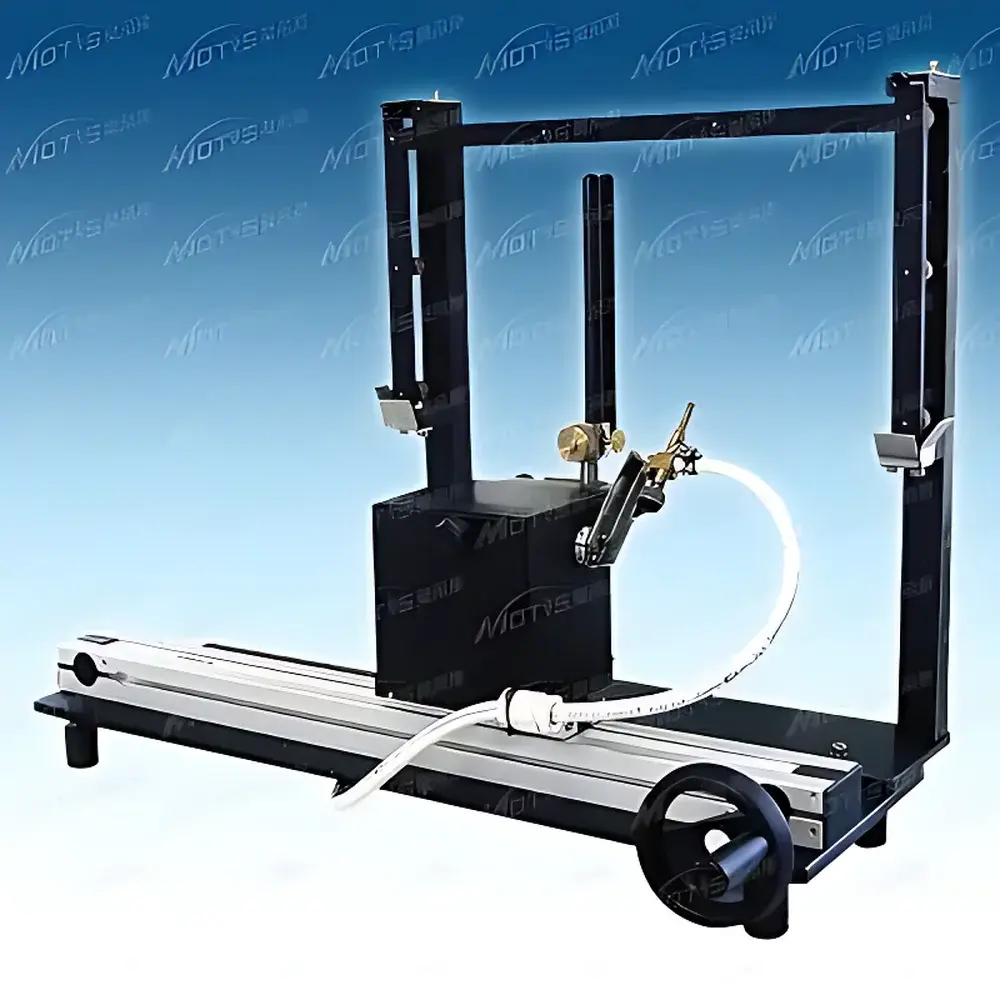
Flame Spread Tester Polynorme 503 by MOTIS
| Brand | MOTIS |
|---|---|
| Origin | Shanghai, China |
| Model | Polynorme 503 |
| Applicable Standard | NF P 92-504 |
| Test Principle | Vertical flame impingement using calibrated gas burner |
| Sample Holder | Dual U-shaped fixtures for rigid and flexible materials |
| Compliance | French building material fire reaction classification (M0–M4), rail industry non-metallic component qualification |
Overview
The MOTIS Polynorme 503 Flame Spread Tester is a precision-engineered combustion test apparatus designed to evaluate the surface flame spread behavior of construction and transportation materials under controlled vertical flame impingement. It operates in strict accordance with the French national standard NF P 92-504, which defines the methodology for assessing fire reaction characteristics—including ignition time, flame propagation extent, and self-extinguishment behavior—of flat, solid materials used in building façades, interior linings, and railway vehicle interiors. The instrument utilizes a calibrated Bunsen-type gas burner delivering a defined thermal flux (typically 30 kW/m² at the sample surface) to initiate localized flame exposure. The test configuration ensures reproducible flame geometry, stable burner positioning, and precise timing of ignition onset relative to flame front advancement. This enables quantitative assessment of flame travel distance over time, supporting classification into the M0 (non-combustible) through M4 (highly flammable) categories per French regulatory frameworks.
Key Features
- Compliance-certified design validated against NF P 92-504 Annex A and B requirements for both rigid and semi-rigid substrates
- Dual-purpose U-shaped sample holder assembly accommodating specimens up to 250 mm × 90 mm (L × W), with independent clamping mechanisms optimized for low-density foams, laminates, composites, and rigid panels
- Integrated gas flow control system with digital mass flow meters for propane or butane, ensuring ±1.5% volumetric repeatability across operational ranges
- Automated burner positioning stage with micrometer-adjustable vertical alignment (±0.1 mm resolution) to maintain consistent flame standoff distance (20 mm nominal)
- Thermocouple array (Type K, Class 1) embedded in the specimen support frame for real-time backside temperature monitoring during test execution
- Fire-resistant observation window with integrated LED illumination and high-speed camera mounting interface (1080p @ 250 fps recommended) for flame front tracking and post-test analysis
Sample Compatibility & Compliance
The Polynorme 503 supports testing of homogeneous and layered non-metallic materials commonly employed in architectural cladding, ceiling systems, insulation boards, and railcar interior components (e.g., seat covers, wall panels, flooring underlays). Specimens must be conditioned per ISO 291 (23 °C ± 2 °C, 50 % RH ± 5 %) prior to testing. The system meets mechanical and procedural requirements outlined in NF P 92-504 Sections 4–6, including burner calibration verification, airflow management in the test chamber (≤0.5 m/s ambient draft), and dimensional tolerances for specimen mounting. While not directly aligned with ASTM E84 or EN 13823, comparative correlation studies have been published by independent laboratories for cross-regulatory interpretation where permitted under national derogation clauses.
Software & Data Management
The instrument operates via a dedicated Windows-based control interface (v3.2+) that logs timestamped events—including ignition trigger, first visible flame, maximum flame height, extinction time, and char length—with millisecond resolution. All raw data streams (gas flow, thermocouple readings, operator annotations) are stored in encrypted .CSV and SQLite formats compliant with GLP audit trail requirements. Export functionality supports PDF report generation with embedded metadata (test ID, operator, calibration certificate numbers, environmental conditions), satisfying documentation needs for certification bodies such as CSTB, SNCF Réseau, or AFNOR-accredited third-party labs. Optional integration with LIMS platforms is available via OPC UA protocol.
Applications
- Qualification of façade insulation systems for French public buildings (ERP regulations)
- Fire safety validation of composite sandwich panels used in TGV and regional train carriages
- R&D screening of intumescent coatings, flame-retardant additives, and polymer blends targeting M0/M1 classification
- Technical due diligence for CE marking dossiers involving harmonized standards referenced in EU Construction Products Regulation (CPR) Annex ZA
- Comparative benchmarking against legacy materials during formulation optimization cycles
FAQ
What is the required specimen thickness range for NF P 92-504 testing?
Standard specimens shall be 3 mm ± 0.2 mm thick unless otherwise specified in product-specific annexes; deviations require justification in test reports.
Does the Polynorme 503 include automatic flame detection?
No—flame progression is assessed visually by trained operators per NF P 92-504 Section 5.2; however, optional high-speed video analysis modules enable objective flame front tracking.
Is calibration traceable to national metrology institutes?
Yes—gas flow meters are certified to ISO/IEC 17025 by CNAS-accredited laboratories; annual recalibration certificates include uncertainty budgets per GUM guidelines.
Can this system be used for testing textiles or carpets?
Not without modification—the U-holder geometry and support rigidity are optimized for planar rigid/semi-rigid substrates; textile testing requires supplemental framing per NF P 92-507 Annex C.
What maintenance intervals are recommended for the burner assembly?
Burner nozzle inspection and cleaning every 50 test cycles; full gas train leak testing and thermocouple verification prior to each daily test session.
Related Products



