
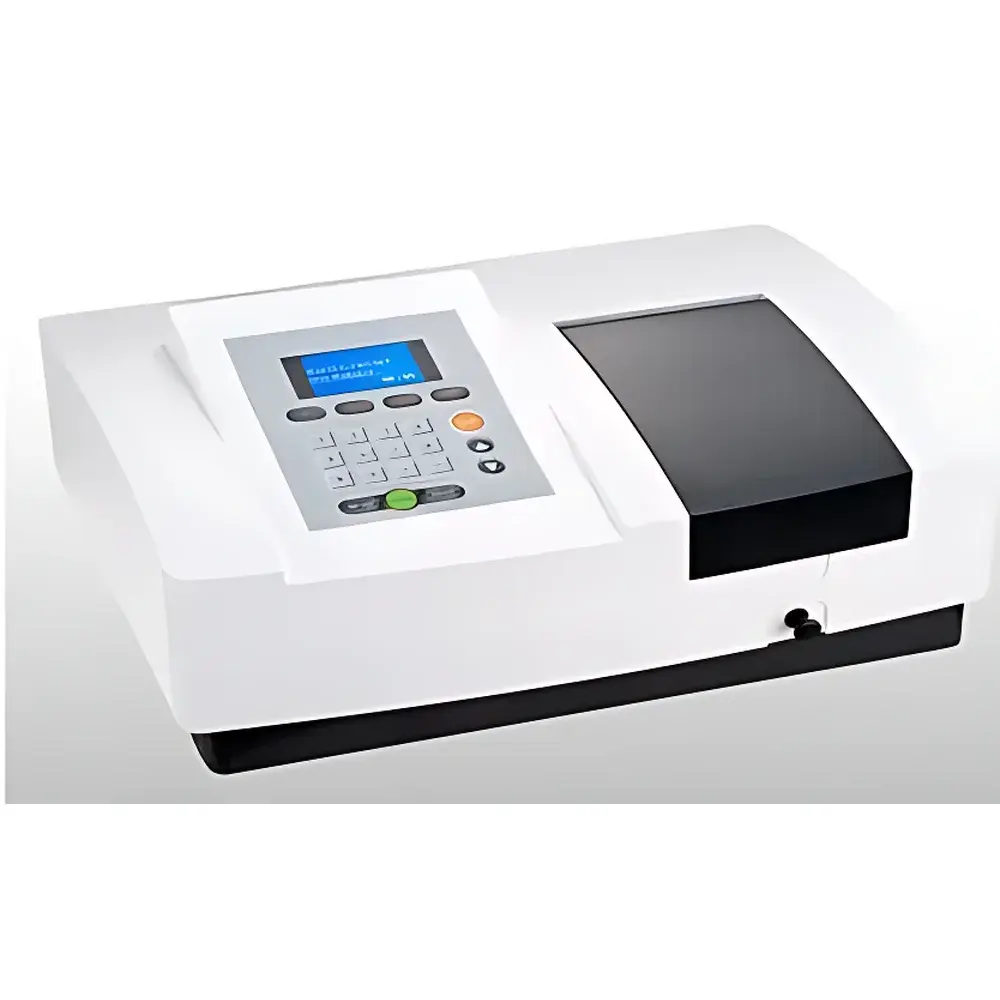
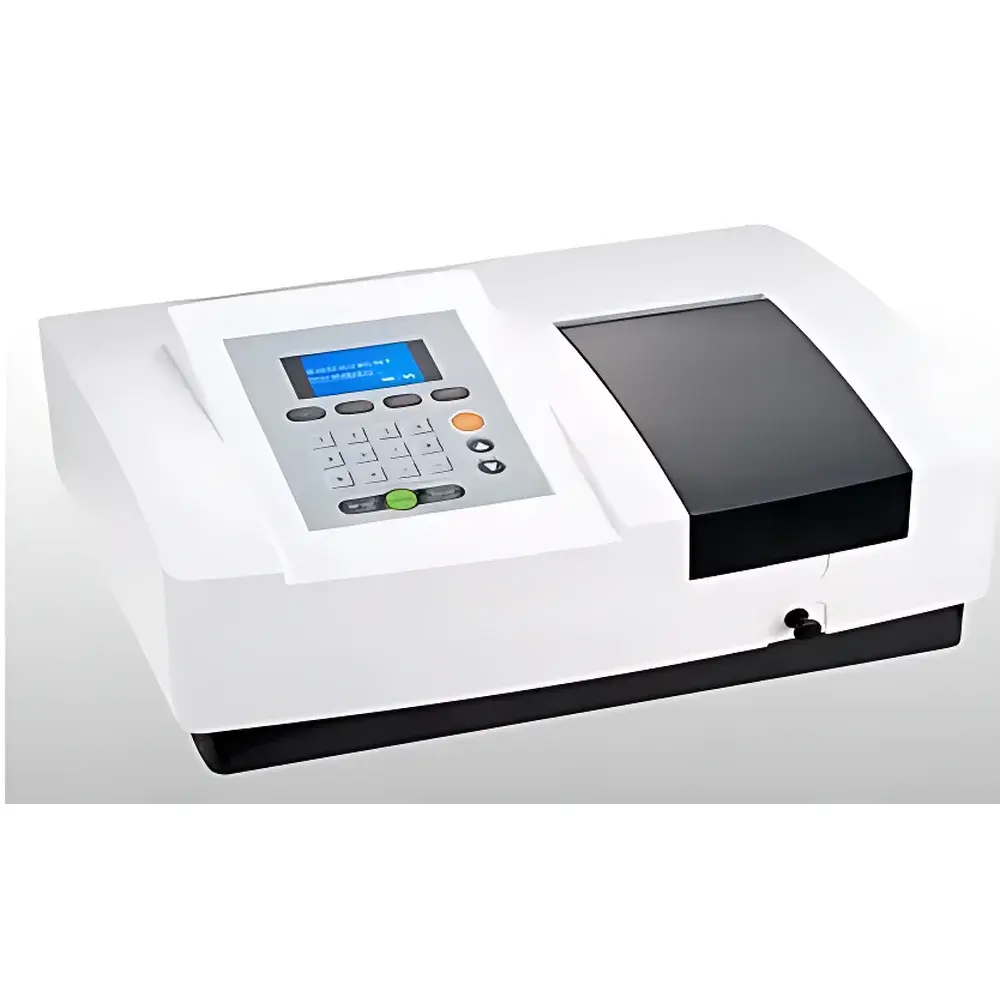
Chu Ding Technology UV754N Ultraviolet-Visible Spectrophotometer
| Brand | Chu Ding Technology |
|---|---|
| Origin | Shanghai, China |
| Model | UV754N |
| Optical Design | Single-beam |
| Detector Type | Photomultiplier Tube (PMT) |
| Wavelength Range | 190–1100 nm |
| Wavelength Accuracy | ±2 nm |
| Wavelength Repeatability | 0.5 nm |
| Spectral Bandwidth | 4 nm |
| Stray Light | ≤0.3% T at 220 nm and 360 nm |
| Photometric Accuracy | ±0.5% T |
| Photometric Repeatability | ±0.2% T |
| Absorbance Range | –0.030 to 3.0 A |
| Transmittance Range | 0.0–200% T |
| Baseline Stability | ±0.002 A/h |
| Display | 128 × 64 dot-matrix LCD |
| Interface | RS-232C serial port |
| Data Output | Integrated thermal printer interface |
| Software Support | UV754PC quantitative analysis software suite |
Overview
The Chu Ding Technology UV754N Ultraviolet-Visible Spectrophotometer is a precision single-beam optical instrument engineered for routine qualitative and quantitative analysis in research, quality control, and teaching laboratories. It operates on the fundamental principle of Beer–Lambert law-based absorption spectroscopy, measuring the intensity of light transmitted through or reflected from a sample as a function of wavelength across the ultraviolet (190 nm) to near-infrared (1100 nm) spectral region. Designed with a photomultiplier tube (PMT) detector for high signal-to-noise ratio and dynamic range, the UV754N delivers reliable photometric performance under standard laboratory conditions. Its robust mechanical architecture, calibrated optical path, and thermally stabilized monochromator support consistent spectral acquisition without requiring frequent recalibration. While not a scanning spectrophotometer with motorized wavelength drive, its manually adjustable wavelength selector—coupled with digital readout and microprocessor-controlled data handling—enables reproducible endpoint measurements for absorbance, transmittance, concentration, and kinetic profiling.
Key Features
- Single-beam optical configuration optimized for cost-effective, high-reproducibility absorbance measurements in regulated and academic environments.
- Photomultiplier tube (PMT) detector ensuring superior sensitivity and low-noise detection across the full 190–1100 nm range.
- Fixed 4 nm spectral bandwidth, balancing resolution and throughput for general-purpose UV-Vis applications including pharmaceutical assay and environmental monitoring.
- Digital 128 × 64 dot-matrix LCD display with real-time parameter readout—including wavelength, absorbance, transmittance, and concentration—enabling intuitive operation without external computing hardware.
- Integrated quantitative analysis module supporting up to 10 user-defined calibration curves; compatible with standard cuvette formats (10 mm pathlength).
- RS-232C serial interface compliant with ANSI/TIA/EIA-232-F standards, enabling bidirectional communication with PCs running Windows-based UV754PC analysis software for data export, report generation, and method archiving.
- Thermal drift compensation circuitry ensures baseline stability of ±0.002 A/h, meeting minimum requirements for extended kinetic or multi-sample batch measurements.
Sample Compatibility & Compliance
The UV754N accommodates standard quartz, glass, or plastic cuvettes (10 mm optical path) and supports liquid, solution-phase samples across diverse matrices—including aqueous buffers, organic solvents, and diluted biological extracts. Its optical design complies with core performance benchmarks referenced in ISO 9001-certified manufacturing and aligns with functional expectations outlined in ASTM E275 (Standard Practices for Describing and Measuring Performance of UV-Vis Spectrophotometers). While not validated for 21 CFR Part 11 compliance out-of-the-box, the instrument’s audit-trail-capable UV754PC software—when deployed on validated Windows workstations—supports GLP/GMP-aligned workflows when combined with documented SOPs, user access controls, and electronic signature protocols. The system meets essential photometric accuracy criteria specified in USP for UV-Vis spectrophotometric assays used in pharmaceutical QC.
Software & Data Management
The UV754N is fully supported by the UV754PC desktop application, a Windows-compatible software package designed for method development, data visualization, and regulatory documentation. Key capabilities include: automatic calibration curve fitting (linear, polynomial, and log-log models), time-scan kinetics with configurable interval logging, multi-wavelength quantitation, and DNA/protein concentration calculation using built-in extinction coefficients (e.g., 550 L·mol⁻¹·cm⁻¹ for dsDNA at 260 nm). All measurement sessions generate timestamped .CSV files with metadata (wavelength, absorbance, date/time, operator ID if entered), facilitating traceability. Raw spectral data can be exported for secondary processing in MATLAB, Origin, or Python-based analytical pipelines. The RS-232 interface supports command-line control via ASCII protocol, allowing integration into automated lab systems using LabVIEW or custom Python scripts.
Applications
This spectrophotometer serves as a foundational analytical tool in multiple sectors. In pharmaceutical quality control, it performs assay validation per USP monographs for active ingredient quantification (e.g., paracetamol at 243 nm, aspirin at 277 nm). Environmental labs apply it to COD determination, nitrate/nitrite analysis via colorimetric reactions, and heavy metal speciation using complexometric reagents. Food and beverage laboratories use it for pigment quantification (e.g., anthocyanins, chlorophyll), preservative verification (sorbic acid at 264 nm), and enzymatic activity assays (NADH/NADPH at 340 nm). Academic institutions deploy the UV754N for undergraduate spectroscopy labs, enzyme kinetics experiments (Michaelis–Menten plots), and polymer degradation studies via carbonyl index tracking at 1710 cm⁻¹ (via FTIR correlation, though not measured directly here). Its broad wavelength coverage also enables validation of filter performance and lamp output profiles.
FAQ
Is the UV754N suitable for GMP-regulated environments?
Yes—when operated with documented procedures, trained personnel, and UV754PC software deployed on a validated computer system with appropriate access controls and audit trail activation, it fulfills core instrumental requirements for routine QC testing.
Can it measure absorbance below 190 nm?
No—the lower limit is fixed at 190 nm due to atmospheric oxygen absorption and quartz cuvette cutoff; vacuum UV extension requires purged or deuterium-lamp-equipped instrumentation.
What cuvette materials are recommended?
Quartz cuvettes are mandatory for measurements below 350 nm; optical glass or PMMA cuvettes may be used above 350 nm for non-critical applications.
Does it support kinetic scanning over time?
Yes—the UV754PC software enables time-based absorbance monitoring at fixed wavelengths, with sampling intervals configurable from 0.1 s to 600 s.
How is wavelength accuracy verified?
Using NIST-traceable holmium oxide or didymium oxide filters, which provide sharp reference peaks at certified wavelengths (e.g., 241.5 nm, 279.4 nm, 360.9 nm); verification should be performed quarterly or after transport.



