
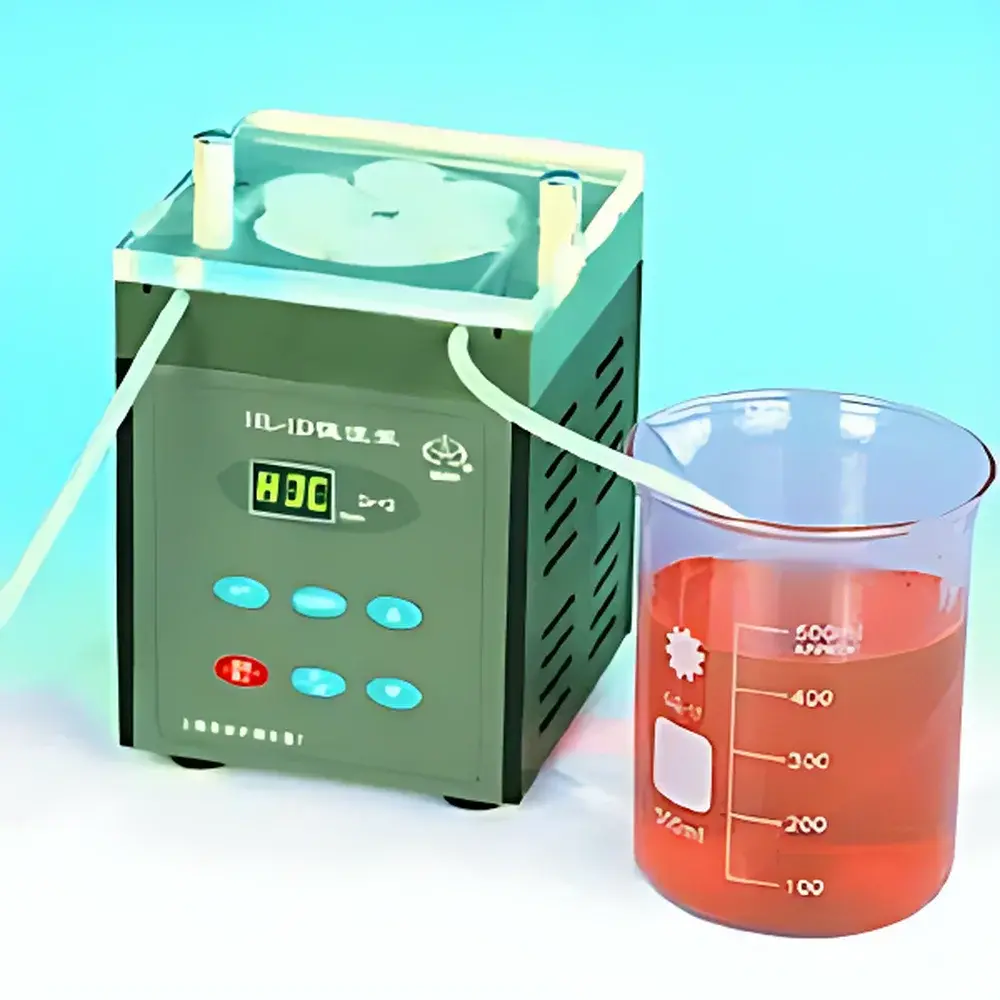
Chuding HL-1 Single-Channel Peristaltic Pump
| Brand | Chuding |
|---|---|
| Origin | Shanghai, China |
| Model | HL-1 |
| Dimensions (W×D×H) | 120×120×180 mm |
| Flow Rate | 1–600 mL/h |
| Maximum Back Pressure | ≥3 kg/cm² |
| Drive Type | Mechanical stepless speed control (non-electronic variable speed) |
| Channel Configuration | Single-channel |
| Pump Head Material | Standard elastomeric tubing housing (HL-1) |
| Power Supply | AC 220 V, 50 Hz |
| Weight | Approx. 2.8 kg |
Overview
The Chuding HL-1 is a compact, single-channel peristaltic pump engineered for precise, pulse-free fluid delivery in laboratory-scale applications requiring consistent volumetric flow control. Operating on the principle of occlusion-based peristalsis—where rollers compress flexible tubing against a rigid track to generate positive displacement—the HL-1 delivers reproducible flow rates without contact between the pump mechanism and the fluid path. This design ensures complete fluid isolation, eliminating risk of contamination or cross-sample carryover, making it suitable for sensitive biological, pharmaceutical, and analytical workflows. Designed for benchtop use in academic labs, clinical diagnostics support, environmental monitoring stations, and quality control settings, the HL-1 provides reliable low-to-moderate flow performance (1–600 mL/h) under back pressures up to ≥3 kg/cm² (≈294 kPa), accommodating standard laboratory tubing sizes (e.g., Tygon® L/S 14, PharMed® BPT 0.76 mm ID). Its mechanical stepless speed control enables continuous adjustment without digital electronics, enhancing operational robustness in environments where electromagnetic interference or regulatory-grade data integrity are not primary concerns.
Key Features
- Single-channel architecture with front-access tubing loading for rapid tube replacement and maintenance
- Mechanical stepless speed regulation—no microprocessor or firmware dependencies; ideal for stable long-term operation
- Robust aluminum alloy chassis and precision-machined roller assembly for extended service life and minimal pulsation
- Standard configuration supports common silicone or thermoplastic elastomer tubing (ID 0.5–3.2 mm)
- Optional HL-1S variant features a fully PTFE pump head compatible with aggressive organic solvents (e.g., acetone, chloroform, THF) and strong acids/bases
- Benchtop footprint (120 × 120 × 180 mm) optimized for space-constrained fume hoods or modular lab setups
- No internal valves, seals, or lubricants in the fluid path—compliant with USP Class VI and ISO 10993 biocompatibility expectations for non-invasive fluid handling
Sample Compatibility & Compliance
The HL-1 is compatible with a wide range of chemically inert, food-grade, and pharma-compliant tubing materials—including silicone, Viton®, C-Flex®, and PharMed® BPT—enabling safe transfer of aqueous buffers, cell culture media, reagent solutions, and mild organic solvents. When equipped with the HL-1S PTFE head, compatibility extends to halogenated hydrocarbons, esters, and concentrated mineral acids. While the HL-1 does not include built-in audit trail or electronic calibration logging, its mechanical drive system meets general-purpose requirements under ISO/IEC 17025 for equipment used in supporting testing activities. It is routinely deployed in workflows aligned with CLSI GP26-A3 (clinical laboratory pump validation), ASTM D3417 (polymer solution pumping), and EPA Method 3510C (liquid-phase extraction support). No electrical certification for hazardous locations (e.g., ATEX, IECEx) is provided.
Software & Data Management
The HL-1 operates as a standalone analog device with no embedded software, firmware, or digital interface. Flow rate is controlled manually via calibrated dial adjustment; no USB, RS-232, or Ethernet connectivity is included. As such, it does not support FDA 21 CFR Part 11-compliant electronic records, remote monitoring, or automated protocol integration. This architecture intentionally prioritizes simplicity, reliability, and ease of qualification in GxP-adjacent environments where documentation of manual operation (e.g., logbook entries, SOP-defined speed settings) suffices for traceability. Users requiring digital control may integrate the HL-1 into external PLC or DAQ systems using optional 0–5 V analog speed input (available on HL-1B/HL-1D variants—not standard on base HL-1).
Applications
- Continuous infusion in small-animal pharmacokinetic studies (IV/SC dosing support)
- Mobile phase delivery in preparative HPLC fraction collection systems
- Reagent dosing in automated wet chemistry analyzers (e.g., COD, TN, TP determination)
- Cell perfusion in bioreactor seed train or hollow-fiber culture platforms
- Calibration standard delivery in ion chromatography and atomic absorption spectroscopy sample introduction
- Effluent sampling in wastewater treatment pilot plants and leaching column experiments
- Low-pressure solvent recycling loops in teaching laboratories (e.g., organic synthesis workups)
FAQ
Is the HL-1 suitable for sterile or aseptic applications?
Yes—when paired with gamma-irradiated, sterile-packaged tubing and operated within a laminar flow hood, the HL-1 maintains fluid path sterility. Tubing replacement is tool-free and validated in ISO 13408-1 cleanroom-compatible procedures.
What tubing sizes are recommended for optimal flow accuracy at 600 mL/h?
For maximum flow, use 3.2 mm ID silicone or C-Flex® tubing with wall thickness ≥1.6 mm. Accuracy degrades above 400 mL/h with sub-1.6 mm ID tubing due to elastic fatigue and slip.
Can the HL-1 be mounted vertically or inverted?
No—operation outside horizontal orientation risks premature roller bearing wear and inconsistent occlusion pressure. Mounting must comply with gravity-assisted fluid intake (inlet positioned lower than pump head).
Does the HL-1 require periodic calibration?
While not electronically calibrated, users should verify flow rate quarterly using gravimetric measurement (ASTM D1298) against certified reference weights and timed collection. Deviation >±3% warrants tubing replacement or roller alignment check.
Is tubing lifespan documented under continuous operation?
At 30 rpm and 25°C ambient, standard silicone tubing lasts ~200 hours before flow drift exceeds ±5%. PTFE-lined tubing (HL-1S) extends service life to ~450 hours under identical conditions.



