
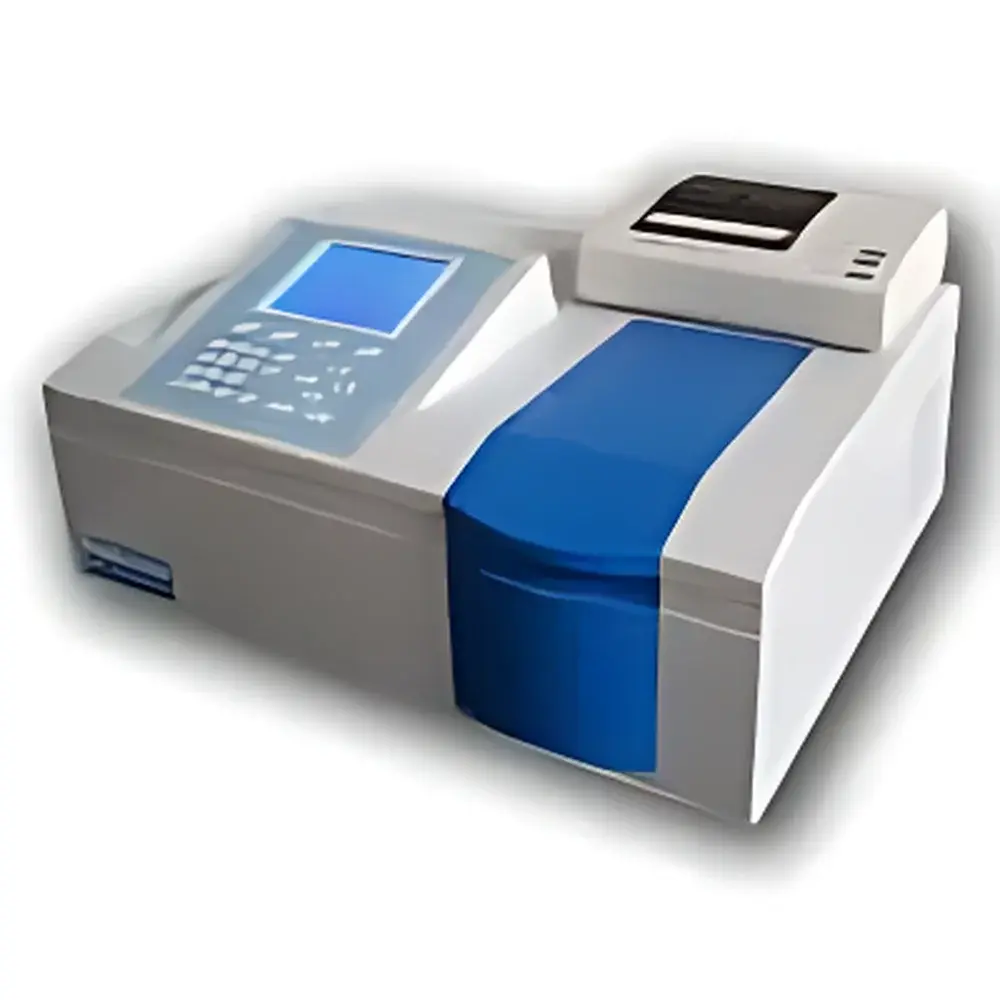
ChuDing UV1900 Dual-Beam Ultraviolet-Visible Spectrophotometer
| Brand | ChuDing |
|---|---|
| Origin | Shanghai, China |
| Model | UV1900 |
| Wavelength Range | 190–1100 nm |
| Wavelength Accuracy | ±0.3 nm |
| Wavelength Repeatability | 0.2 nm |
| Spectral Bandwidth | 2 nm |
| Stray Light | ≤0.05% T (at 220 nm, NaI solution) |
| Photometric Range | –3 to +3 A |
| Photometric Accuracy | ±0.3% T (0–100% T) |
| Photometric Repeatability | 0.001 Abs (0–0.5 Abs) |
| Baseline Flatness | ≤±0.0005 A |
| Noise | ≤0.0003 Abs/h |
| Drift | ≤±0.0004 Abs/h |
| Display | 5.1-inch 320×240 dot-matrix LCD |
| Power Supply | AC 220 V/50 Hz or AC 110 V/60 Hz |
Overview
The ChuDing UV1900 Dual-Beam Ultraviolet-Visible Spectrophotometer is engineered for precision quantitative and qualitative analysis across research laboratories, quality control environments, and educational institutions. Utilizing a dual-beam optical architecture with real-time reference beam compensation, the instrument minimizes errors induced by source instability, detector drift, and environmental fluctuations—ensuring high reproducibility in absorbance and transmittance measurements from 190 nm to 1100 nm. Its optimized Czerny–Turner monochromator incorporates a high-efficiency holographic blazed grating and precision-aligned optical path, delivering low stray light (≤0.05% T at 220 nm using NaI solution) and excellent photometric linearity. The system operates on fundamental Beer–Lambert law principles, enabling accurate concentration determination, spectral characterization, and kinetic monitoring under controlled experimental conditions.
Key Features
- Dual-beam optical design with simultaneous sample and reference beam detection, enabling real-time baseline correction and enhanced long-term stability.
- High-performance holographic blazed grating with 2 nm spectral bandwidth ensures optimal resolution and signal-to-noise ratio across the full UV-Vis range.
- Advanced photometric performance: photometric accuracy of ±0.3% T (0–100% T), repeatability of 0.001 Abs (0–0.5 Abs), and baseline flatness ≤±0.0005 A over the entire wavelength scan range.
- Modular sample compartment with tool-free, removable configuration supports rapid adaptation to accessories including variable-pathlength cuvette holders, Peltier temperature-controlled cells, fiber-optic probes, and solid-sample reflectance modules.
- Open-source lamp housing design facilitates straightforward replacement of deuterium and tungsten-halogen lamps without optical realignment.
- Integrated 5.1-inch 320×240 dot-matrix LCD display with intuitive on-board navigation enables standalone operation without external PC dependency.
Sample Compatibility & Compliance
The UV1900 accommodates standard 10 mm square quartz, glass, or plastic cuvettes (path lengths from 1 mm to 100 mm with optional holders), as well as microvolume, flow-cell, and integrating sphere configurations. It complies with core international performance standards including ISO 9001-certified manufacturing processes and aligns with measurement traceability requirements defined in ASTM E275, ISO 6223, and USP . While not pre-certified for 21 CFR Part 11, its data export functionality (CSV, TXT, XML) and audit-ready parameter logging support integration into GLP/GMP-compliant workflows when deployed with validated third-party LIMS or ELN systems. All critical optical and electronic components—including detectors, gratings, and power regulation circuits—are sourced from internationally recognized suppliers to ensure consistent metrological integrity.
Software & Data Management
The UV1900 is operated via Windows-based proprietary software supporting bilingual (English/Chinese) interface, offering full instrument control and advanced data processing. Capabilities include multi-wavelength photometric reading (1–6 wavelengths simultaneously), full-spectrum scanning (absorbance, transmittance, energy), derivative spectroscopy (1st–3rd order), peak/valley detection, spectral subtraction, and multi-point calibration curve generation (1–9 standards; linear, quadratic, cubic, or quartic regression). Raw spectral data and method parameters are saved in vendor-neutral formats (e.g., .csv, .txt) compatible with MATLAB, OriginLab, and Python-based analytical pipelines. Software logs timestamped measurement metadata—including lamp hours, wavelength calibration history, and user ID—facilitating internal QA documentation and retrospective method verification.
Applications
This spectrophotometer serves routine and specialized applications across pharmaceutical development (excipient compatibility, dissolution testing, assay validation), environmental analysis (nitrate, phosphate, COD determination), food safety (colorant quantification, antioxidant capacity assays), biochemical research (protein quantification via Bradford/Lowry, nucleic acid purity assessment at 260/280 nm), and materials science (thin-film transmittance, nanoparticle plasmon resonance characterization). Its kinetic scanning mode supports enzyme activity assays, reaction rate profiling, and stability-indicating methods under isothermal or programmed thermal conditions when paired with accessory temperature controllers.
FAQ
What is the minimum detectable absorbance change supported by the UV1900?
The instrument achieves a noise level of ≤0.0003 Abs/h, enabling reliable detection of absorbance changes ≥0.001 Abs under stabilized conditions.
Can the UV1900 perform DNA/RNA purity assessments?
Yes—its spectral accuracy and 190–1100 nm range allow precise measurement of A260/A280 and A260/A230 ratios for nucleic acid purity evaluation per standard protocols.
Is wavelength calibration traceable to NIST standards?
While factory calibration uses certified holmium oxide and didymium filters, end-users may perform optional recalibration using NIST-traceable reference materials (e.g., SRM 2034, SRM 930e) following ISO/IEC 17025 guidelines.
Does the system support automated data export to laboratory information management systems (LIMS)?
Direct LIMS integration requires middleware configuration; however, all measurement outputs comply with ASTM E1384 and ISO/IEC 11179 metadata standards for seamless ingestion into validated enterprise platforms.
What maintenance intervals are recommended for optimal photometric performance?
Lamp replacement every 1,000–2,000 hours (deuterium) and 2,000–5,000 hours (tungsten-halogen); annual optical alignment verification and quarterly baseline validation using air/reference blank are advised per ISO 17025 quality assurance practices.





