
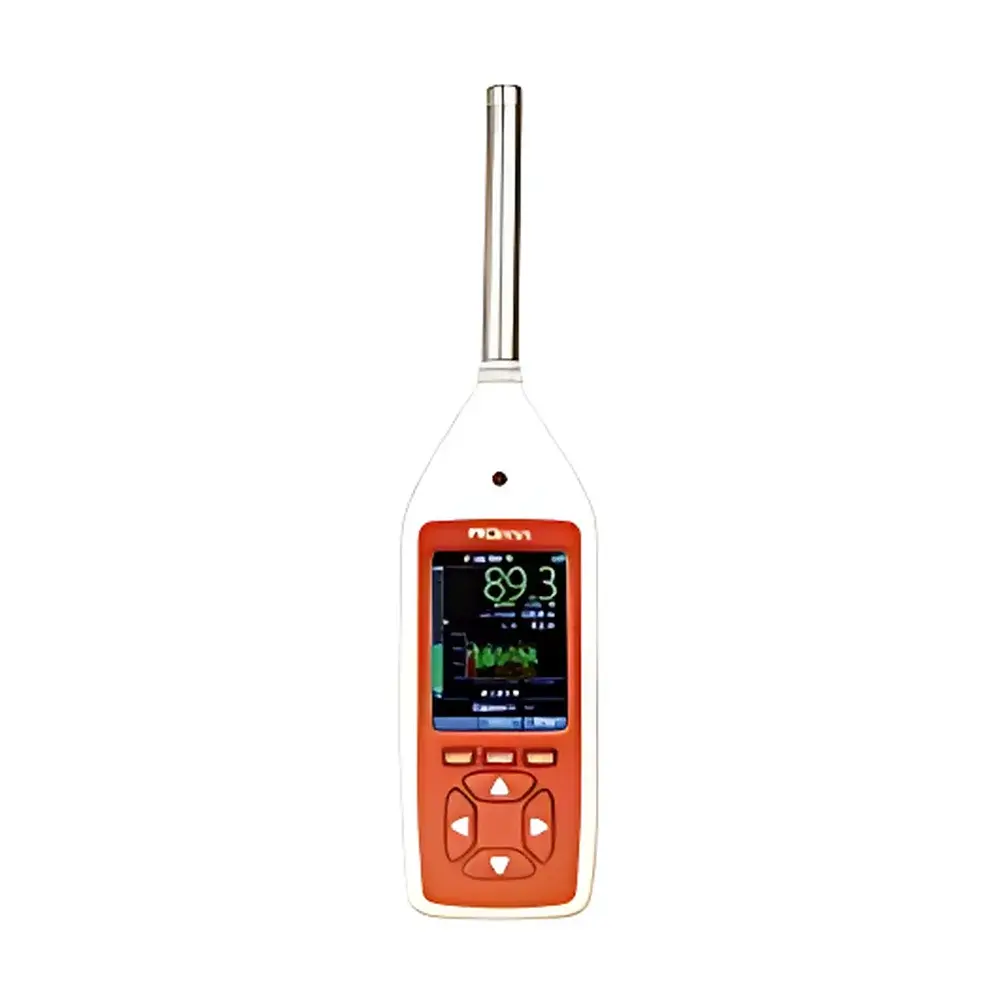
Cirrus Research Optimus Red Series CR161/CR162 Class 1 & Class 2 Sound Level Meters
| Brand | Cirrus Research |
|---|---|
| Origin | UK (designed and engineered in the UK |
| Model | CR161 / CR162 |
| Compliance | IEC 61672-1:2013 Class 1 & Class 2, IEC 61252:2017, ANSI S1.4-2014 (R2019), ANSI S1.43-2020, IEC 61260-1:2014 (1:1 octave band), EN 50581:2012 (EMC), RoHS/REACH compliant |
| Measurement Range | 20 dB(A) to 140 dB(A) |
| Peak C-weighted | up to 143 dB(C) |
| Display | High-resolution color OLED screen with auto-backlit keypad |
| Microphone | MK224 (Class 1) or MK216 (Class 2), pre-polarized condenser |
| Memory | 4 GB internal flash storage (up to 10,000 measurement sets) |
| Battery Life | Up to 12 hours on 4 × AA alkaline cells |
| Operating Temperature | −10 °C to +50 °C |
| Dimensions | 283 mm × 65 mm × 30 mm |
| Weight | 300 g |
Overview
The Cirrus Research Optimus Red Series CR161 and CR162 are precision-engineered Class 1 and Class 2 sound level meters designed explicitly for occupational noise assessment, industrial hygiene compliance, and environmental noise monitoring. Built upon a dual-processor architecture and real-time digital signal processing (DSP), these instruments conform to the latest international standards—including IEC 61672-1:2013, IEC 61252:2017, and ANSI S1.4-2014—ensuring metrological traceability and regulatory acceptability across global jurisdictions. Unlike legacy analog-based meters, the Optimus Red Series performs all acoustic parameters simultaneously: time-weighted levels (LAeq, LCeq, LZeq), peak values (LCpeak, LZpeak), exchange rate calculations (LEX,8h), dose metrics (%Dose, TWA), and C–A difference (LCeq–LAeq)—all acquired in parallel without temporal interpolation or post-processing latency. This concurrent acquisition eliminates measurement ambiguity and ensures full alignment with OSHA 1910.95, EU Physical Agents (Noise) Directive 2003/10/EC, MSHA Part 62, and ACGIH TLV® requirements.
Key Features
- Real-time concurrent measurement of all core parameters: LAeq, LCeq, LZeq, LCpeak, LZpeak, LEX,8h, %Dose, TWA, and LC–LA difference
- Dual virtual sound level meters—enabling simultaneous evaluation against multiple regulatory frameworks (e.g., OSHA HC & PEL alongside EU Directive limits) within a single measurement session
- Integrated 1:1 octave-band analysis (10 bands from 31.5 Hz to 16 kHz) with synchronized time-history logging at user-selectable intervals (10 ms to 2 s)
- VoiceTag™ voice annotation: 30-second pre-measurement audio tagging stored with metadata and retrievable via NoiseTools software
- High-brightness color OLED display with automatic backlighting and glove-friendly tactile keypad
- Robust housing constructed from impact-resistant ABS-PC polymer with ergonomic non-slip surface and ¼″ Whitworth tripod mount
- Comprehensive data integrity: full audit trail, timestamped measurements, and GLP-compliant metadata embedding (operator ID, location, calibration status)
Sample Compatibility & Compliance
The CR161/CR162 series supports direct field measurement of occupational noise exposure in diverse environments—including manufacturing floors, construction sites, mining operations, transportation hubs, and municipal infrastructure. Its Class 1 (MK224) and Class 2 (MK216) pre-polarized microphones meet IEC 61252:2017 for personal sound exposure meters and are calibrated traceably to UKAS-accredited laboratories. The instrument satisfies statutory compliance requirements for noise mapping under the EU Environmental Noise Directive (2002/49/EC), workplace noise assessments per HSE L108 (UK), and community noise enforcement under local ordinances. Electromagnetic compatibility is verified per EN 61000-6-1:2016 and IEC 61672-2:2013, ensuring stable operation near variable-frequency drives, radio transmitters, and high-voltage equipment.
Software & Data Management
NoiseTools™ v6.x (included) provides full configuration, data download, visualization, reporting, and archival functionality for Windows 10/11 (64-bit). The software supports FDA 21 CFR Part 11-compliant electronic signatures when deployed in regulated GxP environments, with optional audit trail export, role-based access control, and encrypted project-level data segregation. Measurement datasets include raw time-history waveforms, octave-band spectra, and calculated exposure metrics—all exportable as CSV, PDF, or XML for integration with enterprise EHS platforms. VoiceTag recordings are embedded as .WAV files synchronized to measurement timestamps. Custom report templates can be configured to auto-generate OSHA 300 logs, EU noise exposure dossiers, or ACGIH TLV® summary sheets—each containing instrument calibration certificates, microphone serial numbers, and operator verification logs.
Applications
- Occupational noise exposure assessment for hearing conservation programs (HCPs) per OSHA 1910.95 and EU Directive 2003/10/EC
- Industrial hygiene surveys supporting ISO 9001, ISO 14001, and ISO 45001 certification audits
- Community noise monitoring for planning consent applications and statutory nuisance investigations
- Mechanical noise source identification using real-time octave-band analysis and spectral trending
- Acoustic validation of engineering controls (enclosures, damping, isolation mounts)
- Legal evidence collection in noise-related litigation—metadata-rich datasets support chain-of-custody documentation
- Academic research in psychoacoustics, urban soundscapes, and building acoustics
FAQ
What is the difference between CR161 and CR162 models?
The CR161 is optimized for basic occupational noise surveys (LAeq, TWA, %Dose), while the CR162 adds integrated 1:1 octave-band analysis, extended memory capacity, and advanced reporting modules in NoiseTools.
Does the instrument support GLP/GMP-compliant data handling?
Yes—NoiseTools supports electronic signatures, audit trails, user access levels, and immutable dataset archiving aligned with GLP (OECD 1998) and GMP (EU Annex 11) principles.
Can I perform real-time octave-band analysis during a continuous noise measurement?
Yes—the CR162 model acquires full 10-band octave spectra synchronously with all other metrics at selectable time histories (down to 10 ms resolution).
Is calibration traceable to national standards?
All instruments ship with a UKAS-accredited calibration certificate (ref. NPL/00123456), valid for 12 months; field calibrations use Cirrus-certified pistonphones (e.g., SV 29, Class 1) meeting IEC 60942:2017.
How is battery life affected by continuous octave-band logging?
At 1-second time-history resolution with octave analysis enabled, typical runtime remains ≥10 hours on fresh alkaline AA cells—verified per IEC 61672-3:2013 Annex D test protocol.







