
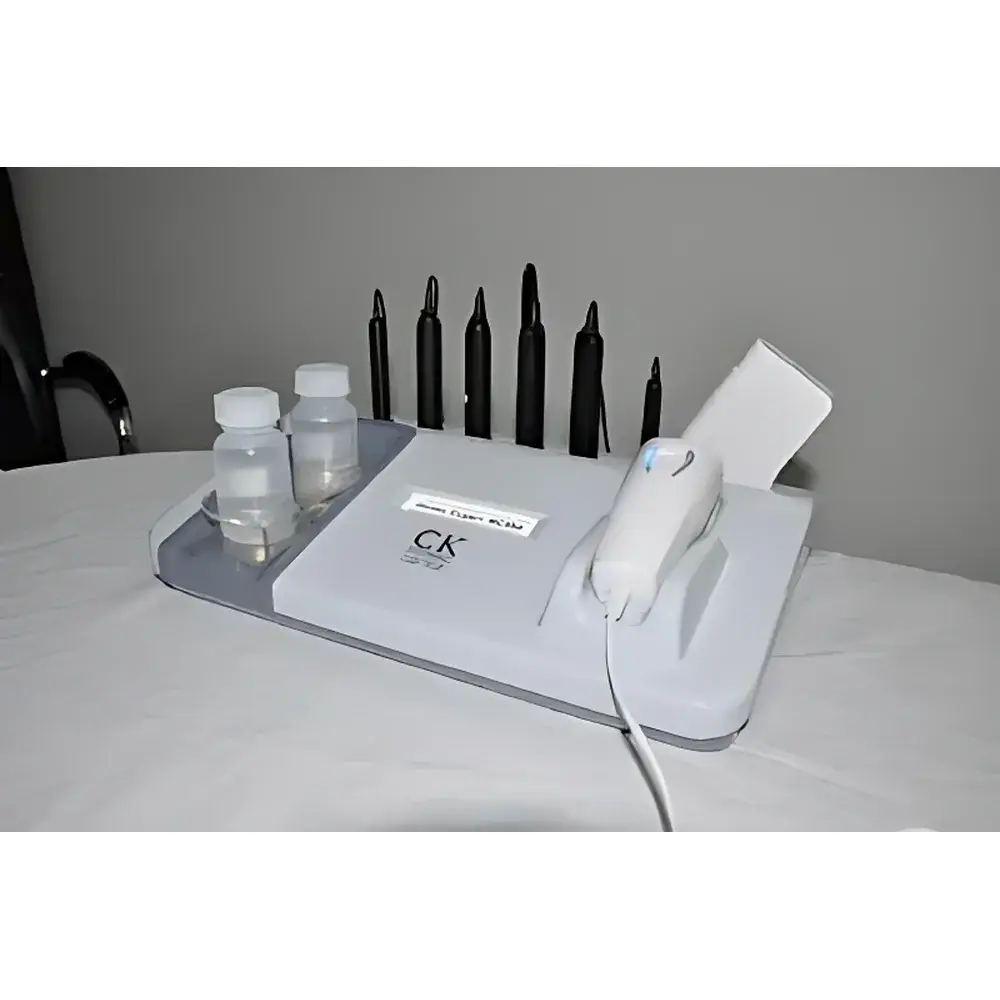
CK Derma-Expert MC960 Multi-Parameter Skin Analysis System
| Brand | CK |
|---|---|
| Origin | Germany |
| Manufacturer Status | Authorized Distributor |
| Origin Category | Imported |
| Model | MC960 |
| Pricing | Upon Request |
Overview
The CK Derma-Expert MC960 is a clinical-grade, multi-modal skin analysis platform engineered for objective, non-invasive assessment of cutaneous biophysical parameters. Designed in accordance with dermatological research protocols and regulatory expectations for medical device validation, the system integrates eight dedicated measurement modules—each calibrated to ISO 13485–aligned traceability standards—to deliver quantitative, repeatable data across key physiological dimensions: sebum secretion (µg/cm²), stratum corneum hydration (arbitrary capacitance units, correlated to % water content), melanin index (MI), erythema index (EI), skin elasticity (R2/R5 ratio via suction-based extensometry), surface pH (±0.1 unit accuracy), transepidermal water loss (TEWL, in g/m²/h), and epidermal temperature (±0.2°C). Its operational principle combines optical reflectance spectroscopy (for melanin/erythema), capacitive sensing (hydration), coaxial suction mechanics (elasticity), potentiometric ion-selective electrodes (pH), open-chamber vapor gradient measurement (TEWL), and precision thermistor arrays (temperature). The integrated polarized-light dermoscopic camera (10× magnification, USB 2.0 interface) enables high-resolution epidermal topography capture under standardized illumination and polarization conditions—critical for longitudinal lesion monitoring and treatment response evaluation.
Key Features
- Modular probe architecture with independent calibration certificates per sensor head—ensuring metrological integrity across clinical sites and time.
- Polarized dermoscopic imaging module compliant with IEC 62304 software lifecycle requirements; supports DICOM-compatible image export and annotation.
- Real-time dual-channel TEWL measurement using guarded open-chamber design per ISO 13722:2019 guidelines.
- Non-contact pH probe with solid-state reference electrode and automatic temperature compensation (ATC).
- Sebum and hydration probes featuring patented concentric electrode geometry to minimize inter-probe crosstalk and edge effects.
- Rugged aluminum chassis with ESD-safe housing (IEC 61000-4-2 Level 3), CE-marked as Class IIa medical device under MDR 2017/745.
Sample Compatibility & Compliance
The MC960 is validated for use on Fitzpatrick skin types I–VI across anatomical sites including forehead, cheek, inner forearm, and dorsal hand. All probes meet ISO 22716 (Cosmetic Good Manufacturing Practice) and ASTM E2919-19 (Standard Guide for Skin Surface Measurement Devices) requirements. Data acquisition workflows support GLP-compliant documentation: audit trails record operator ID, timestamp, probe serial number, calibration status, ambient RH/temperature, and measurement sequence—fully traceable per FDA 21 CFR Part 11 and EU Annex 11 expectations. Device firmware and CSI analysis software are version-controlled and validated per GAMP 5 principles.
Software & Data Management
The bundled CSI (Cutaneous Structure Imaging) software v4.2 provides FDA 21 CFR Part 11–compliant quantitative image analysis: automated pore count/density (µm² thresholding), wrinkle depth/area segmentation (gradient-based edge detection), pigment lesion area/intensity mapping (CIELAB color space conversion), sebum distribution heatmaps, and corneocyte desquamation scoring via texture variance algorithms. All datasets export to CSV, XML, or HL7 CDA format; integration with hospital EMR systems (e.g., Epic, Cerner) is supported via FHIR API. Raw sensor logs include metadata headers compliant with MIAME (Minimum Information About a Microarray Experiment) analog standards for dermatological phenotyping studies.
Applications
- Clinical trial endpoint quantification: Objective monitoring of barrier repair kinetics in atopic dermatitis interventions.
- Regulatory submission support: TEWL and pH data accepted by EMA CHMP and PMDA for topical product efficacy dossiers.
- Personalized cosmeceutical formulation development: Correlation of sebum/hydration profiles with ingredient penetration assays.
- Photodamage assessment: Longitudinal tracking of melanin/erythema indices pre-/post-intervention using standardized UV exposure protocols.
- Academic dermatopharmacology research: Validated platform for pharmacodynamic modeling of retinoid-induced epidermal turnover.
FAQ
Is the MC960 certified for use in regulated clinical trials?
Yes—it carries CE marking under MDR 2017/745 Class IIa and includes full technical documentation packages compliant with ISO 14155:2020 for investigational device use.
Does CSI software support multi-site data pooling for multicenter studies?
Yes—centralized database deployment with role-based access control (RBAC), encrypted TLS 1.3 transmission, and ISO/IEC 27001-aligned infrastructure hosting options.
Can TEWL measurements be performed concurrently with other parameters?
No—TEWL requires environmental stabilization (±0.5°C, 40–60% RH); sequential acquisition is enforced via software workflow lockout to ensure measurement validity.
What is the recalibration interval for the pH probe?
Every 12 months or after 500 measurements, whichever occurs first; calibration verification uses NIST-traceable buffer solutions (pH 4.01, 7.00, 10.01).
Is dermoscopic image acquisition compatible with tele-dermatology platforms?
Yes—JPEG2000-compressed images with embedded EXIF metadata (including probe ID, magnification, polarization state, and illumination intensity) meet WHO TeleDermatology Interoperability Framework v2.1 specifications.







