
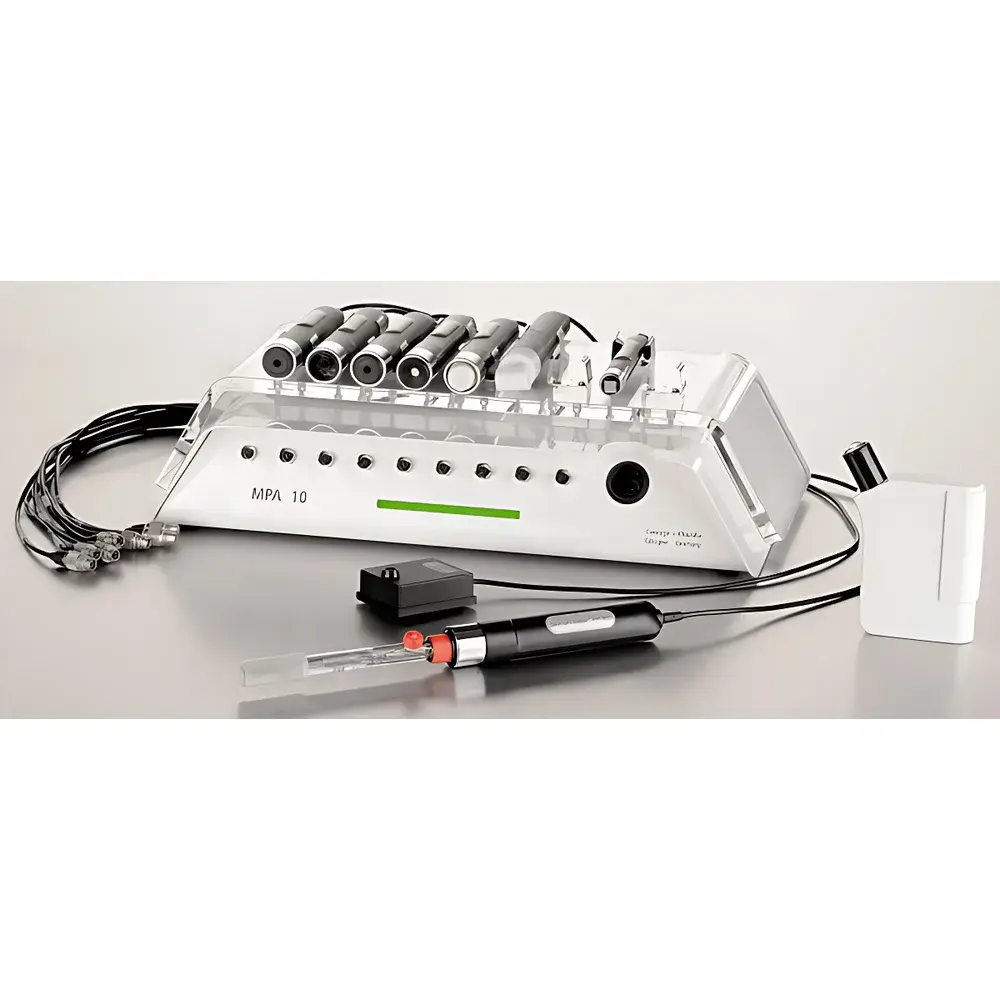
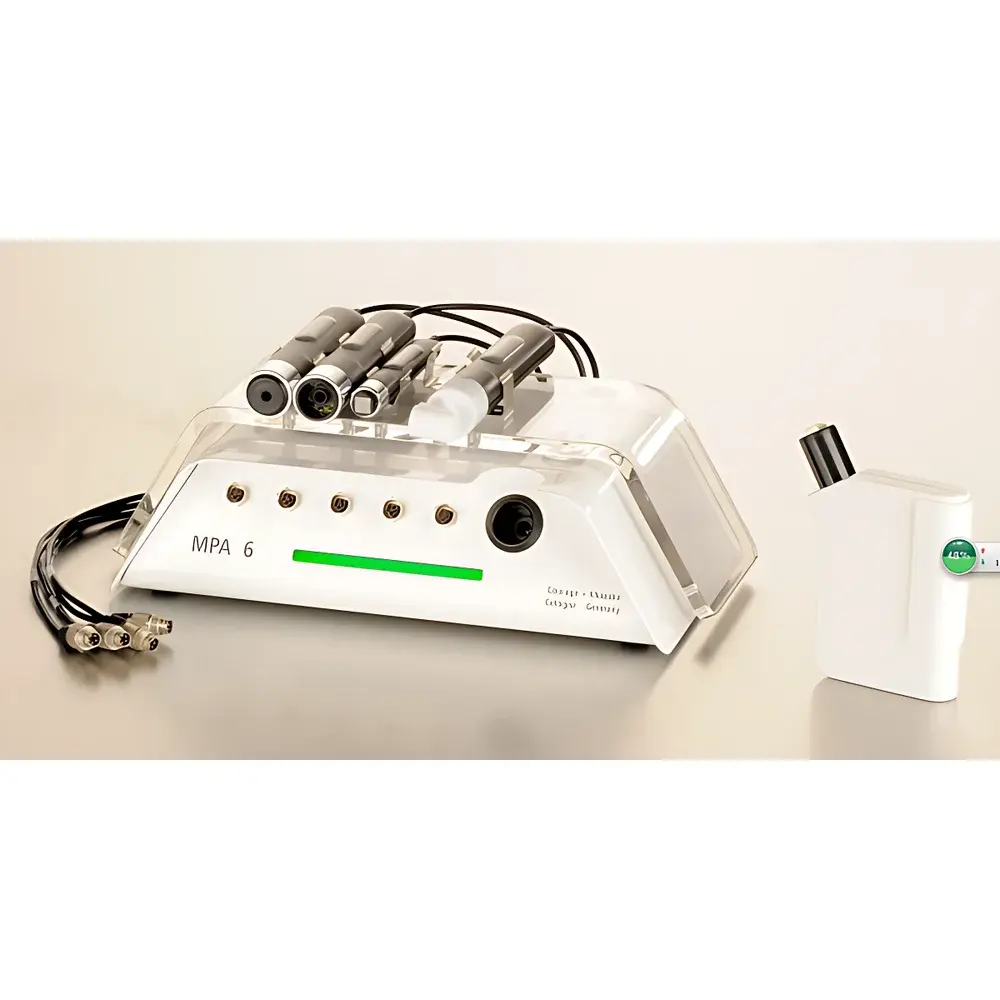
CK MPA6/10 Multi-Probe Skin Analysis System
| Brand | CK |
|---|---|
| Origin | Germany |
| Manufacturer Status | Authorized Distributor |
| Origin Category | Imported |
| Model | MPA6/10 |
| Pricing | Upon Request |
Overview
The CK MPA6/10 Multi-Probe Adapter (MPA) System is a modular, research-grade platform engineered for comprehensive, non-invasive biophysical assessment of human skin in clinical dermatology, cosmetic R&D, and regulatory safety evaluation. Unlike single-function instruments, the MPA6/10 operates on a centralized control architecture that integrates up to nine independently calibrated probes—each adhering to ISO 24442:2019 (Cosmetics — In vivo determination of skin hydration), ISO 24444:2019 (In vivo determination of sun protection factor), and relevant ASTM E2857 standards for measurement repeatability. The system employs probe-specific transduction principles: capacitance-based dielectric measurement (Corneometer), optical reflectance spectroscopy (Mexameter), open-chamber vapor diffusion kinetics (Tewameter), thermistor-based thermal equilibrium (Temperature & RH probe), and piezoelectric resonance (Reviscometer). Its core design enables synchronized multi-parameter acquisition under controlled environmental conditions (22 ± 1°C, 40–60% RH), minimizing inter-test variability and supporting longitudinal cohort studies.
Key Features
- Modular probe interface supporting up to nine simultaneous or sequential connections—configurable as MPA6 (6-port) or MPA10 (10-port) variants per hardware revision.
- Dedicated real-time signal processing firmware per probe type, ensuring metrological traceability to NIST-traceable reference standards.
- Integrated environmental monitoring module (temperature and relative humidity) co-located with test site for automatic correction of TEWL and transepidermal water loss calculations per ISO 16127.
- Automatic probe recognition and software auto-configuration—eliminating manual calibration file selection and reducing operator-induced error.
- Rugged aluminum chassis with ESD-safe enclosure (IEC 61326-1 compliant), designed for daily use in GLP-compliant laboratories and clinical trial environments.
- USB 2.0 and Ethernet connectivity options for networked deployment in multi-station testing facilities; supports time-synchronized data logging across distributed systems.
Sample Compatibility & Compliance
The MPA6/10 is validated for use on volar forearm, cheek, forehead, and dorsal hand sites in adult and pediatric populations (≥3 years). Probe contact geometry conforms to ISO 20795-1:2013 requirements for skin-contacting medical devices. All probes meet CE marking under Directive 2017/746/EU (IVDR) as Class I non-invasive diagnostic devices. Data integrity complies with FDA 21 CFR Part 11 requirements when used with CK’s certified software suite (MPA Control v5.2+), including electronic signatures, audit trails, and immutable raw-data archiving. Full documentation packages—including IQ/OQ/PQ protocols, uncertainty budgets per probe, and ISO/IEC 17025-aligned validation reports—are available upon request for GMP-regulated submissions.
Software & Data Management
MPA Control Software (v5.2 or later) provides unified acquisition, visualization, and statistical analysis across all connected probes. Each probe launches its native analytical interface—e.g., Mexameter’s melanin/hemoglobin index quantification, Tewameter’s dynamic TEWL slope calculation, or Reviscometer’s viscoelasticity parameter extraction (R0, R2, R5)—within a synchronized timeline. Raw data exports in CSV, XML, and .mpa binary formats support integration with SAS, JMP, and Python-based statistical pipelines. The software includes built-in compliance tools: user access levels (admin/operator/reviewer), session-based audit logs, and automated report generation compliant with OECD TG 402 and CTFA guidelines. Backups are encrypted and timestamped; local storage meets HIPAA-compliant data retention policies for clinical trial data.
Applications
- Cosmetic formulation efficacy testing: Quantifying barrier recovery kinetics post-irritant challenge using combined TEWL + Corneometer + pH-Meter data.
- Topical drug development: Monitoring stratum corneum hydration gradients and sebum modulation during corticosteroid or retinoid treatment regimens.
- Photobiology studies: Correlating Mexameter-derived melanin indices with UVB exposure dose-response curves under controlled irradiance conditions.
- Clinical dermatology trials: Objective endpoint assessment in atopic dermatitis (SCORAD correlation), rosacea (erythema quantification), and wound healing (elasticity restoration metrics).
- Regulatory dossier preparation: Generating ISO-compliant datasets for EU CPNP notifications, Health Canada Natural Health Products submissions, and US FDA OTC Monograph support data.
FAQ
Can the MPA6/10 be upgraded from 6 to 10 probe ports post-purchase?
Yes—hardware expansion kits (including reinforced backplane and firmware license activation) are available directly from CK GmbH’s Service Division.
Is probe cross-calibration supported between different MPA units?
All probes undergo individual factory calibration against master reference standards; inter-unit reproducibility is verified per ISO 5725-2, with typical CV < 2.3% for Corneometer and < 3.1% for Tewameter across five instruments.
Does the system support wireless probe operation?
No—probes require direct wired connection via shielded coaxial or twisted-pair cabling to maintain signal fidelity and electromagnetic compatibility per EN 61326-1.
Are raw voltage signals accessible for custom algorithm development?
Yes—CK provides documented low-level API access (DLL libraries and protocol manuals) under NDA for academic and industrial R&D partners.
What is the recommended recalibration interval for clinical use?
Annual recalibration is advised per ISO/IEC 17025; however, daily verification using CK-certified reference standards (e.g., hydration phantoms, optical density filters) is required for GLP/GCP compliance.






