
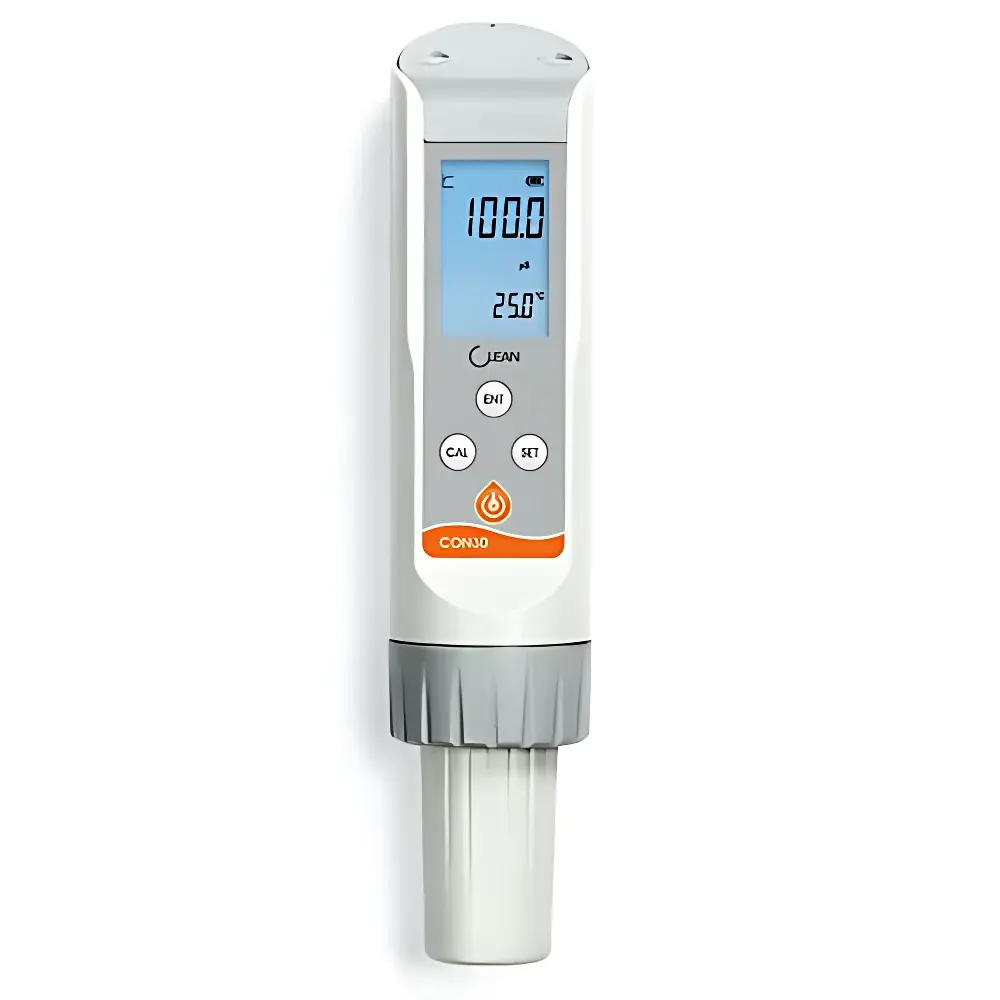
CLEAN CON30 Conductivity/TDS/Salinity/Temperature Meter
| Origin | USA |
|---|---|
| Manufacturer Type | Authorized Distributor |
| Origin Category | Imported |
| Model | CON30 |
| Instrument Type | Benchtop & Field-Portable Water Quality Analyzer |
| Price Range | USD 280 – 1,400 (FOB) |
Overview
The CLEAN CON30 Conductivity/TDS/Salinity/Temperature Meter is a compact, field-deployable multi-parameter water quality analyzer engineered for high reproducibility in both laboratory and environmental monitoring applications. Based on four-electrode conductivity measurement principle (ASTM D1125–22), the device simultaneously quantifies electrical conductivity (EC), total dissolved solids (TDS), salinity (as NaCl or seawater equivalent), and temperature using a single integrated CS3930 stainless steel electrode (SUS316L, cell constant K = 1.0 cm⁻¹). Its immersion-style probe design enables rapid deployment in open water bodies, effluent streams, cooling towers, and boiler feedwater systems—eliminating the need for sample transfer and minimizing contamination risk. The instrument operates on standardized conversion algorithms compliant with ISO 7888 (conductivity of water) and USP , with user-adjustable TDS factors (0.40–1.00) and salinity coefficients (0.65 default) to accommodate diverse ionic matrices.
Key Features
- Floating ergonomic housing with IP67-rated enclosure—fully submersible up to 1 m for 30 minutes; resistant to dust ingress and mechanical shock per IEC 60529
- Four-hole bubble-resistant electrode geometry (CS3930) ensures stable signal acquisition under turbulent or aerated conditions; self-cleaning surface minimizes fouling in wastewater or algae-rich samples
- Auto-ranging conductivity measurement across five overlapping decades: 0.1 μS/cm to 50.0 mS/cm (full-scale accuracy ±1% FS)
- Programmable temperature compensation (0.00–10.00% / °C, factory-default 2.00%) with adjustable reference temperature (15–30 °C, default 25 °C)
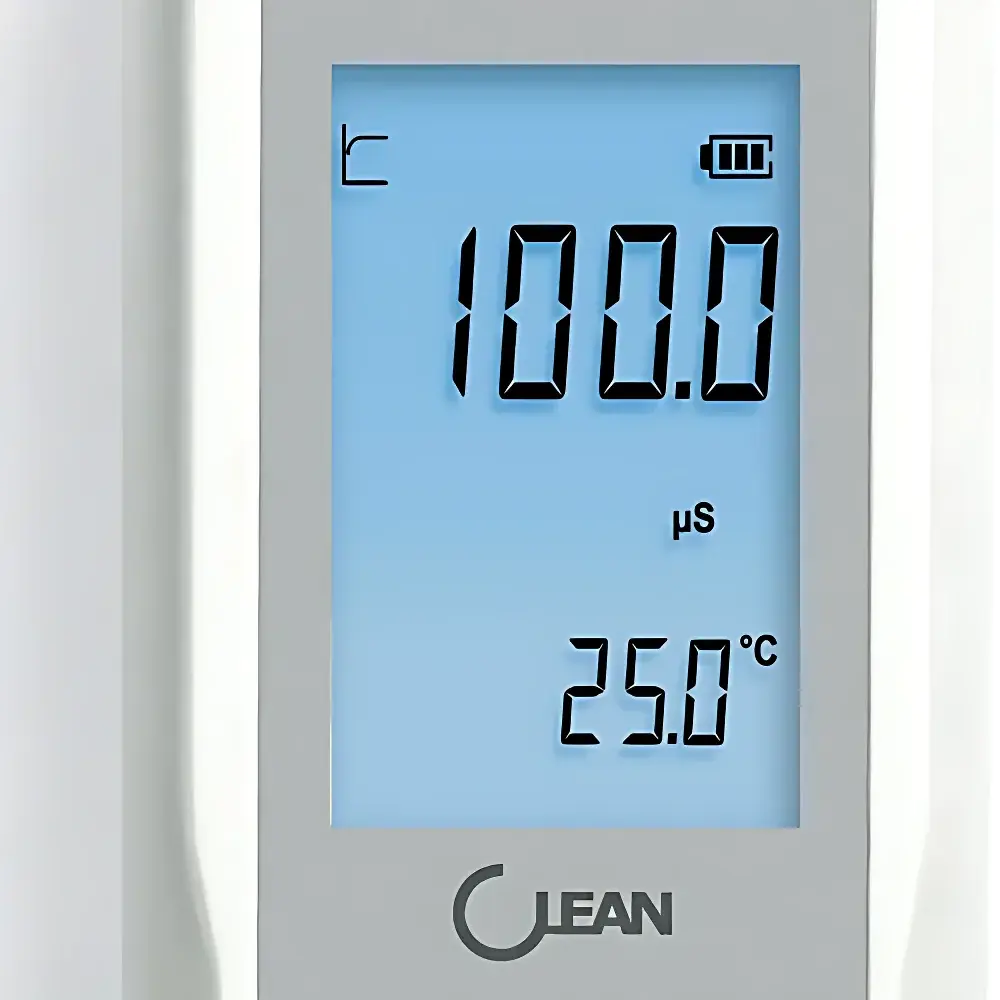
- Multi-line LCD display (21 × 34 mm active area) with energy-efficient LED backlight—readable in low-light field environments
- Battery compartment and electrode replacement require no tools; powered by a single 1.5 V AAA alkaline cell (typical life >1,000 hours of intermittent use)
- Auto-hold function triggered upon stable reading—enables hands-free operation during cast-and-retrieve sampling in rivers or reservoirs
- Automatic power-off after 5 minutes of inactivity; manual backlight timeout configurable to 30 seconds
Sample Compatibility & Compliance
The CON30 is validated for use with freshwater, brackish water, treated effluent, boiler feedwater, and ultrapure water (up to 18.2 MΩ·cm resistivity equivalent). It meets the operational requirements of EPA Method 120.1 (conductivity), ASTM D5391 (electrical conductivity of purified water), and ISO 10523 (pH and conductivity of natural waters). Its electrode construction (SUS316L passivated surface) resists chloride-induced pitting corrosion in coastal or industrial wastewater matrices. Device firmware supports GLP-compliant data integrity: all calibrations are timestamped and stored internally with operator ID fields (via optional PC interface). While not FDA 21 CFR Part 11 certified out-of-the-box, audit trails can be exported in CSV format for integration into validated LIMS environments.
Software & Data Management
The CON30 operates as a standalone instrument with no embedded Bluetooth or USB connectivity. All calibration parameters, measurement history (last 100 readings), and configuration settings—including TDS factor, salinity coefficient, and temperature coefficient—are retained in non-volatile memory during battery replacement. Data export requires optional serial-to-USB adapter (RS-232 TTL level) and CLEAN DataLink software (v3.2+), which generates reports compliant with ISO/IEC 17025 documentation standards. Software supports batch calibration verification logs, drift analysis over time, and comparative overlay of multiple field campaigns.
Applications
- Environmental field surveys: stream health assessment, wetland salinity mapping, stormwater runoff monitoring
- Industrial process control: boiler water conductivity tracking, reverse osmosis permeate verification, cooling tower cycle management
- Laboratory QC/QA: incoming raw water qualification, pharmaceutical water system validation (PW, WFI per USP ), calibration standard verification
- Wastewater treatment: activated sludge monitoring, membrane bioreactor (MBR) influent/effluent profiling, desalination pre-treatment screening
- Educational use: undergraduate chemistry and environmental science labs requiring portable, rugged instrumentation with traceable metrology
FAQ
Does the CON30 support two-point or multi-point conductivity calibration?
No—the instrument implements auto-ranging single-point calibration only, aligned with ASTM D1125’s recommended practice for field-portable meters used in non-regulated monitoring contexts.
Is the CS3930 electrode compatible with other CLEAN meters?
Yes—the CS3930 (K = 1.0, 13 mm diameter, SUS316L body) is mechanically and electrically interoperable with the CLEAN CON20, CON40, and PHCON series instruments.
Can temperature compensation be disabled for research-grade raw conductivity reporting?
Yes—manual temperature compensation mode allows users to record uncorrected conductivity values at measured temperature, preserving thermodynamic integrity for Arrhenius-based modeling.
What is the maximum operating depth for submerged measurements?
Per IP67 certification, the meter may be fully immersed at depths ≤1 meter for ≤30 minutes; prolonged submersion beyond this specification voids warranty and risks seal degradation.
How often should the electrode be cleaned or recalibrated in high-fouling environments?
In wastewater or algal bloom conditions, clean the electrode weekly with 0.1 M HNO₃ followed by deionized water rinse; verify calibration before each field day or after every 20 measurements.
Related Products







