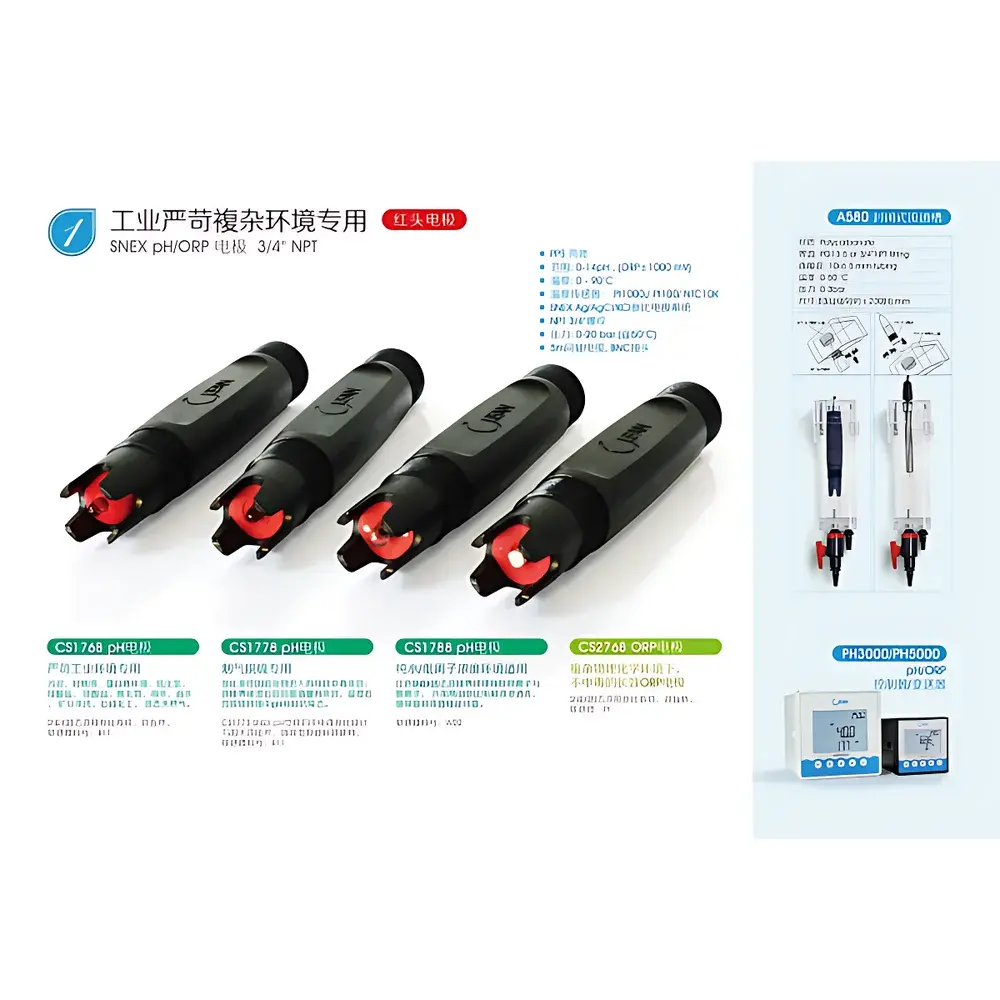
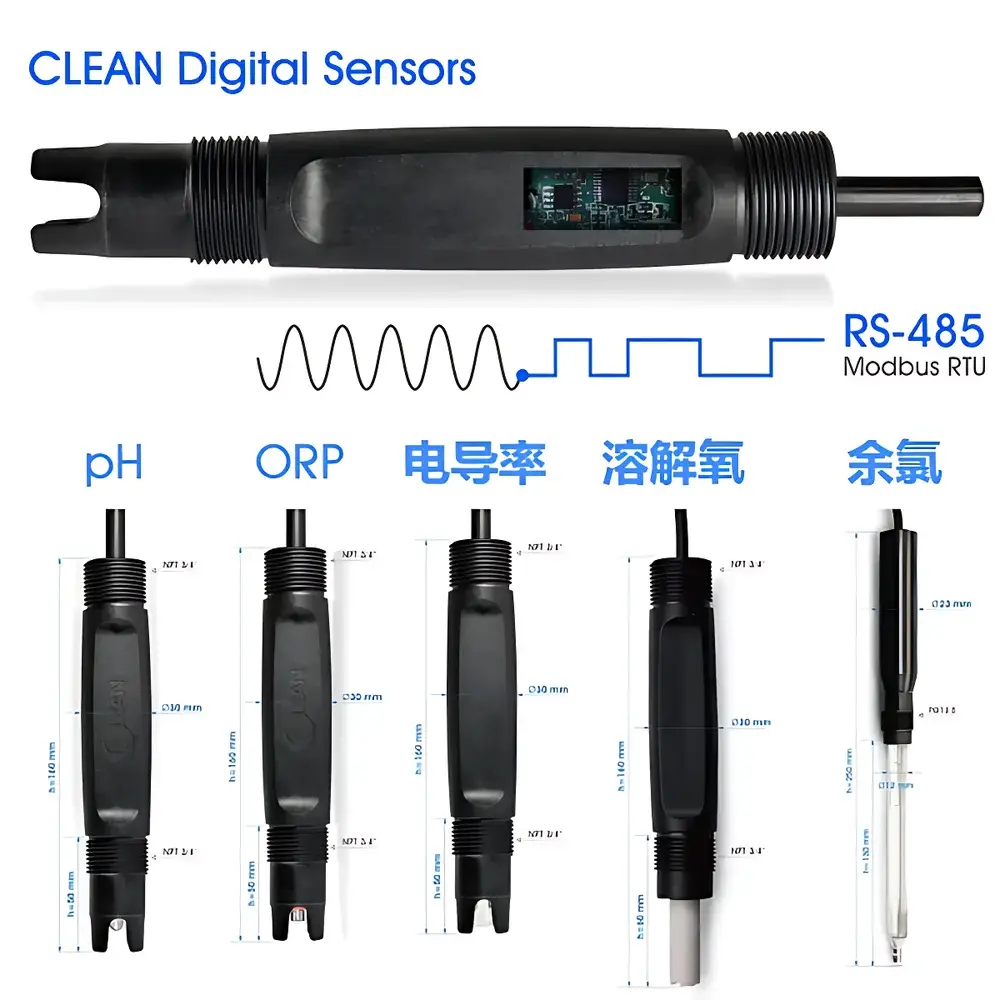
CLEAN CS1728D HF-Resistant Digital pH Electrode with RS-485 Output
| Brand | CLEAN |
|---|---|
| Origin | Taiwan |
| Model | CS1728D |
| pH Range | 0–12 |
| Zero Point | 7.00 ± 0.25 |
| Resolution | 0.01 pH |
| Temperature Range | 0–80 °C |
| Max Pressure | 10 bar |
| Body Material | PPS/PP |
| Sensing Membrane | W28 hemispherical glass |
| Membrane Resistance | < 500 MΩ |
| Reference System | SNEX Ag/AgCl/KCl solid-state double-junction |
| Liquid Junction | SNEX dual-salt bridge |
| Threaded Connection | NPT 3/4" |
| Cable Length | 5 m |
| Output Interface | RS-485 Modbus RTU |
| Supply Voltage | DC 12 V |
| IP Rating | IP68 |
Overview
The CLEAN CS1728D is a purpose-engineered digital pH electrode designed for continuous, high-reliability measurement in hydrofluoric acid (HF)-containing process streams. Unlike conventional pH electrodes—whose glass membranes and liquid-junction reference systems rapidly degrade in HF environments—the CS1728D integrates two proprietary technologies: a chemically stabilized W28 hemispherical pH-sensitive glass membrane and the SNEX solid-state double-junction reference system. The electrode operates on the principle of potentiometric measurement, where the potential difference between the sensing and reference elements is converted to a pH value using the Nernst equation. Its RS-485 Modbus RTU interface enables direct integration into industrial SCADA, DCS, or PLC networks without external signal conditioning. Engineered for semiconductor wafer etching, photovoltaic wet processing, petrochemical HF alkylation units, and acidic wastewater treatment, the CS1728D delivers stable calibration retention and extended service life—even at HF concentrations up to 1000 ppm.
Key Features
- W28 specialized glass membrane: Resists HF-induced leaching and surface etching; maintains mechanical integrity and electrochemical response stability under prolonged exposure.
- SNEX solid-state double-junction reference system: Eliminates conventional KCl electrolyte leakage and HF ingress through the liquid junction; prevents reference potential drift caused by HF penetration into the internal reference chamber.
- Digital RS-485 output with Modbus RTU protocol: Enables noise-immune, long-distance (up to 1200 m) communication in electrically noisy industrial settings; supports multi-drop network configuration.
- Robust PPS/PP housing: Chemically inert to strong acids, oxidizers, and organic solvents; rated for continuous operation at pressures up to 10 bar and temperatures up to 80 °C.
- IP68-rated sealed construction: Fully submersible; suitable for immersion in open tanks, pipelines, and effluent channels without risk of moisture ingress or connector corrosion.
- NPT 3/4″ threaded mounting: Ensures leak-tight process connection; compatible with standard sanitary and industrial piping adapters.
Sample Compatibility & Compliance
The CS1728D is validated for use in aggressive aqueous matrices containing hydrofluoric acid, ammonium bifluoride, buffered HF solutions, and mixed acid systems (e.g., HNO₃/HF, H₂SO₄/HF). It complies with IEC 61000-6-2 (EMC immunity) and IEC 61000-6-4 (EMC emissions) standards. While not intrinsically safe certified, its low-power DC 12 V operation and non-sparking design support deployment in Class I, Division 2 hazardous locations when installed per NEC Article 500 guidelines. For regulated pharmaceutical or biotech applications, the electrode’s stable zero point (7.00 ± 0.25) and repeatable calibration behavior support adherence to USP , ISO 9001, and FDA 21 CFR Part 11 requirements when paired with compliant data loggers and audit-trail-capable controllers such as the CLEAN PH3000 transmitter.
Software & Data Management
When interfaced with CLEAN’s PH3000 transmitter or third-party Modbus-compatible controllers, the CS1728D supports full digital diagnostics—including electrode impedance monitoring, temperature-compensated mV offset tracking, and real-time signal health flags. Calibration data (including two-point free calibration via CU.CAL mode) is stored internally with timestamping and user ID tagging. All pH, mV, and temperature values are transmitted with 16-bit resolution, enabling traceable, GLP-compliant recordkeeping. The transmitter’s built-in 4–20 mA analog outputs (pH/ORP and temperature) provide redundant analog backup for legacy control loops, while its dual SPST relays support automated cleaning cycles or alarm-triggered shutdown protocols aligned with ISA-84 SIS Level 1 requirements.
Applications
- Semiconductor manufacturing: Real-time pH monitoring in HF-based wafer cleaning, etching, and post-etch rinse baths.
- Photovoltaic cell production: Control of texturing and anti-reflective coating etch baths containing HF/NH₄F mixtures.
- Petrochemical refining: Process control in HF alkylation units and spent acid regeneration systems.
- Chemical synthesis: pH supervision during fluorination reactions and metal fluoride precipitation processes.
- Industrial wastewater treatment: Continuous monitoring of HF-neutralization reactors and fluoride removal stages (e.g., CaF₂ precipitation).
FAQ
What makes the CS1728D resistant to hydrofluoric acid when standard pH electrodes fail?
The failure mechanism of conventional electrodes in HF involves both glass membrane dissolution and HF diffusion through the liquid junction into the reference system. The CS1728D eliminates both pathways: the W28 glass composition reduces Si–O bond lability, while the SNEX solid-state double junction replaces the porous ceramic frit with ion-selective polymer barriers that block HF anion migration.
Can the CS1728D be used in hot concentrated HF solutions above 60 °C?
It is rated for continuous operation up to 80 °C—but exposure to >500 ppm HF at temperatures exceeding 60 °C accelerates long-term drift. For such conditions, quarterly verification against NIST-traceable buffer standards (e.g., B1 or B2 series) is recommended.
Is calibration required before each use?
No. The electrode exhibits excellent zero-point stability (±0.25 pH over 30 days under static HF exposure). Two-point calibration with certified buffers (e.g., pH 4.01 and 7.00) is recommended every 7–14 days in dynamic process applications, or after mechanical cleaning or thermal shock.
Does the RS-485 interface support automatic temperature compensation?
Yes. The integrated Pt1000-grade temperature sensor provides real-time thermal data to the transmitter, which applies the standardized NIST pH-temperature correction algorithm per ISO 3696 and ASTM D1293.