
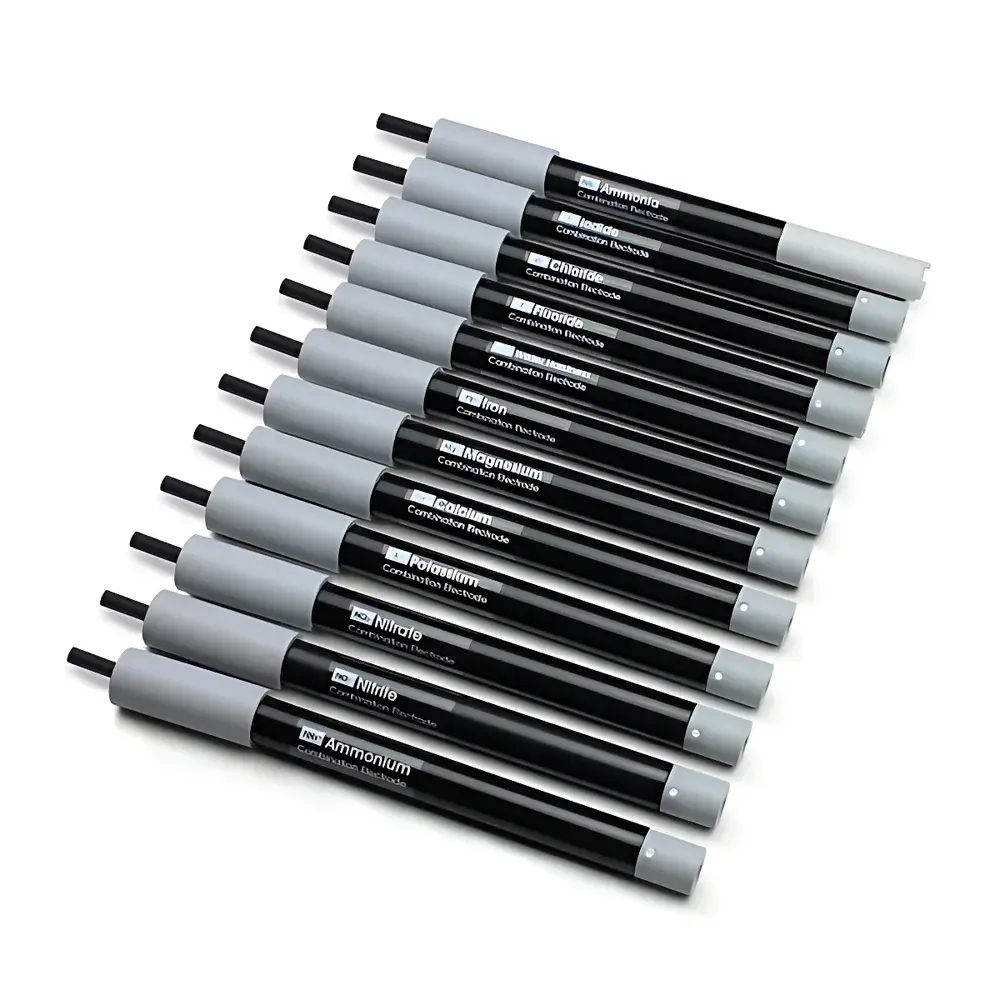
CLEAN CS6510Cl Chloride Ion-Selective Electrode (ISE)
| Brand | CLEAN |
|---|---|
| Origin | Shanghai, China |
| Model | CS6510Cl |
| Instrument Type | Online ISE Sensor |
| Measurement Range | 0–99,999 mg/L (ppm) Cl⁻ |
| Detection Limits | 0.01 / 0.1 / 1 mg/L (ppm) |
| Response Time | 30 s (to 95% signal stability) |
| Accuracy | ±2.5% of reading |
| Operating Temperature | 0–50 °C |
| Output Interface | BNC |
| Body Material | Glass |
| Dimensions | Ø12 × 110 mm |
| Reference System | Double-junction Ag/AgCl with annular ceramic frit |
| Interferents | S²⁻, I⁻, CN⁻, Br⁻ |
| pH Range | 2–12 |
| Input Impedance | <1 MΩ |
| Temperature Compensation | Not recommended for direct electrode compensation |
| Storage | Long-term—dry |
| Electrode Slope | 56 ± 3 mV/decade at 25 °C |
Overview
The CLEAN CS6510Cl is a robust, glass-body chloride ion-selective electrode engineered for reliable potentiometric measurement of chloride concentration in aqueous solutions. Based on the principle of selective membrane potential development—governed by the Nernst equation—the sensor generates a stable, logarithmic voltage response proportional to the activity of Cl⁻ ions in the sample. Its solid-state polymeric membrane exhibits high selectivity for chloride over common anions such as bromide, iodide, cyanide, and sulfide, though interference mitigation requires appropriate ionic strength adjustment (ISA) and pH control within the operational range of 2–12. Designed explicitly for continuous online deployment, the CS6510Cl integrates seamlessly into industrial process streams, municipal water networks, and laboratory-grade monitoring systems. Unlike lab-based batch electrodes, this model features a PG13.5/NPT 3/4″ threaded housing compatible with standard pipe-mounting configurations, enabling direct insertion into flowing water, boiler feedwater, cooling circuits, or effluent channels without bypass loops or flow cells.
Key Features
- Glass-bodied construction ensures mechanical durability and chemical resistance in aggressive industrial environments, including wastewater, desalination brine, and electroplating baths.
- Double-junction reference system with annular ceramic liquid junction minimizes clogging and reduces junction potential drift—critical for long-term stability in suspended-solids-laden samples.
- Optimized membrane formulation delivers a Nernstian slope of 56 ± 3 mV per decade change in Cl⁻ activity at 25 °C, verified per ISO 10523 and ASTM D6508 protocols.
- BNC output interface enables plug-and-play compatibility with commercial ion meters, pH/ISE benchtop analyzers, and programmable logic controllers (PLCs) equipped with high-impedance analog inputs.
- No integrated temperature sensor—designed for external thermal compensation via PT100 or NTC probes connected to the host analyzer, ensuring traceable calibration per ISO/IEC 17025 requirements.
- Low input impedance (<1 MΩ) allows stable signal transmission over 1-m shielded cable runs without active buffering, reducing installation complexity and grounding noise susceptibility.
Sample Compatibility & Compliance
The CS6510Cl is validated for use across diverse matrices: potable water, surface water, seawater (up to 35,000 ppm Cl⁻), boiler feedwater, biological fluids (serum, urine, saliva), agricultural extracts (soil leachates, honey, feed), and food homogenates. It complies with methodological frameworks referenced in EPA Method 300.0, ISO 9297 (water quality—determination of chloride), and USP for pharmaceutical excipient testing. For regulated environments—including drinking water utilities operating under EU Directive 98/83/EC or U.S. EPA SDWA compliance—the electrode supports audit-ready operation when paired with data loggers meeting FDA 21 CFR Part 11 requirements for electronic records and signatures. The absence of internal electrolyte refilling eliminates maintenance-related downtime, aligning with GLP/GMP preventive maintenance schedules.
Software & Data Management
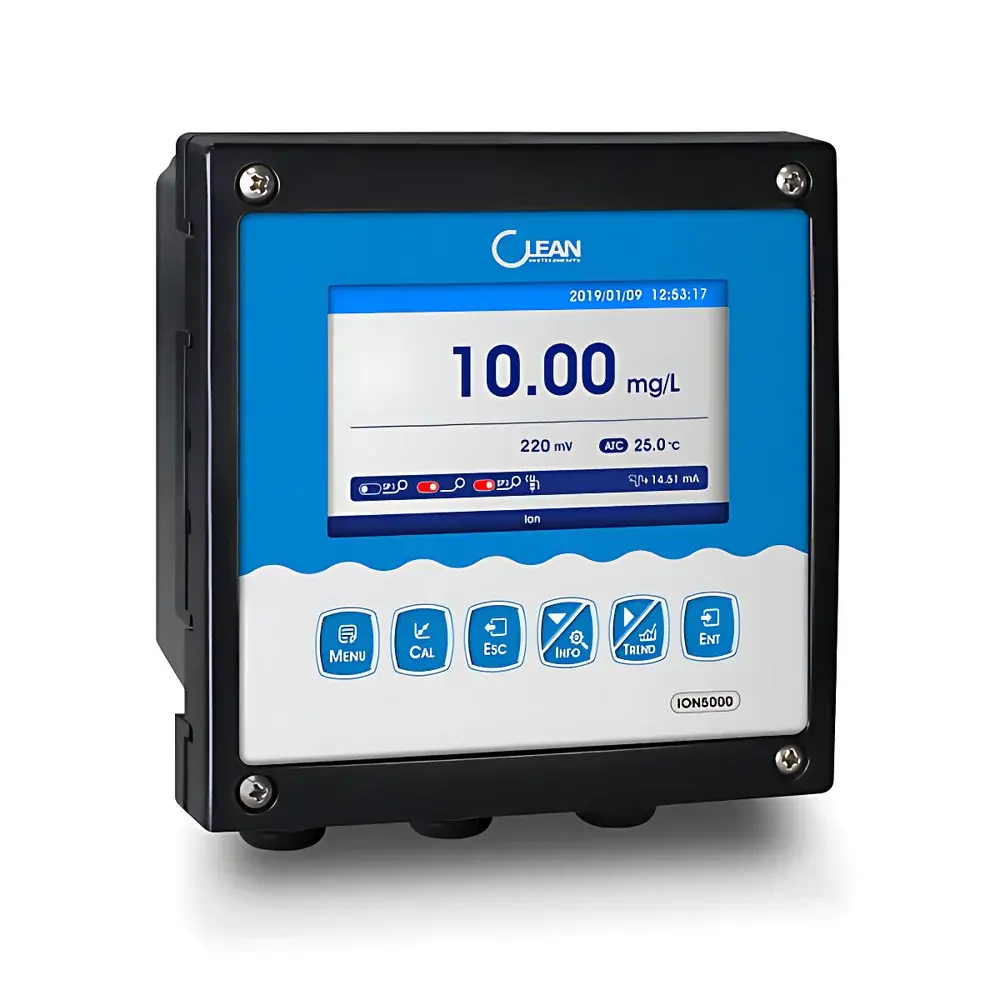
As a transducer—not a standalone instrument—the CS6510Cl relies on host instrumentation for signal conditioning, calibration, and data handling. When interfaced with CLEAN’s ION5000 online ion monitor or third-party platforms (e.g., Hach SC200, Endress+Hauser Liquiline CM44P), it supports multi-point calibration (2–5 points), real-time temperature-compensated concentration calculation, and linear/non-linear curve fitting. Data logging includes timestamped readings, slope diagnostics, and junction potential deviation alerts. RS485 Modbus RTU output enables integration into SCADA systems, while dual 4–20 mA outputs support redundant control loops—for instance, triggering chlorine dosing pumps upon exceeding upper threshold limits in distribution networks. All configuration changes are password-protected to meet IEC 62443 cybersecurity baselines for critical infrastructure.
Applications
- Continuous monitoring of chloride ingress in reinforced concrete structures via embedded sensor arrays linked to corrosion potential assessment systems.
- In-line verification of deionized water purity in semiconductor fab ultrapure water (UPW) loops, where Cl⁻ > 1 ppb risks wafer etching defects.
- Real-time tracking of chloride breakthrough in ion exchange resin beds used for boiler makeup water treatment.
- Regulatory reporting for wastewater discharge permits requiring monthly average Cl⁻ concentrations below jurisdictional thresholds (e.g., California WDRs, German LAWA guidelines).
- Quality control of dairy powders and infant formula, where chloride content correlates with thermal processing history and salt adulteration risk.
- Field-deployable analysis of soil salinity using portable ISE meters—validated against USDA ARS standard methods for agricultural land assessment.
FAQ
Can the CS6510Cl be used in high-turbidity or slurry samples?
Yes—its double-junction design and ceramic frit resist fouling better than single-junction electrodes; however, periodic cleaning with dilute ISA solution and gentle polishing of the sensing surface is recommended every 7–14 days in such applications.
Is temperature compensation built into the electrode?
No—the CS6510Cl lacks an integrated thermistor. Accurate concentration reporting requires external temperature measurement and algorithmic compensation performed by the host analyzer.
What is the recommended storage protocol between measurements?
For short-term storage (1 week), store dry in its protective cap, away from volatile organics and strong oxidizers.
Does the electrode require reconditioning after exposure to high-chloride seawater?
Not routinely—its membrane demonstrates excellent recovery post-exposure up to saturation (≈190,000 ppm); however, recalibration is advised before resuming low-range measurements (<10 ppm).
How does the CS6510Cl compare to silver/silver chloride titration methods?
While titration offers higher absolute accuracy in certified labs, the CS6510Cl provides continuous, real-time data at lower operational cost—making it ideal for trend analysis, alarm triggering, and process optimization rather than final compliance certification.
Related Products







