
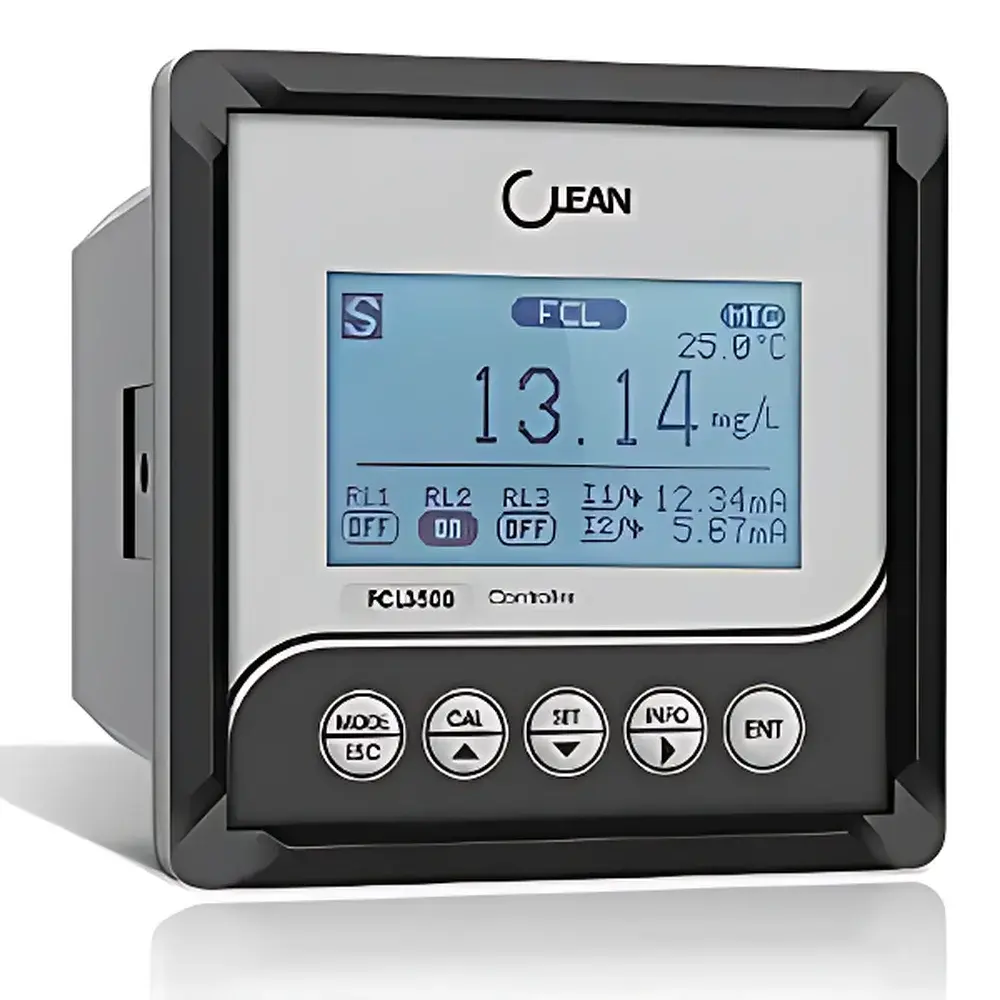
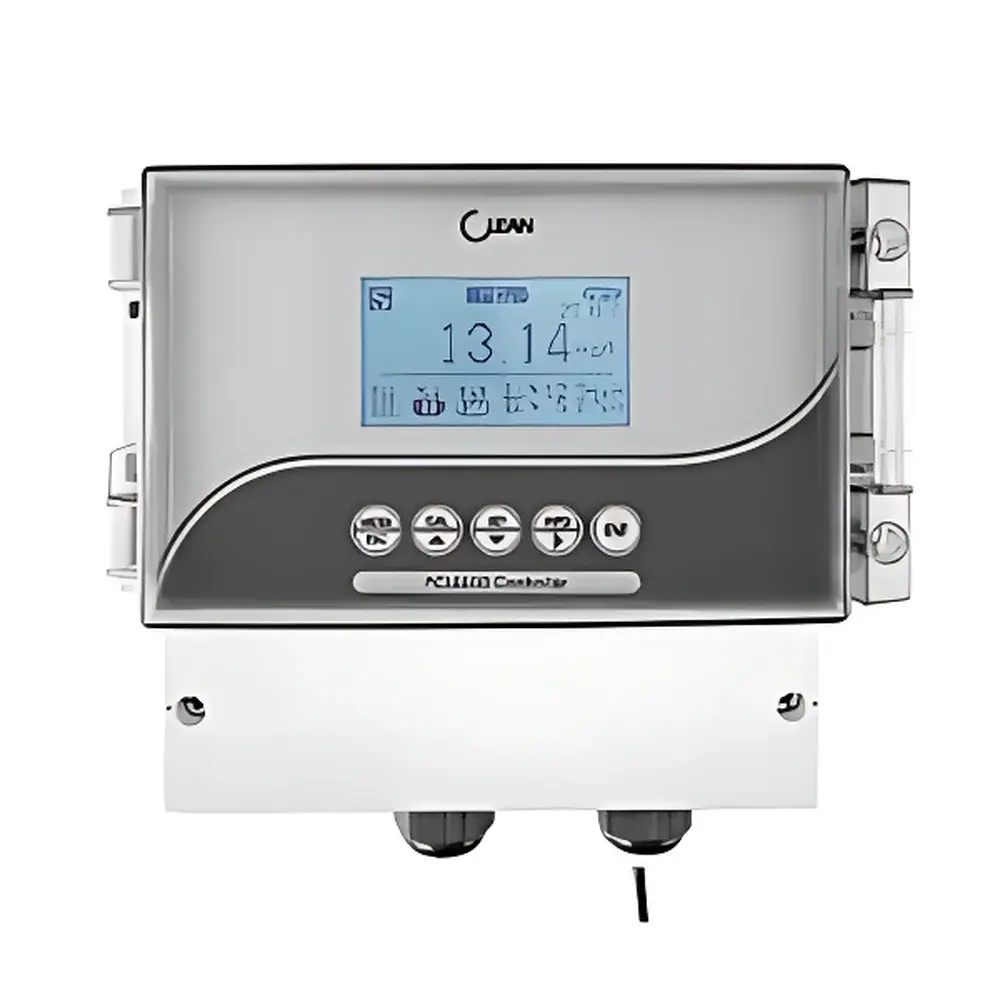
CLEAN FCL5000 Residual Chlorine Controller
| Brand | CLEAN (USA) |
|---|---|
| Origin | Shanghai, China |
| Model | FCL5000 |
| Instrument Type | Online Analyzer |
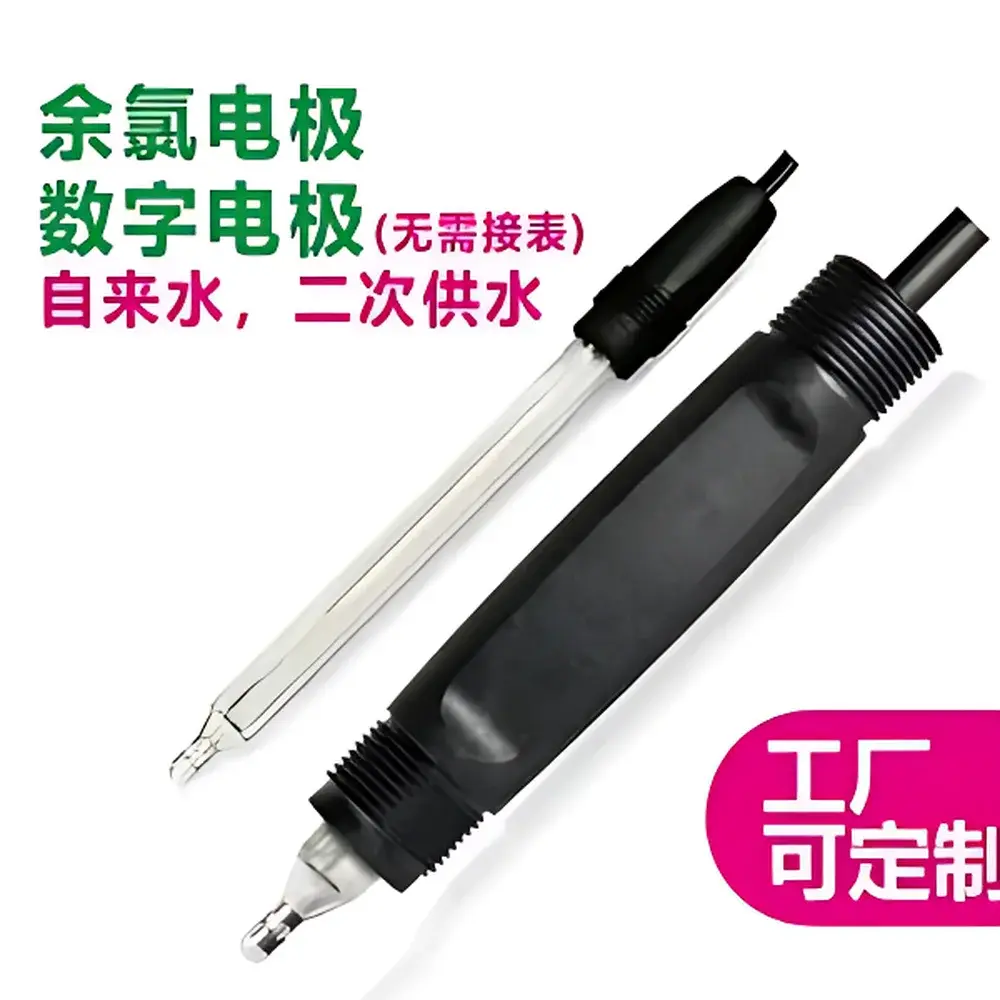
| Measurement Principle | Amperometric Electrochemical Sensor (Three-Electrode Constant-Voltage Method, Membrane-Free) |
| Measured Parameter | Free Chlorine (HOCl/OCl⁻) |
| Range | 0.000–2.000 ppm and 0.00–20.00 ppm (dual-range auto-switching) |
| Accuracy | ±2% of full scale |
| Resolution | 0.001 ppm |
| Detection Limit | 0.000 ppm |
| pH Compensation Range | 4.00–9.00 pH (nonlinear, automatic) |
| pH Input Range | 0.00–14.00 pH |
| pH Resolution | 0.01 pH |
| pH Accuracy | ±0.01 pH |
| Temperature Range | −10.0–130.0 °C |
| Temp. Resolution | 0.1 °C |
| Temp. Accuracy | ±0.3 °C |
| Output | Dual isolated 4–20 mA (±1% FS, load < 500 Ω) |
| Communication | RS-485 with optical isolation, MODBUS RTU protocol |
| Relay Outputs | Two SPST control relays (2.5 A / 230 VAC) + one configurable function relay |
| Power Supply | 85–260 VAC or optional 24 VDC |
| Enclosure Rating | IP65 |
| Operating Environment | 0–60 °C, RH < 90% non-condensing |
| Mounting | Panel mount (cutout: 92.5 × 92.5 mm) |
| Dimensions (H×W×D) | 108 × 108 × 128 mm |
| Calibration Method | DPD colorimetric verification compatible |
Overview
The CLEAN FCL5000 Residual Chlorine Controller is an industrial-grade online analyzer engineered for continuous, real-time monitoring and control of free chlorine concentration in potable water distribution systems, municipal drinking water treatment plants, swimming pools, water parks, and secondary water supply networks. It employs a membrane-free, three-electrode amperometric electrochemical sensing principle—specifically a constant-voltage amperometric method—which eliminates the need for electrolyte refills, replaceable membranes, or frequent sensor recalibration. This architecture delivers long-term stability, reduced maintenance overhead, and high reproducibility in variable flow and temperature conditions. Unlike optical or colorimetric analyzers, the FCL5000 operates without reagents or consumables during routine measurement, making it suitable for unattended 24/7 operation in critical infrastructure environments where reliability and operational continuity are mandated by regulatory frameworks such as EPA Method 334.0 and ISO 7393-2.
Key Features
- True dual-range amperometric detection (0.000–2.000 ppm and 0.00–20.00 ppm), with automatic range switching based on measured concentration
- Integrated pH compensation functionality—accepts concurrent pH input (via standard pH electrode) and applies non-linear correction across 4.00–9.00 pH to improve residual chlorine accuracy in varying alkalinity conditions
- High-immunity digital signal processing with user-adjustable filtering coefficients to suppress electrical noise in electrically noisy plant environments (e.g., near pumps, VFDs, or chlorination dosing panels)
- Dual isolated 4–20 mA analog outputs—fully configurable per channel for chlorine concentration, pH value, temperature, or derived control signals
- RS-485 interface with galvanic optical isolation and native MODBUS RTU support for seamless integration into SCADA, DCS, or PLC-based supervisory systems
- Three programmable relays: two dedicated control relays (e.g., for chlorine dosing pump activation/deactivation or alarm staging) and one multi-function relay configurable for cleaning cycle initiation, fault signaling, or system reset
- 128×64 dot-matrix LCD with bilingual (English/Chinese) menu navigation, intuitive icon-driven interface, and real-time trend display of chlorine, pH, and temperature
- Robust IP65-rated NEMA 4X enclosure designed for wall or panel mounting in humid, chemically aggressive environments typical of pump rooms, filter galleries, and pool equipment enclosures
Sample Compatibility & Compliance
The FCL5000 is validated for use with clear, low-turbidity aqueous samples containing free chlorine (hypochlorous acid and hypochlorite ion) at ambient temperatures between 5–35 °C—conditions representative of finished drinking water, recirculated pool water, and treated cooling tower make-up. It is not intended for applications involving high organic loading, suspended solids > 10 NTU, or strong oxidant interferences (e.g., ozone, chlorine dioxide, or peracetic acid), nor for medical wastewater streams where complex redox-active compounds may cause sensor poisoning or drift. The instrument complies with electromagnetic compatibility standards IEC 61326-1 (industrial environment) and safety standard IEC 61010-1. Its analog output and relay logic support integration into facilities operating under GLP/GMP-aligned process validation protocols, and its MODBUS RTU implementation enables audit-ready data logging when paired with compliant SCADA historian systems. While not certified to NSF/ANSI 61 or UL 61010-1 out-of-the-box, the FCL5000 meets functional requirements for Class A instrumentation per AWWA B100-2019 guidelines for residual disinfectant monitoring.
Software & Data Management
The FCL5000 operates without embedded software updates or cloud connectivity—its firmware resides in flash memory and is field-upgradable via RS-485 using CLEAN’s proprietary configuration utility (Windows-compatible). All calibration events—including DPD colorimetric reference verification—are timestamped and stored in non-volatile memory with operator ID tagging (where enabled via external authentication layer). The device supports full audit trail generation for key parameters: zero/span calibration dates, pH compensation coefficient updates, relay state transitions, and analog output scaling changes. When integrated into a MODBUS network, upstream systems can retrieve historical min/max/avg values over user-defined intervals (e.g., hourly chlorine excursions), enabling compliance reporting aligned with EPA SDWA monitoring requirements. No proprietary drivers or middleware are required; standard MODBUS TCP-to-RTU gateways enable secure remote access through firewalled industrial networks.
Applications
- Municipal drinking water treatment: real-time feedback control of sodium hypochlorite or gaseous chlorine dosing at clearwell outlets and booster stations
- Swimming pool & aquatic facility management: maintaining WHO-recommended free chlorine residuals (0.4–1.0 mg/L) while minimizing DBP formation through precise dosing modulation
- Secondary water supply systems: monitoring rooftop tank effluent and pressure vessel discharge points to ensure residual biocide persistence throughout vertical distribution networks
- Food & beverage processing: verifying chlorine levels in CIP rinse water and pre-operational sanitization loops where microbiological safety is governed by FDA 21 CFR Part 117 and HACCP plans
- Commercial building HVAC: monitoring chlorine residual in closed-loop cooling water systems to prevent Legionella proliferation per ASHRAE Guideline 12-2020
FAQ
Does the FCL5000 require daily maintenance or electrolyte replacement?
No. Its membrane-free, three-electrode amperometric sensor eliminates the need for electrolyte refills, membrane replacements, or frequent mechanical cleaning—typical maintenance intervals are quarterly visual inspection and annual DPD-based performance verification.
Can the FCL5000 measure chlorine dioxide or total chlorine?
No. It is specifically calibrated and validated for free chlorine only. Cross-sensitivity to chlorine dioxide exceeds ±15% at concentrations > 0.2 ppm; total chlorine measurement requires separate DPD-based lab analysis or a dedicated total chlorine analyzer.
Is the pH compensation algorithm adjustable by the user?
Yes. While factory-default compensation follows the standard HOCl dissociation curve, advanced users may import custom pH–chlorine response lookup tables via MODBUS register writes—subject to validation per local regulatory QA/QC procedures.
What flow rate is required for stable readings with the included flow cell?
The standard CS5530 flow-through cell requires minimum linear flow velocity of 0.3 m/s, corresponding to ≥30 L/h at nominal 1/2″ NPT inlet/outlet ports. Lower flow rates induce boundary layer effects and increase measurement lag.
How is traceability ensured during calibration?
Each DPD colorimetric verification must be performed using NIST-traceable DPD reagents and a calibrated spectrophotometer (e.g., Hach DR3900). The FCL5000 stores the verification result, operator ID, date/time, and reference standard lot number—supporting ISO/IEC 17025-compliant calibration records.







