
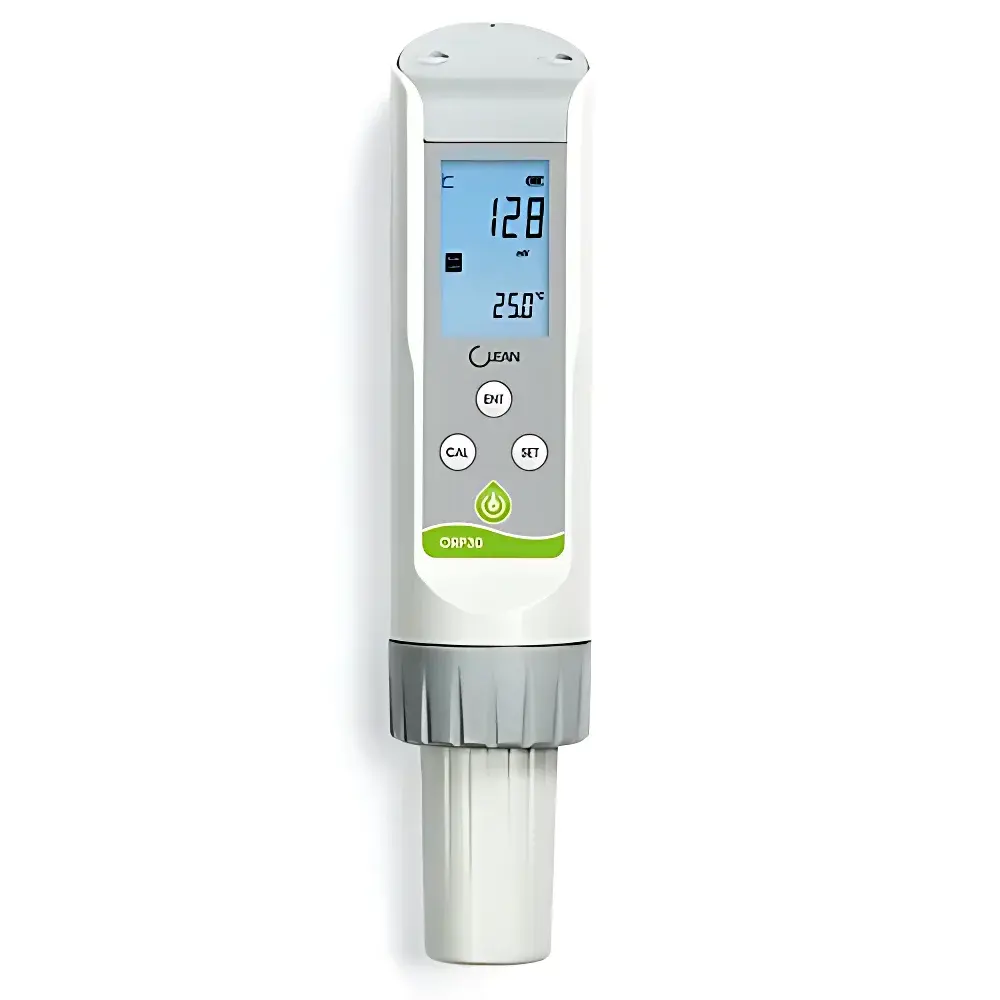
CLEAN ORP30 Portable Oxidation-Reduction Potential (ORP) Meter
| Brand | CLEAN |
|---|---|
| Origin | USA |
| Model | ORP30 |
| Instrument Type | Portable/Handheld Water Quality Analyzer |
| ORP Range | −900 to +900 mV |
| ORP Resolution | 1 mV |
| ORP Accuracy | ±1 mV |
| Temperature Range | 0.0–100.0 °C (32–212 °F) |
| Temperature Resolution | 0.1 °C / 1 °F |
| Calibration | Two-point using standard solutions (86 mV and 255 mV) |
| Electrode | Replaceable CS2930 platinum disc planar ORP electrode |
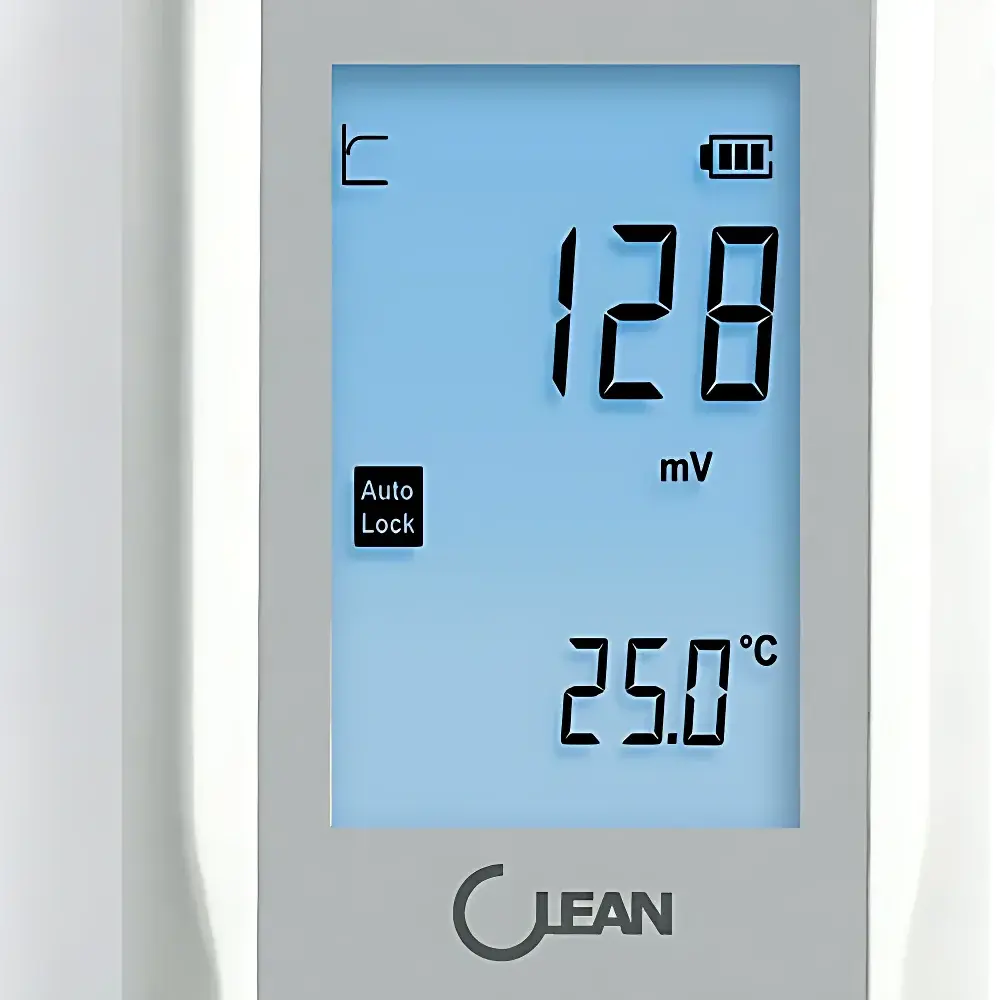
| Display | Multi-line LCD (21 × 34 mm) with auto-backlight |
| Ingress Protection | IP67 |
| Auto-power-off | 5 minutes of inactivity |
| Power | 1 × 1.5 V AAA battery |
| Dimensions (H×W×D) | 185 × 40 × 48 mm |
| Weight | 95 g |
Overview
The CLEAN ORP30 Portable Oxidation-Reduction Potential (ORP) Meter is a field-deployable, electrochemical measurement instrument engineered for reliable, real-time quantification of redox potential in aqueous systems. Operating on the principle of potentiometric measurement, the ORP30 detects the voltage difference between a noble metal sensing electrode (platinum) and a stable reference electrode—typically Ag/AgCl—immersed in solution. This differential voltage, expressed in millivolts (mV), reflects the net tendency of a solution to gain or lose electrons, serving as a critical surrogate indicator for disinfection efficacy, chemical stability, microbial activity, and oxidation-reduction equilibrium in water matrices. Designed for both laboratory benchtop verification and unattended field deployment, the ORP30 delivers traceable, repeatable measurements without requiring external power sources or data loggers. Its compact ergonomic form factor, combined with robust environmental sealing and intuitive single-hand operation, ensures operational continuity across variable ambient conditions—from chlorinated pool decks to remote riverbank sampling sites.
Key Features
- IP67-rated enclosure providing full dust ingress protection and submersion resistance up to 1 meter for 30 minutes—validated per IEC 60529
- Float-capable housing design enabling safe deployment in open water bodies; integrated auto-hold function locks readings upon stabilization for rapid field documentation
- Replaceable CS2930 planar platinum disc ORP electrode with low polarization impedance and fast response time (<15 seconds to 95% of final value under standard conditions)
- Multi-line LCD display (21 × 34 mm active area) with adjustable auto-backlight (30-second timeout), optimized for legibility under low-light or high-glare conditions
- Tool-free maintenance architecture: battery and electrode replacement require no screws, adhesives, or specialized tools—facilitating rapid turnaround during routine calibration or field servicing
- Energy-efficient operation powered by a single 1.5 V AAA alkaline cell, supporting >2,000 measurement cycles per battery under typical usage profiles
- Intelligent power management with automatic shutdown after 5 minutes of user inactivity—compliant with IEC 62368-1 energy conservation guidelines
Sample Compatibility & Compliance
The ORP30 is validated for direct immersion measurement in potable water, wastewater effluents, swimming pool and spa recirculation systems, surface water (rivers, lakes, reservoirs), groundwater monitoring wells, and industrial process streams with conductivity ≥50 µS/cm. It is not intended for non-aqueous solvents, highly viscous slurries, or solutions containing suspended solids >100 mg/L without pre-filtration. The instrument complies with ASTM D1293–22 (Standard Test Methods for pH of Water) and ISO 5814:2012 (Water quality — Determination of dissolved oxygen — Electrochemical probe method), as both standards reference ORP as a supplementary parameter for process control validation. While the ORP30 itself does not carry CE marking or FDA 510(k) clearance, its electrical safety design adheres to UL 61010-1 and its measurement methodology aligns with EPA Method 150.1 (Oxidation-Reduction Potential) for ambient water quality surveillance programs.
Software & Data Management
The ORP30 operates as a standalone, microprocessor-controlled analog-to-digital conversion platform with no embedded firmware update capability or wireless connectivity. All measurement data remain resident on-device only and are not stored internally beyond the active display buffer. For regulatory traceability, users are advised to record values manually or integrate the ORP30 into validated paper-based or electronic laboratory notebooks (ELN) compliant with 21 CFR Part 11 requirements. Calibration events—including date, operator ID, standard solution lot numbers, and measured mV offsets—must be documented externally to satisfy GLP and ISO/IEC 17025 audit criteria. No proprietary software drivers or PC interfaces are provided; however, the device’s analog output characteristics are compatible with third-party analog input modules (e.g., LabJack U3-HV or National Instruments USB-6009) when used with appropriate signal conditioning.
Applications
- Chlorine residual efficacy monitoring in municipal drinking water distribution systems and recreational water facilities
- In-process redox control during biological wastewater treatment (e.g., denitrification zone verification in activated sludge basins)
- Field screening of sediment porewater redox status in wetland restoration and contaminated site assessments
- Verification of ozone or UV disinfection system performance via ORP threshold correlation (e.g., WHO-recommended ≥650 mV for pathogen inactivation)
- Quality assurance testing of reverse osmosis permeate and deionized water storage tanks
- Educational laboratory instruction on electrochemical principles, Nernst equation derivation, and water chemistry equilibria
FAQ
What calibration standards are required for the ORP30?
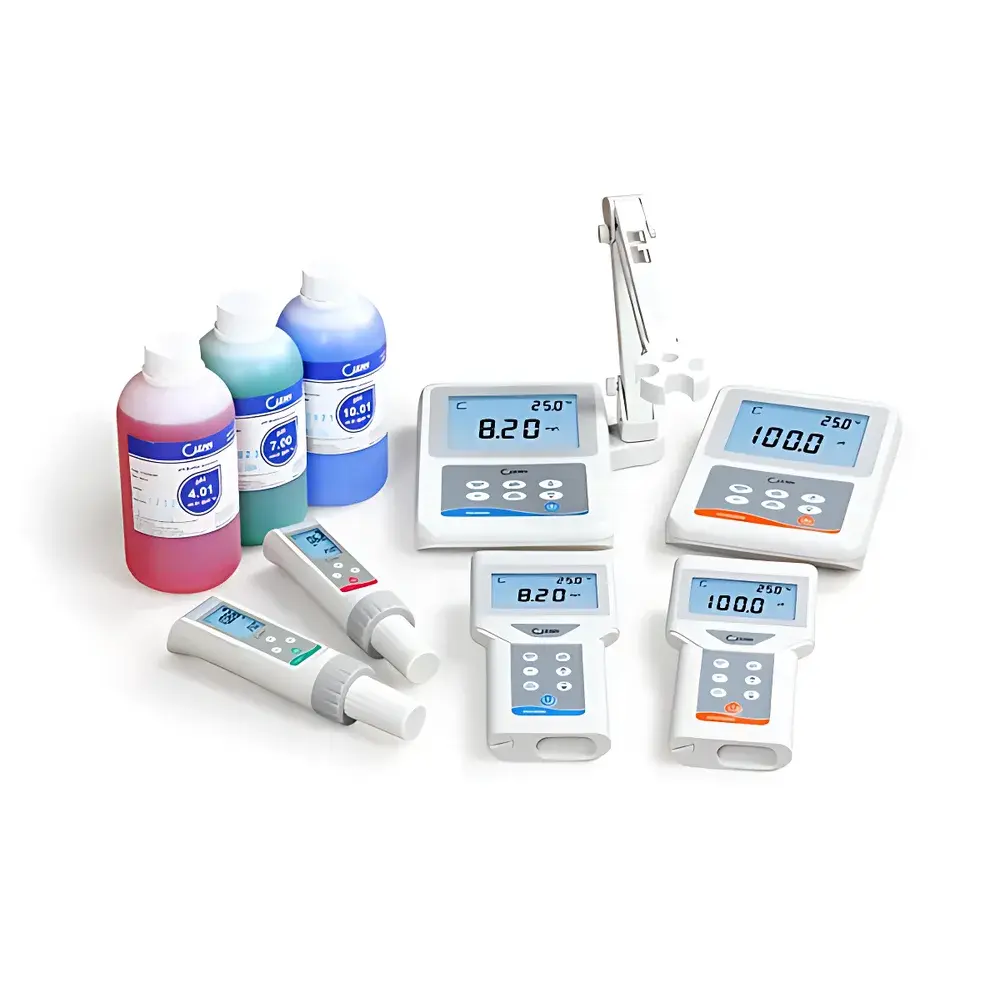
The ORP30 requires two certified redox buffer solutions: one at +86 mV (pH 4.01, quinhydrone-based) and another at +255 mV (pH 7.00, Zobell’s solution). Calibration must be performed before first use and after electrode replacement.
Can the ORP30 measure ORP in seawater?
Yes—provided the sample temperature remains within 0–40 °C and the electrode is rinsed thoroughly with deionized water after each use to prevent chloride-induced passivation of the platinum surface.
Is temperature compensation automatic?
No—the ORP30 displays simultaneous ORP and temperature readings but does not apply automatic temperature compensation (ATC) to ORP values, as per ISO 5814 guidance which treats ORP as an absolute potential metric rather than a compensated parameter.
How often should the CS2930 electrode be replaced?
Under normal use (≤5 measurements/day), electrode service life exceeds 18 months. Performance degradation is indicated by sluggish response (>30 s), drift >±5 mV over 10-minute static measurement, or inability to achieve stable calibration.
Does the ORP30 meet GLP documentation requirements?
The instrument supports GLP compliance through external recordkeeping only; it provides no built-in audit trail, timestamping, or electronic signature functionality.







