
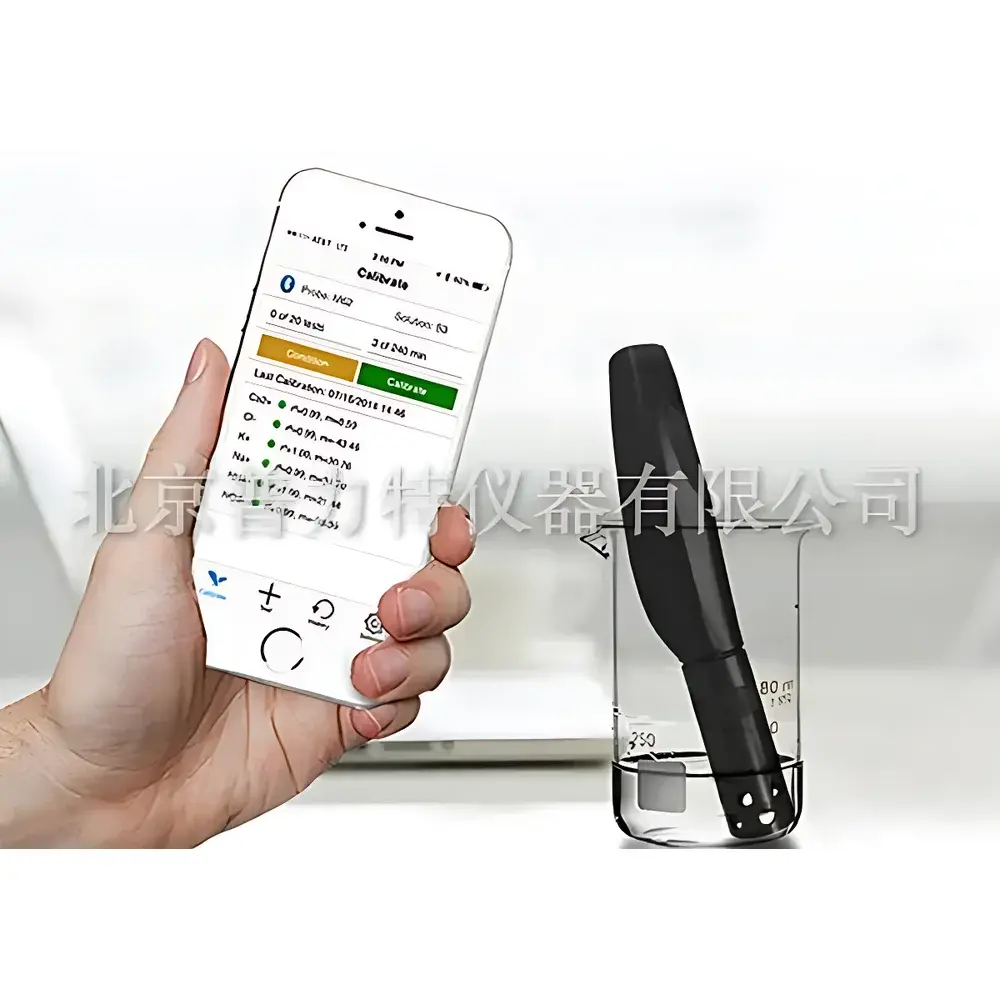
CleanGrow CleanGrow Multi-Ion Analyzer
| Origin | Ireland |
|---|---|
| Manufacturer Type | Distributor |
| Origin Category | Imported |
| Model | CleanGrow |
| Price Range | USD 6,800–13,600 (est.) |
| Instrument Type | Portable Multi-Ion Analyzer |
| Measurement Range | 0.5–60,000 ppm |
| Detection Limit | 0.1 ppm |
| Response Time | 1 second |
| Measurement Accuracy | ±0.1 ppm |
| Operating Temperature | Ambient (15–30 °C) |
| Sensor Slope (25 °C) | NH₄⁺: 54 ± 5 mV/decade |
| Ca²⁺ | 25 ± 5 mV/decade |
| Cl⁻ | 54 ± 5 mV/decade |
| NO₃⁻ | 58 ± 5 mV/decade |
| K⁺ | 54 ± 5 mV/decade |
| Na⁺ | 54 ± 5 mV/decade |
| Mg²⁺ | 25 ± 5 mV/decade |
| Linear Range (ppm) | NH₄⁺: 0.5–9,000 |
| Ca²⁺ | 0.1–4,000 |
| Cl⁻ | 1.5–35,000 |
| NO₃⁻ | 0.6–60,000 |
| K⁺ | 0.3–39,000 |
| Na⁺ | 2–2,500 |
| Mg²⁺ | 2.4–2,400 |
| pH Compatibility Range | 3.5–9.0 |
| Resolution | 0.1 ppm |
| Power Supply | Rechargeable Li-ion battery |
| Interface | iOS-compatible via Bluetooth (iPhone/iPad) |
| Dimensions | 3.5 cm × 18 cm |
Overview
The CleanGrow Multi-Ion Analyzer is a field-deployable, potentiometric ion-selective sensor platform engineered for simultaneous, real-time quantification of seven major aqueous ionic species: ammonium (NH₄⁺), potassium (K⁺), sodium (Na⁺), calcium (Ca²⁺), magnesium (Mg²⁺), chloride (Cl⁻), and nitrate (NO₃⁻). Unlike optical or chromatographic methods, the CleanGrow employs solid-state, non-enzyme-based ion-selective electrodes (ISEs) operating on the Nernst principle—transducing ionic activity into measurable millivolt potentials with logarithmic response across six decades of concentration. Its design prioritizes operational robustness in variable environmental conditions, eliminating dependence on carrier buffers, reagents, or high-pressure fluidics. The instrument delivers laboratory-grade reproducibility (±0.1 ppm accuracy, <1 s response) without requiring controlled lab infrastructure—making it suitable for regulatory monitoring, agricultural runoff assessment, aquaculture management, and drinking water verification under ISO 5667-3 and EPA Method 300.1 guidelines.
Key Features
- Simultaneous detection of up to seven ions in a single 20-second measurement cycle, with full six-sensor calibration completed in under 60 seconds
- Potentiometric ISE array with factory-trimmed slopes (e.g., 54 ± 5 mV/decade for monovalent cations/anions; 25 ± 5 mV/decade for divalent ions) ensuring traceable electrochemical performance
- True portable architecture: compact 3.5 cm × 18 cm form factor powered by integrated rechargeable Li-ion battery (≥12 h continuous operation)
- Bluetooth 5.0 interface compliant with iOS 14+ devices; no external PC or dedicated hardware required for operation or data export
- Dry-storage compatible sensors—no hydration or conditioning required between uses; minimal maintenance beyond periodic slope verification
- On-device metadata tagging: automatic timestamping, geolocation (via paired iOS device GPS), and user-annotated notes embedded in each measurement record
Sample Compatibility & Compliance
The CleanGrow accepts untreated liquid samples within pH 3.5–9.0 and conductivity ≤5 mS/cm. It is validated for use with surface water, groundwater, irrigation channels, hydroponic nutrient solutions, wastewater effluents, and potable water matrices. All sensor response characteristics conform to ISO 15195:2018 (reference measurement procedures for electrolytes) and support GLP-compliant workflows through audit-trail-enabled data logging. While not certified for clinical diagnostics, its measurement uncertainty profile aligns with EPA-approved ISE-based protocols for ambient water quality reporting (e.g., 40 CFR Part 136). No buffer addition, filtration, or dilution is required for samples within linear range—reducing procedural error and consumables cost.
Software & Data Management
The proprietary CleanGrow iOS application provides full instrument control, real-time visualization, and structured data export. Each session logs raw mV signals, calculated concentrations (ppm), calibration diagnostics (including R² and residual deviation per electrode), and contextual metadata. Export options include CSV and Excel (.xlsx) formats compatible with LIMS integration. All data files are digitally signed and timestamped; local storage persists across app updates. The software enforces user-defined calibration validity windows and flags out-of-spec responses—supporting 21 CFR Part 11 readiness when deployed with institutional Apple Device Enrollment Program (DEP) policies and managed iOS configurations.
Applications
- Agricultural water management: real-time tracking of K⁺, NO₃⁻, and NH₄⁺ in fertigation systems to prevent over-application and leaching
- Aquaculture facility monitoring: concurrent Mg²⁺, Ca²⁺, and Cl⁻ profiling to maintain optimal osmoregulatory balance in recirculating systems
- Environmental compliance: rapid screening of Cl⁻ and NO₃⁻ in stormwater runoff per NPDES permit requirements
- Hydroponics & controlled-environment agriculture: daily nutrient solution auditing without sending samples to off-site labs
- Drinking water safety verification: field confirmation of Na⁺ and NO₃⁻ against WHO Guideline Values (200 mg/L and 50 mg/L respectively)
- Educational laboratories: hands-on teaching of ion-selective electrode theory, Nernst equation derivation, and multi-analyte interference correction
FAQ
Does the CleanGrow require calibration buffers or reference solutions?
No. Calibration uses dry-standardized solid-state reference tablets included with each sensor kit—eliminating liquid buffer preparation, shelf-life concerns, and cross-contamination risk.
Can measurements be performed in turbid or particulate-laden water?
Yes—provided particles do not physically obstruct the sensor membrane surface. No filtration is mandated unless suspended solids exceed 50 mg/L and cause signal drift.
Is the device compliant with ISO/IEC 17025 or accredited testing standards?
While the CleanGrow itself is not an accredited testing body, its documented measurement uncertainty (±0.1 ppm at mid-range), traceable calibration methodology, and data integrity controls enable laboratories to incorporate it into ISO/IEC 17025:2017-compliant validation protocols.
How often must sensors be replaced?
Typical service life exceeds 18 months under weekly field use; lifetime is tracked automatically in-app based on cumulative exposure time and calibration stability metrics.
Can historical data be synchronized across multiple iOS devices?
Yes—when configured with a shared iCloud account or enterprise MDM solution, measurement libraries and calibration histories synchronize securely across authorized devices.
Related Products







