
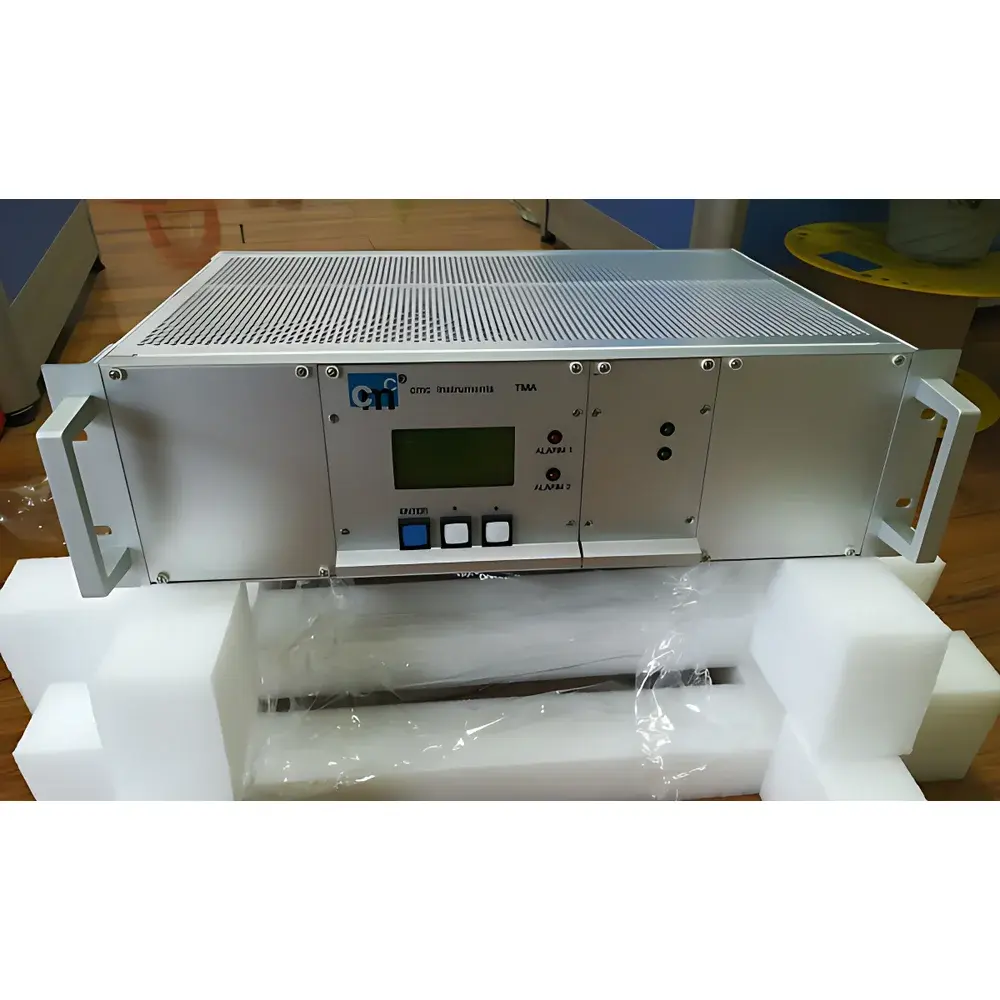
CMC TMA-202-19 Electrolytic Trace Moisture Analyzer
| Origin | Germany |
|---|---|
| Manufacturer Type | Authorized Distributor |
| Origin Category | Imported |
| Model | TMA-202-19 |
| Price Range | USD 13,500–27,000 (FOB) |
| Product Type | Online Dew Point Analyzer |
| Measurement Principle | Electrolytic (P2O5 Sensor) |
| Operating Temperature | -20 to +50 °C |
| Accuracy | ±1 ppmv (H₂O) |
| Repeatability | ±1 ppmv (H₂O) |
| Measurement Range | 0–10 / 0–100 / 0–1000 / 0–2500 ppmv (Auto-ranging) |
| Full-Scale Accuracy | ±1% FS |
| Sensitivity | 0.1% FS |
| Display | Backlit LCD |
| Analog Output | 4–20 mA or 0–10 V (isolated) |
| Alarm Outputs | 2 SPDT relays (configurable) |
| Sample Flow Rate | 20 Nl/h |
| Recommended Sample Pressure | 0.1–0.5 barg |
| Sample Temperature | 5–150 °C |
| T₉₀ Response Time | <1 s |
| T₅₀ Response Time | <8 s |
| Ambient Operating Temperature | 5–65 °C |
| Cable Length | Standard 3 m (up to 300 m optional) |
| Dimensions (Rack Mount) | 482 × 133 × 350 mm (W×H×D) |
| Dimensions (Wall Mount) | 300 × 260 × 280 mm |
| Dimensions (Desktop) | 257 × 160 × 316 mm |
Overview
The CMC TMA-202-19 is a high-stability, online trace moisture analyzer engineered for continuous, real-time monitoring of water vapor concentration in industrial process gases and purified carrier streams. It employs the well-established electrolytic measurement principle based on phosphorus pentoxide (P2O5) sensor technology—where water molecules are quantitatively decomposed at an anode surface and reformed at a cathode, generating a current directly proportional to the water concentration. This amperometric detection method delivers exceptional sensitivity and long-term baseline stability in ultra-dry environments (down to single-digit ppmv), making it suitable for applications demanding stringent moisture control, such as semiconductor purge gas monitoring, SF6 insulation gas verification, hydrogen fuel cell feed gas qualification, and pharmaceutical nitrogen blanketing systems.
Key Features
- Electrolytic P2O5 sensing cell with dual-electrode architecture (platinum or rhodium options) ensures consistent electrochemical efficiency and low drift over extended operation.
- Auto-ranging capability across four selectable spans (0–10, 0–100, 0–1000, 0–2500 ppmv) enables seamless adaptation to varying process conditions without manual recalibration.
- Fast response dynamics: T90 < 1 second and T50 < 8 seconds support dynamic process control and rapid fault detection in critical gas loops.
- Rugged, modular housing available in rack-mount, wall-mount, and desktop configurations—designed for integration into control rooms, skids, or field enclosures compliant with IP65 ingress protection.
- Isolated 4–20 mA analog output with HART protocol support (optional) facilitates compatibility with DCS, PLC, and SCADA systems while maintaining signal integrity over long cable runs (up to 300 m).
- Dual configurable alarm relays provide fail-safe dryness violation signaling for interlock or shutdown logic per IEC 61511 functional safety guidelines.
Sample Compatibility & Compliance
The TMA-202-19 accommodates a broad range of non-corrosive and mildly corrosive process gases—including N2, Ar, He, H2, O2, CO2, SF6, and synthetic air—within a sample temperature range of 5–150 °C and pressure range of 0.1–0.5 barg. Optional sensor cells constructed from stainless steel (SS), Monel, Hastelloy, borosilicate glass, or PFA enable chemical compatibility with aggressive media such as chlorine, ammonia, or HF-containing streams. All configurations meet CE marking requirements under the EU Electromagnetic Compatibility Directive 2014/30/EU and Low Voltage Directive 2014/35/EU. The analyzer supports audit-ready data logging and complies with GLP/GMP documentation expectations when paired with validated software workflows.
Software & Data Management
The embedded firmware supports local parameter configuration via front-panel navigation and provides timestamped event logs for calibration history, alarm triggers, and sensor diagnostics. When connected to CMC’s optional PC-based configuration utility (TMA-Config v3.2), users gain access to advanced features including multi-point calibration validation, sensor life estimation, trend charting, and exportable CSV reports. For enterprise-level integration, the device supports Modbus RTU over RS-485 (optional) and can be incorporated into centralized asset management platforms aligned with ISA-95 and ISO/IEC 17025 traceability frameworks. All calibration and operational records adhere to FDA 21 CFR Part 11 requirements when electronic signatures and audit trails are enabled.
Applications
- Monitoring dew point stability in nitrogen generators used for electronics manufacturing cleanrooms.
- Verifying moisture content in SF6 gas prior to injection into high-voltage circuit breakers (per IEC 60480 and ASTM D2029).
- Ensuring hydrogen purity compliance (<1 ppmv H2O) for PEM fuel cell stack inlet specifications (ISO 8573-8 Class 1).
- Controlling drying efficiency in vacuum ovens and freeze-dryers during pharmaceutical lyophilization cycles.
- Validating dryness of compressed air systems serving pneumatic instrumentation in food processing lines (ISO 8573-1 Class 2).
- Supporting quality assurance in specialty gas production facilities certified to ISO 8573-1 and CGA G-13 standards.
FAQ
What is the recommended calibration frequency for the TMA-202-19 in continuous operation?
Calibration should be performed at least once every 6 months under stable operating conditions; more frequent verification (e.g., quarterly) is advised when measuring highly variable or reactive gas matrices.
Can the electrolytic sensor be regenerated in situ after exposure to condensable contaminants?
No—P2O5 sensors are not regenerable. Exposure to liquid water, oils, or silicones causes irreversible degradation; proper sample conditioning (filtration, coalescing, and cooling) upstream is mandatory.
Is the TMA-202-19 compatible with hazardous area installations?
The base unit is rated for general-purpose use (non-hazardous locations); intrinsic safety barriers or explosion-proof enclosures must be applied externally per ATEX/IECEx Zone 2 requirements.
How does the accuracy specification of ±1 ppmv apply across the full measurement range?
This absolute uncertainty applies only within the 0–10 ppmv span; for higher ranges, accuracy is specified as ±1% of full scale (e.g., ±10 ppmv at 0–1000 ppmv range).
Does the analyzer support remote diagnostics via Ethernet or wireless protocols?
Standard configuration includes RS-232 and RS-485 interfaces; Ethernet/IP or Wi-Fi connectivity requires optional communication modules and firmware upgrade (TMA-Net v2.1).





