
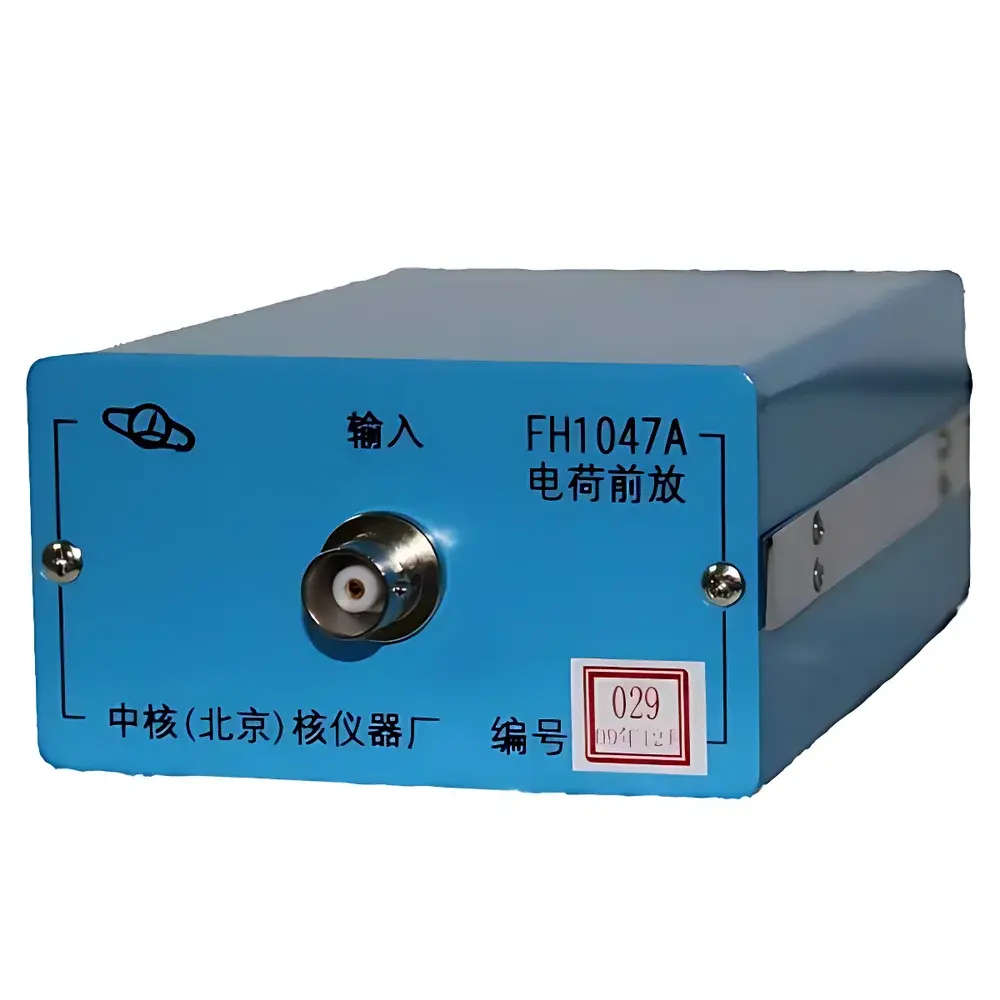
CNCS FH1047A Charge-Sensitive Preamplifier
| Brand | CNCS |
|---|---|
| Origin | Beijing, China |
| Manufacturer Type | Authorized Distributor |
| Country of Origin | China |
| Model | FH1047A |
| Pricing | Available Upon Request |
| Charge Sensitivity | 1×10¹² V/C or 40 mV/MeV (Si) |
| Noise Performance (FWHM, Si) | ≤2.2 keV + 0.05 keV/pF (Type A, typical 1.5 keV + 0.04 keV/pF) / ≤2.5 keV + 0.03 keV/pF (Type B, typical 1.5 keV + 0.03 keV/pF) |
| Output Pulse Rise Time | ≤30 ns (with zero external capacitance) |
| Max Linear Output Range | +2 V (1 kΩ load) |
| Operating Temperature | 0–50 °C |
| Relative Humidity | ≤90% at +40 °C |
Overview
The CNCS FH1047A is a high-performance charge-sensitive preamplifier engineered for low-noise, high-resolution alpha-particle spectroscopy in ambient-temperature laboratory and nuclear measurement environments. Designed specifically for integration with silicon surface-barrier (SSB) semiconductor detectors, the FH1047A serves as the critical first-stage signal conditioning unit in α-spectrometry systems—converting minute charge pulses generated by incident ionizing radiation into stable, measurable voltage signals. Its core architecture employs an N-channel field-effect transistor (N-FET) as the input device, optimized for ultra-low input capacitance and minimal gate leakage current—key prerequisites for preserving energy resolution and signal integrity in pulse-height analysis applications. Unlike general-purpose amplifiers, the FH1047A is characterized by its precisely calibrated charge-to-voltage gain (1×10¹² V/C), enabling direct correlation between output amplitude and deposited particle energy in silicon (40 mV/MeV). This deterministic relationship underpins quantitative nuclide identification and activity determination in nuclear safeguards, environmental radioactivity monitoring, and materials assay workflows.
Key Features
- N-channel FET input stage for exceptionally low input noise and high input impedance (>10¹⁵ Ω)
- Charge sensitivity of 1×10¹² V/C (equivalent to 40 mV/MeV in Si), traceable to fundamental detector physics
- Two noise-optimized variants: FH1047A (≤2.2 keV + 0.05 keV/pF FWHM, Si) and FH1047B (≤2.5 keV + 0.03 keV/pF FWHM, Si), both delivering typical performance of 1.5 keV + 0.04 keV/pF (A) or 1.5 keV + 0.03 keV/pF (B)
- Fast pulse response: ≤30 ns rise time under zero external capacitance conditions—ensuring minimal pulse pile-up in high-count-rate scenarios
- Linear output range of ±2 V into 1 kΩ load, compatible with standard shaping amplifiers and multichannel analyzers (MCAs)
- Robust thermal design supporting continuous operation from 0 °C to 50 °C with humidity tolerance up to 90% RH at +40 °C
Sample Compatibility & Compliance
The FH1047A is validated for use with planar and passivated ion-implanted silicon surface-barrier detectors (typically 30–500 mm² active area) operating in vacuum or dry nitrogen environments. It complies with IEC 61000-6-3 (EMI emission limits) and IEC 61000-6-2 (immunity to electrostatic discharge and RF fields), ensuring stable operation in shared nuclear instrumentation racks. While not certified to ISO/IEC 17025 for calibration laboratories per se, its performance specifications align with ASTM E1452–22 (Standard Guide for Calibration of Alpha Spectrometry Systems) and support GLP-compliant data acquisition when integrated into validated spectrometer configurations. Traceable documentation—including factory test reports verifying noise FWHM, gain linearity, and temperature drift (<0.02%/°C)—is provided with each unit.
Software & Data Management
The FH1047A operates as a hardware-level analog signal conditioner and does not incorporate embedded firmware or digital interfaces. It delivers analog output directly to downstream spectroscopic electronics (e.g., spectroscopy amplifiers, ADC modules, or MCAs such as ORTEC ASPEC-927 or Canberra DSA-1000). When paired with compliant MCA software (e.g., Maestro™, Genie™ 2000, or PyMCA), full audit trails—including amplifier gain settings, acquisition timestamps, and detector bias history—can be maintained in accordance with FDA 21 CFR Part 11 requirements via system-level validation protocols. No proprietary drivers or configuration utilities are required; signal integrity is preserved through standard 50-Ω coaxial interconnects (e.g., SHV or LEMO-00).
Applications
- Alpha-particle energy spectroscopy for uranium, plutonium, americium, and polonium isotopic analysis
- Environmental monitoring of radionuclides in soil, air filters, and swipe samples per EPA Method 901.1
- Nuclear fuel cycle QA/QC: verification of enrichment levels, burnup assessment, and contamination screening
- Research-grade nuclear physics experiments requiring sub-keV energy resolution at room temperature
- Calibration source characterization using ²⁴¹Am, ²³⁹Pu, and mixed-α standards
FAQ
Is the FH1047A compatible with cryogenic detectors?
No—the FH1047A is optimized for room-temperature silicon surface-barrier detectors. For liquid-nitrogen-cooled HPGe or Si(Li) systems, a low-capacitance, cryo-compatible preamplifier with different biasing and thermal management is required.
Can it be used with PIN diode detectors?
Yes, provided the detector’s leakage current remains below 1 nA and capacitance is within 10–100 pF. Performance validation (noise, resolution) must be conducted empirically for each detector pairing.
Does it support remote gain adjustment?
No—gain is fixed by internal feedback components. Output scaling is adjusted externally via the main amplifier or MCA gain controls.
What is the recommended power supply?
±12 V DC, regulated, with ripple <5 mV RMS; current draw: ≤25 mA per rail. Standard NIM or CAMAC crate supplies are suitable.
Is CE marking available?
Units supplied to EU markets include CE marking per EMC Directive 2014/30/EU and RoHS 2011/65/EU compliance documentation.




