
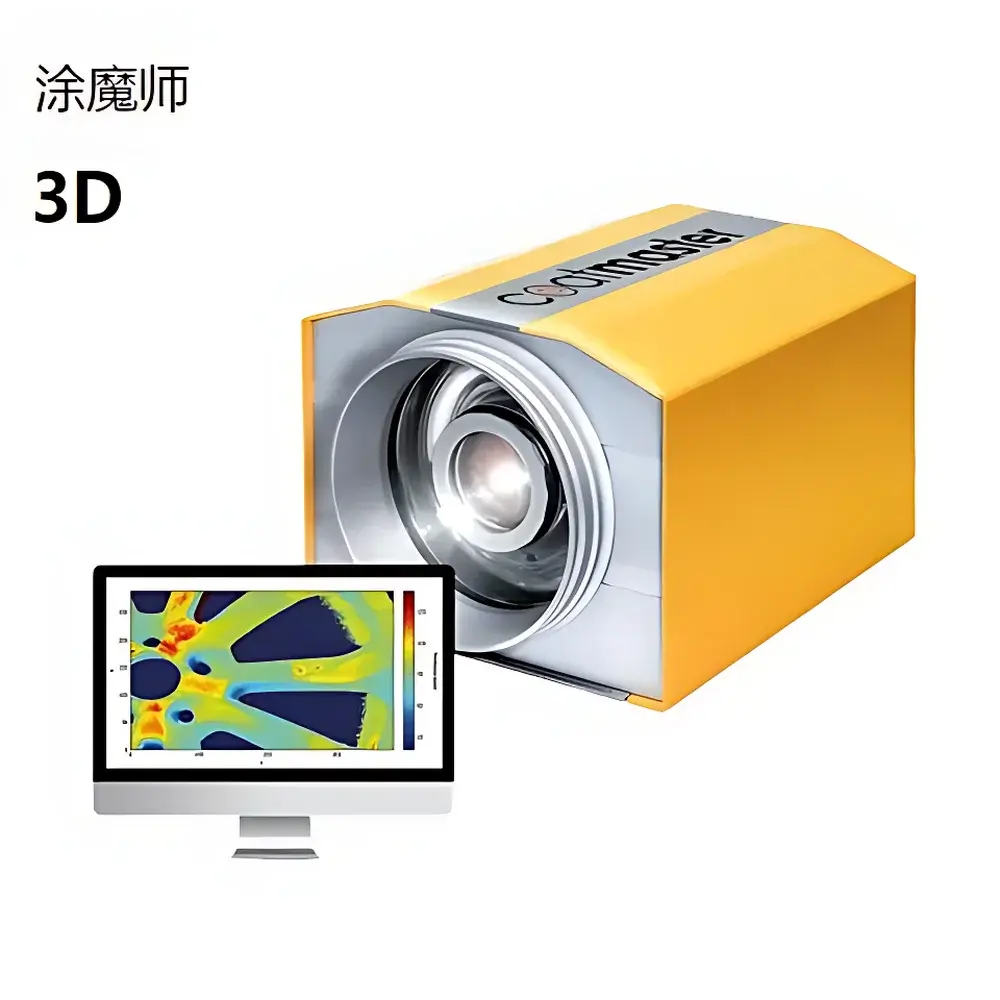
Coatmaster 3D Non-Contact Thickness Analyzer
| Brand | Coatmaster |
|---|---|
| Origin | Switzerland |
| Model | Coatmaster 3D |
| Measurement Principle | Thermal Spectral Profilometry (TSP) |
| Measurement Range | 1–2000 µm |
| Measurement Time | 0.5 s per frame |
| Measurement Distance | 10–120 cm (material-dependent) |
| Tilt Tolerance | ±45° (material-dependent) |
| Relative Standard Deviation | < 2% (on 60 µm uncured powder coating over aluminum substrate at 5 cm distance) |
| Max. Substrate Speed | 120 m/min |
| Color Independence | Full-spectrum — including white and highly reflective surfaces |
| Spatial Resolution | Adjustable via user-defined ROI |
| Data Export | Automated CSV/Excel-compatible structured logs |
| Interface | SPS, Ethernet/IP, OPC UA for PLC integration |
| Compliance | Designed for ISO 2178, ISO 2360, ASTM D7091 alignment |
Overview
The Coatmaster 3D Non-Contact Thickness Analyzer is an industrial-grade, real-time optical metrology system engineered for in-line measurement of uncured powder coatings and liquid paint films on moving substrates. Unlike conventional contact or eddy-current gauges, it employs Thermal Spectral Profilometry (TSP)—a patented non-destructive optical technique that analyzes thermal emission spectra modulated by coating thickness and substrate thermal properties. This principle enables absolute thickness quantification without physical contact, calibration drift, or surface reflectivity bias—making it uniquely suited for high-speed, high-mix production environments where part geometry, color variation, and dynamic motion present persistent challenges to traditional metrology.
Key Features
- True non-contact operation: No mechanical probing, no risk of surface damage or contamination—critical for pre-cure powder layers.
- Full-field 2D thickness mapping: Captures spatial distribution across arbitrarily defined regions of interest (ROI), not just single-point values.
- Real-time acquisition at 2 Hz frame rate: Delivers thickness data synchronized with conveyor motion up to 120 m/min.
- Material-agnostic tilt tolerance: Operates reliably at ±45° incidence angles—enabling measurement on complex geometries including curved surfaces, internal cavities, edges, and recessed features.
- Color-invariant performance: Validated across the full visible spectrum—including high-albedo white, metallic, and textured finishes—eliminating need for substrate-specific calibration.
- Modular integration architecture: Native support for SPS, EtherNet/IP, and OPC UA protocols ensures seamless interoperability with existing PLCs, SCADA systems, and MES platforms.
Sample Compatibility & Compliance
The Coatmaster 3D is validated for use on metallic (aluminum, steel), composite, and thermally stable non-metallic substrates carrying uncured thermoset powders (epoxy, polyester, hybrid) and solvent-borne/waterborne liquid coatings. Its measurement range (1–2000 µm) covers typical industrial powder film builds used in automotive, appliance, and architectural applications. While not a certified reference instrument per se, its output aligns with traceable standards including ISO 2178 (non-magnetic coatings on magnetic substrates), ISO 2360 (non-conductive coatings on non-magnetic conductive substrates), and ASTM D7091 (non-destructive measurement of dry film thickness). Optional software modules provide 21 CFR Part 11–compliant electronic signatures, audit trails, and role-based access control—meeting requirements for regulated manufacturing under GLP and GMP frameworks.
Software & Data Management
The Coatmaster Control Suite provides deterministic data handling: every acquired frame is timestamped, georeferenced to conveyor position (via encoder input), and stored in structured, metadata-enriched CSV files. Statistical process monitoring (SPC) tools calculate Cpk, Ppk, mean shift, and trend analysis directly from thickness maps—not averaged point data. Users define upper/lower specification limits (USL/LSL) per zone; real-time visual alerts trigger when local thickness deviates beyond thresholds. Historical datasets are queryable by batch ID, shift, operator, or equipment ID. All logs are immutable post-acquisition and exportable for external QA review or regulatory submission. Integration with factory historians (e.g., OSIsoft PI, Ignition) is supported via standard REST APIs.
Applications
- Automotive body shop: In-line verification of electrocoat (E-coat) and primer-surfacer thickness prior to curing—reducing oven energy waste and improving corrosion resistance consistency.
- Appliance coil coating lines: Monitoring uniformity across wide-width continuous strips, detecting edge thinning or roller marks before final winding.
- Aerospace component finishing: Measuring complex 3D parts (e.g., turbine housings, ducting) without fixturing or repositioning.
- Architectural aluminum extrusion: Ensuring compliance with AAMA 2604/2605 specifications across variable-profile curtain wall sections.
- R&D laboratories: Accelerating formulation trials by eliminating manual cross-sectioning and SEM validation for early-stage powder development.
FAQ
Does the Coatmaster 3D require recalibration when switching between different substrate materials?
No—TSP inherently compensates for substrate emissivity and thermal diffusivity through multi-wavelength spectral modeling. Material-specific setup is limited to selecting pre-validated substrate class profiles (e.g., “Aluminum – Anodized”, “Cold-Rolled Steel – Oiled”) within the software interface.
Can it measure over primer layers or multi-layer stacks?
Yes—the system resolves total dry film thickness (DFT) of the topmost uncured layer. For multi-layer cured systems, it measures only the outermost uncured coat; simultaneous multi-layer resolution requires complementary techniques such as FTIR or XRF.
Is ambient lighting or车间 illumination a factor in measurement stability?
No—TSP operates in the mid-wave infrared (MWIR) band (3–5 µm), rendering it immune to visible light interference, shadowing, or ambient thermal radiation below 100°C.
What level of IT infrastructure is required for deployment?
A dedicated industrial PC (Windows 10/11 IoT LTSC) with GigE NIC and 16 GB RAM suffices for standalone operation. For enterprise-scale deployment, virtualized instances on VMware or Hyper-V are supported with redundant NAS storage for long-term log retention.
How does it interface with Industry 4.0 digital twin initiatives?
Thickness maps are published as OPC UA Information Models with semantic tags (e.g., “Coating_Thickness_Map_Zone_A”, “Mean_DFT_mm”), enabling direct ingestion into digital twin simulation engines for predictive process optimization and root-cause analysis.



