
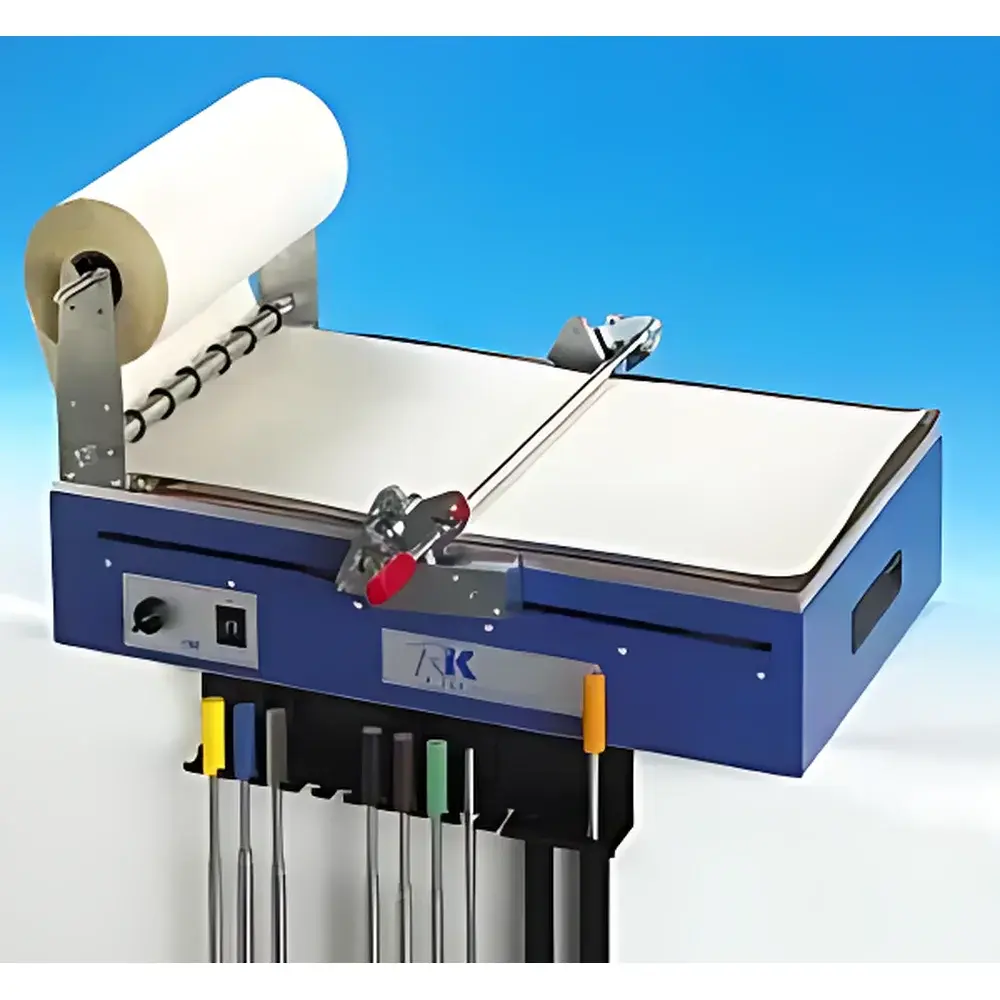
RK K303 Precision Coating Machine for Ink and Pigment Lab-Scale Proofing
| Brand | RK |
|---|---|
| Origin | United Kingdom |
| Model | K303 |
| Coating Speed Range | 1–39 m/min |
| Standard Substrate Support | Tri-layer composite pad (Melinex®/foam/rubber) |
| Optional Substrate Platforms | Vacuum, magnetic, heated, or glass-backed |
| Coating Method | Wire-wound rod (metering rod) with precision wound stainless steel wire |
| Wet Film Thickness Range | 4–120 µm (standard wound rods) |
| Drive Type | Electric or pneumatic (ATEX-compliant for hazardous areas) |
| Rod Cleaning | Integrated comb-style cleaning plate |
| Compliance | Designed for ISO 2836-1 (printing inks), ASTM D823 (coating application), and GLP-aligned lab workflows |
Overview
The RK K303 Precision Coating Machine is an engineered solution for controlled, reproducible lab-scale deposition of liquid coatings—including printing inks, pigment dispersions, paints, varnishes, and functional thin-film formulations—onto flexible and rigid substrates. It operates on the principle of metered wire-wound rod (also known as Mayer rod) coating, where a precisely wound stainless steel wire rod transfers a defined volume of fluid onto the substrate surface during linear translation. The geometry of the wound wire—its diameter, pitch, and winding pattern—dictates the wet film thickness with high repeatability under fixed speed and pressure conditions. Unlike spray or slot-die methods, the K303 delivers deterministic, non-turbulent fluid transfer ideal for formulation development, batch-to-batch comparison, and QC screening in R&D and quality assurance laboratories across ink manufacturing, packaging, graphic arts, and advanced materials sectors.
Key Features
- Motorized or pneumatically driven carriage ensures consistent line speed (1–39 m/min) and uniform downforce—critical for minimizing shear-induced viscosity artifacts and achieving <±2% inter-run thickness variation across identical rod/substrate combinations.
- Interchangeable coating heads support rapid method switching: standard wire-wound rods (4–120 µm), helical-wound rods (150–500 µm), flexographic proofing heads, and gravure (intaglio) proofing modules—all mounted via standardized quick-lock interface.
- Integrated comb-style cleaning plate enables mechanical removal of residual pigment or binder from rods and ink reservoirs without solvent immersion, reducing cross-contamination risk and downtime between samples.
- Modular substrate platform system accommodates standard tri-layer composite pads (Melinex® polyester film / closed-cell foam / rubber backing) as well as optional vacuum-chuck, magnetic, heated (up to 80°C), or optically flat glass plates for specialized adhesion, drying kinetics, or optical characterization studies.
- Robust aluminum frame with precision-ground linear rails and calibrated tension control ensures long-term mechanical stability and positional repeatability—essential for traceable, audit-ready lab documentation.
Sample Compatibility & Compliance
The K303 accepts substrates ranging from 25 µm PET films and 80 g/m² uncoated paper to rigid aluminum foil and pre-treated polymer sheets (max. width: 300 mm; max. length: 400 mm). Its open architecture permits direct integration with environmental chambers or inline spectrophotometers for real-time gloss, color, or film uniformity monitoring. The system complies with core standards governing coating application in industrial R&D: ISO 2836-1 (graphic technology — inks — determination of printability), ASTM D823 (practices for producing films of uniform thickness), and ISO 15528 (paints, varnishes and raw materials for paints and varnishes — sampling). When configured with password-protected user accounts, audit trail logging, and electronic signature capability (via optional RK ControlSuite software), it supports GLP and GMP-aligned workflows per FDA 21 CFR Part 11 requirements.
Software & Data Management
While the base K303 operates via tactile controls and analog speed adjustment, optional RK ControlSuite software (Windows-based) enables full parameter logging—including speed setpoint, actual carriage velocity, ambient temperature/humidity (via external sensor input), operator ID, and timestamped rod ID—for each run. Exportable CSV reports link coating parameters directly to downstream analytical results (e.g., gloss at 60°, DOI, pencil hardness, or SEM cross-section measurements). All configuration changes are recorded with immutable timestamps, satisfying traceability demands for internal audits and regulatory submissions.
Applications
- Rapid comparative evaluation of ink rheology modifiers (e.g., fumed silica vs. organoclay thixotropes) via side-by-side wet film thickness and leveling behavior.
- Development of low-VOC water-based flexo inks using controlled drying profiles on heated platforms.
- Pre-screening of pigment dispersion stability by measuring edge defects, mottle, or orange peel after controlled drawdown on standardized substrates.
- Calibration support for online thickness gauges (e.g., beta-backscatter or eddy current sensors) using certified reference films deposited under validated K303 protocols.
- Teaching labs demonstrating Newtonian vs. non-Newtonian coating flow behavior through systematic speed-thickness correlation studies.
FAQ
What rod types are compatible with the K303?
Standard wire-wound rods (4–120 µm), helical-wound rods (150–500 µm), and OEM-specific flexo/gravure proofing heads are supported via mechanical mounting interfaces.
Can the K303 be used in explosion-proof environments?
Yes—the pneumatic drive variant meets ATEX Category 3G (Zone 2) and IECEx standards for use in areas with potentially explosive atmospheres.
Is calibration certification available?
RK provides factory-verified speed calibration certificates (traceable to UKAS-accredited standards) upon request; annual recalibration services are offered globally.
How is film thickness verified post-coating?
Users typically employ non-contact profilometry (e.g., white-light interferometry), micrometer-based dry-film measurement (per ISO 2808), or gravimetric analysis (mass gain per unit area) depending on coating composition and substrate porosity.
Does the K303 support automated data export to LIMS?
Via RK ControlSuite’s OPC UA or REST API interface, raw run logs and metadata can be pushed to enterprise LIMS or MES platforms compliant with ASTM E1578 or ISO/IEC 17025 data integrity requirements.




