
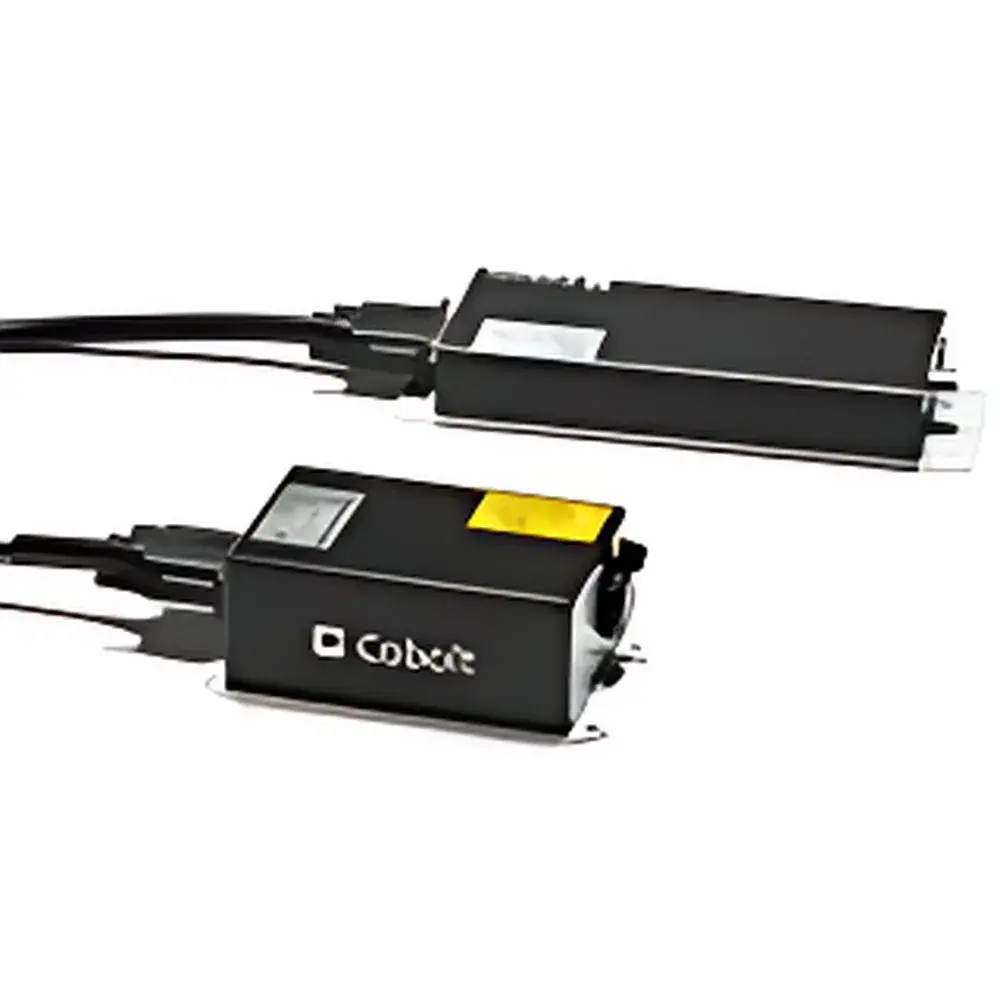
Cobolt newopto Mid-IR OPO Laser System
| Brand | Cobolt |
|---|---|
| Origin | Sweden |
| Manufacturer Type | Authorized Distributor |
| Product Origin | Imported |
| Model | newopto |
| Price | Upon Request |
| Center Wavelength Range | 2–5 µm |
| Average Output Power | >100 mW |
| Repetition Rate | >10 kHz |
| Pulse Width | <5 ns |
| Pulse Energy | >5 µJ |
| Spectral Bandwidth | <1.5 nm |
| Tuning Range | >10 nm (via crystal temperature) |
| Beam Ellipticity | >0.90:1 |
| Collimated Beam Diameter | 1.5 mm |
| Full-Angle Beam Divergence | <3.5 mrad |
| Pulse-to-Pulse Timing Jitter | <1 µs |
| 8-Hour Long-Term Power Stability | <3% |
| Total System Power Consumption | <63 W |
| Operating Temperature | 10–40 °C |
| Laser Head Dimensions (L×W×H) | 125 × 70 × 45 mm |
| Controller Dimensions (L×W×H) | 190 × 72 × 28 mm |
| Communication Interface | RS-232 or USB |
| Warranty | 12 months |
Overview
The Cobolt newopto Mid-IR OPO Laser System is a compact, turnkey optical parametric oscillator engineered for high-stability mid-infrared generation via quasi-phase-matched nonlinear frequency conversion in periodically poled lithium niobate (PPLN) or similar ferroelectric crystals. Operating on the principle of stimulated parametric down-conversion, this system accepts a near-infrared pump laser (typically 1064 nm or 1550 nm) and generates tunable signal and idler beams across the 2–5 µm spectral region—encompassing fundamental vibrational absorption bands of numerous gases, hydrocarbons, and biomolecules. Its all-solid-state architecture eliminates moving parts in the optical path, delivering robust performance in laboratory, industrial, and field-deployable OEM environments. Designed to meet the demanding requirements of trace gas analysis, process monitoring, and spectroscopic research, the system complies with IEC 60825-1:2014 for Class 4 laser safety when properly interlocked and enclosed.
Key Features
- Wide mid-infrared tuning range: center wavelength configurable from 2.0 to 5.0 µm via precise PPLN crystal temperature control (tuning step resolution 10 nm per setting)
- High peak power and pulse fidelity: 5 µJ pulse energy, and <1 µs pulse-to-pulse timing jitter ensure optimal signal-to-noise ratio in time-resolved detection schemes
- Exceptional amplitude stability: <3% RMS power fluctuation over 8 hours enables reliable quantitative measurements without frequent recalibration
- Diffraction-limited beam quality: collimated 1.5 mm output beam with full-angle divergence 0.90:1 supports efficient coupling into multipass cells, hollow-core fibers, and FTIR interferometers
- Low SWaP-C footprint: laser head (125 × 70 × 45 mm) and controller (190 × 72 × 28 mm) integrate seamlessly into space-constrained platforms; total power draw <63 W facilitates air-cooled operation
- Dual communication interface: RS-232 and USB 2.0 enable deterministic command-response protocols for automated wavelength sweeps, power modulation, and status monitoring in custom LabVIEW, Python, or MATLAB environments
Sample Compatibility & Compliance
This OPO system is compatible with standard mid-IR optical components including ZnSe lenses, KBr windows, diamond ATR crystals, and multi-pass gas cells (e.g., 10–100 m path length). It supports both continuous scanning and discrete-wavelength targeting for absorption spectroscopy (TDLAS, QCL-complementary operation), photoacoustic detection, and pump-probe experiments. The system conforms to ISO 17025 calibration traceability requirements when operated with NIST-traceable wavelength meters and power sensors. For regulated environments—including pharmaceutical process analytical technology (PAT) and environmental emissions monitoring—the controller firmware supports audit trail logging and user-access level configuration (aligned with FDA 21 CFR Part 11 principles for electronic records).
Software & Data Management
The included Cobolt Control Suite provides GUI-based wavelength selection, temperature setpoint management, pulse repetition rate adjustment, and real-time power monitoring. All operational parameters are accessible via ASCII command protocol (SCPI-compatible), enabling integration into larger data acquisition frameworks such as National Instruments DIAdem or EPICS-based control systems. Raw spectral datasets generated during wavelength scans can be exported in CSV or HDF5 format, preserving metadata (timestamp, crystal temperature, cavity alignment status, ambient humidity/temperature logs) for GLP-compliant reporting. Firmware updates are delivered via signed binary packages with SHA-256 checksum verification.
Applications
- Trace gas sensing: detection of CO, CO₂, CH₄, NH₃, NOₓ, H₂S, and volatile organic compounds (VOCs) using direct absorption or second-harmonic generation (SHG)-enhanced detection
- Petrochemical process control: in-line monitoring of refinery streams, catalyst deactivation signatures, and hydrocarbon isomer ratios (e.g., n-/iso-butane)
- Biomedical research: label-free tissue imaging via mid-IR photothermal microscopy and lipid/protein secondary structure mapping
- OEM integration: embedded light engine for handheld spectrometers, UAV-mounted environmental sensors, and portable explosives detectors
- Fundamental physics: molecular fingerprinting in ultra-cold molecule trapping, precision measurement of rovibrational transitions, and nonlinear optics studies in chalcogenide waveguides
FAQ
What pump laser sources are compatible with this OPO?
The system is optimized for diode-pumped solid-state (DPSS) or fiber lasers operating at 1064 nm or 1550 nm with pulse durations ≤10 ns and repetition rates between 5–20 kHz.
Is wavelength calibration traceable to NIST standards?
Yes—when used with an external wavemeter calibrated against NIST SRM 2034 (HeNe reference), the system achieves absolute wavelength accuracy of ±0.15 nm across the 2–5 µm range.
Can the output be fiber-coupled?
Standard configuration delivers free-space collimated output; optional ZnSe or chalcogenide fiber coupling kits (with AR coatings and kinematic mounts) are available upon request.
Does the system support external triggering?
Yes—TTL-compatible sync output and trigger input allow synchronization with gated detectors, delay generators, or data acquisition cards with sub-microsecond latency.
What maintenance is required during routine operation?
No consumables or periodic alignment adjustments are needed; recommended annual verification includes thermal drift check of PPLN oven and power meter calibration against a reference detector.



