
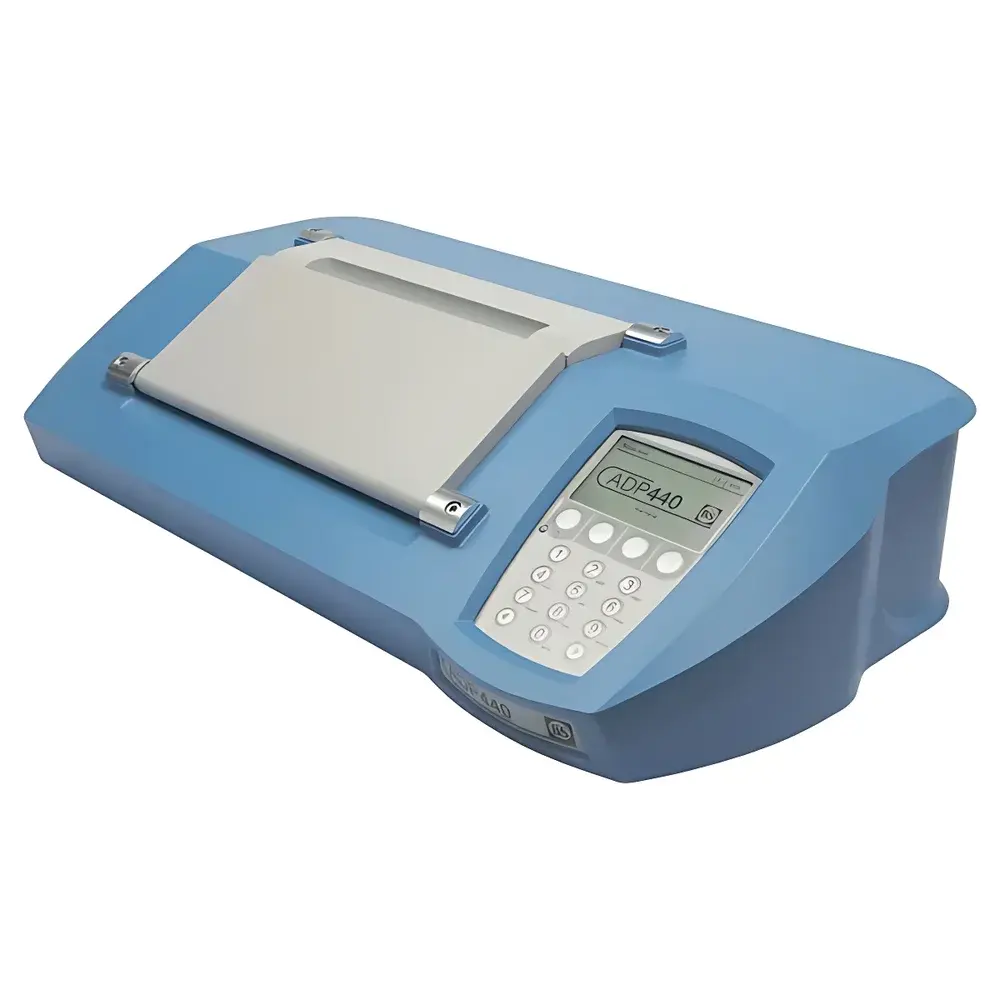
Cole-Parmer ADP440 High-Precision Automated Digital Polarimeter Model 81250-10
| Brand | Cole-Parmer |
|---|---|
| Origin | USA |
| Model | 81250-10 |
| Product Type | Automatic Polarimeter |
| Temperature Control | Yes (external probe) |
| Digital Display | Yes |
| Light Source | LED with interference filter (589.3 nm) |
| Optical Path Diameter | 4 mm |
| Sample Cell Length Range | 20–220 mm |
| Optical Density Range | 0.0–3.0 OD |
| Angular Measurement Range | −355° to +355° |
| ISS Scale Range | −225°Z to +225°Z |
| Angular Resolution | 0.01° / 0.001° (selectable) |
| ISS Resolution | 0.01°Z / 0.001°Z (selectable) |
| Repeatability | ±0.002° (angle), ±0.005°Z (ISS) |
| Accuracy | ±0.01° (angle), ±0.03°Z (ISS) |
| Measurement Time | 4–30 s (adjustable) |
| Operating Temperature Range | 5–40 °C |
| Temperature Compensation Modes | None / Sucrose / Quartz / User-defined |
| Display Languages | English, French, Spanish, German |
| Interface | Dual RS-232 ports, parallel printer port |
| Power Supply | 90–250 VAC, 50–60 Hz |
Overview
The Cole-Parmer ADP440 High-Precision Automated Digital Polarimeter (Model 81250-10) is a single-wavelength, microprocessor-controlled instrument engineered for rigorous quantitative analysis of optically active substances in regulated laboratory environments. It operates on the fundamental principle of optical rotation—measuring the angular deviation of plane-polarized light as it passes through chiral compounds such as sugars, amino acids, pharmaceuticals, and natural products. Designed specifically to meet pharmacopoeial compliance requirements—including USP , EP 2.2.7, and JP 6.07—the ADP440 delivers traceable, reproducible measurements critical for quality control, stability testing, and batch release in GMP-compliant facilities.
Key Features
- Stable, maintenance-free 589.3 nm LED light source coupled with precision interference filtering ensures long-term wavelength fidelity and eliminates mercury lamp aging effects.
- High-sensitivity photodiode detection system supports optical density (OD) measurements up to 3.0 OD, enabling accurate analysis of highly concentrated or turbid samples without dilution.
- Adjustable measurement duration (4–30 seconds) balances throughput and signal-to-noise ratio based on sample clarity and required precision.
- Four-key intuitive interface with multilingual menu support (English, French, Spanish, German) simplifies operation across international laboratories.
- External temperature probe enables real-time, in-situ sample temperature monitoring—critical for temperature-dependent optical rotation corrections per pharmacopoeial guidelines.
- Selectable temperature compensation algorithms (None, Sucrose, Quartz, or user-defined) allow alignment with material-specific thermal coefficients, improving inter-laboratory comparability.
- Dual RS-232 serial interfaces and parallel printer port facilitate integration into LIMS, ELN, or centralized data archiving systems.
Sample Compatibility & Compliance
The ADP440 accommodates standard polarimetric cells ranging from 20 mm to 220 mm path length, supporting both narrow-bore and wide-bore configurations for liquids, syrups, and low-viscosity solutions. Its 4 mm beam diameter ensures compatibility with industry-standard cell geometries while minimizing edge diffraction artifacts. All measurement records—including date/time stamp, operator ID, batch number, calibration history, and raw angular output—are stored internally and exportable in audit-ready format. Data handling conforms to GLP documentation standards and supports full FDA 21 CFR Part 11 compliance when paired with validated software and access-controlled network infrastructure. Instrument calibration verification follows NIST-traceable protocols, and built-in self-diagnostics monitor LED intensity, detector linearity, and thermal drift during startup and idle states.
Software & Data Management
While the ADP440 operates as a standalone instrument, its dual RS-232 outputs enable seamless communication with third-party laboratory software platforms. Raw data streams include timestamped angle (°), ISS (°Z), OD, temperature (°C), and status flags (e.g., “CAL OK”, “TEMP STABLE”). Optional PC-based utilities (sold separately) provide automated report generation compliant with 21 CFR Part 11 Annex 11 requirements—including electronic signatures, audit trails, and immutable record retention. Calibration logs retain full metadata: reference standard identity, certified value, uncertainty, and technician signature—ensuring full traceability for regulatory inspections.
Applications
- Pharmaceutical QC: Quantification of enantiomeric purity in chiral APIs (e.g., levodopa, ibuprofen, escitalopram) per ICH Q5A and USP monographs.
- Sugar Industry: Direct determination of sucrose concentration in cane juice, molasses, and refined syrups using ISS scale per ICUMSA methods.
- Food & Beverage: Verification of honey authenticity, maple syrup grading, and citric acid content in beverages.
- Academic Research: Kinetic studies of enzymatic hydrolysis (e.g., invertase, α-amylase) via time-resolved optical rotation monitoring.
- Chemical Synthesis: In-process monitoring of asymmetric reactions and resolution efficiency in chiral catalyst development.
FAQ
Does the ADP440 comply with pharmacopoeial standards for polarimetry?
Yes—the instrument meets measurement accuracy, repeatability, and documentation requirements specified in USP , European Pharmacopoeia 2.2.7, and Japanese Pharmacopoeia 6.07.
Can temperature compensation be applied automatically during measurement?
Temperature compensation is not fully automatic; it requires manual selection of the appropriate algorithm (Sucrose, Quartz, etc.) prior to measurement. The external probe provides real-time temperature input for correction calculations.
Is NIST-traceable calibration available for this model?
Yes—Cole-Parmer offers optional NIST-traceable quartz control plates (certified at 589.3 nm) with full uncertainty budgets and calibration certificates valid for 12 months.
What is the maximum optical density the detector can handle without saturation?
The photodiode-based detection system maintains linearity up to 3.0 OD, accommodating highly colored or concentrated samples without signal clipping or dynamic range compression.
Can the instrument store multiple user-defined units or formulas?
Up to three custom unit sets (e.g., concentration g/100mL, specific rotation [α], or proprietary indices) may be programmed and recalled via the front panel interface.





