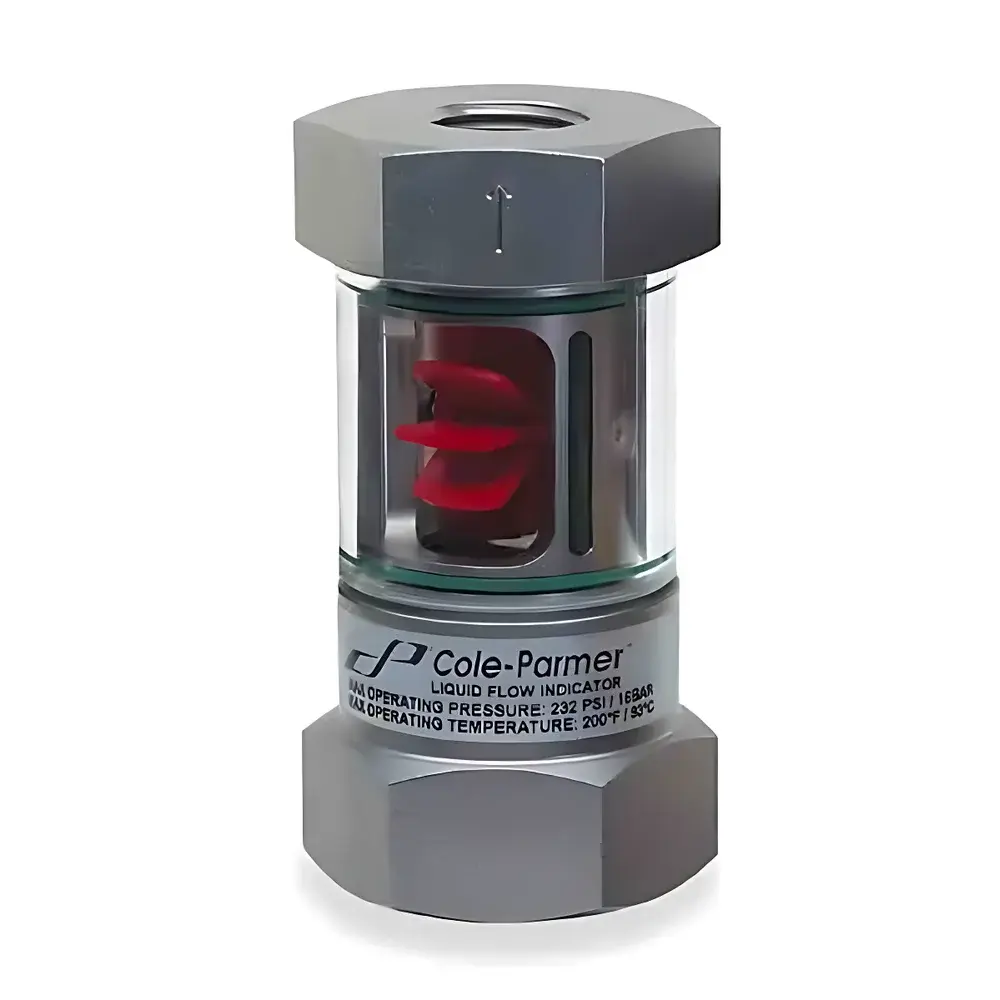
Cole-Parmer Model 32481-62 Direct-Reading Rotameter with Self-Cleaning Mechanism
| Brand | Cole-Parmer |
|---|---|
| Origin | USA |
| Housing Material | Brass |
| Connection | 1/4" NPT |
| Max Flow Capacity | 2.11 GPM |
| Rotor Material | Plastic |
| Self-Cleaning Feature | Yes |
| Viewing Angle | 360° |
| Tube Material | Borosilicate Glass |
| Calibration | Liquid (Water @ 20°C) |
| Accuracy | ±5% FS |
| Operating Temperature | ≤80°C |
| Pressure Rating | ≤150 psi |
| Compliance | ASTM D1947, ISO 4064-3 (for mechanical flow indication principles) |
Overview
The Cole-Parmer Model 32481-62 is a precision-engineered, direct-reading variable-area flowmeter designed for continuous, real-time visual monitoring of liquid flow rates in low-to-medium pressure industrial and laboratory process lines. Based on the classic rotameter principle—where a freely suspended rotor rises within a vertically oriented, tapered glass tube in proportion to volumetric flow—the device delivers immediate, analog flow indication without external power or signal conditioning. Its core measurement mechanism relies on the equilibrium between gravitational force, buoyancy, and viscous drag acting on the rotor; displacement correlates linearly with flow rate under calibrated fluid conditions (water at 20°C). The unit is optimized for clean, non-abrasive, low-viscosity liquids and is commonly deployed in chemical feed systems, coolant loops, solvent delivery lines, and pilot-scale bioprocessing skids where rapid operator assessment and mechanical reliability are prioritized over digital data integration.
Key Features
- 360° panoramic borosilicate glass viewing tube enables unobstructed flow observation from any angle, eliminating blind spots during installation or routine inspection.
- Integrated self-cleaning mechanism: a manually actuated cam-driven wiper engages the inner tube surface with a single quarter-turn of the cleaning knob, removing condensate films, particulate deposits, or residue that could impair rotor mobility or optical clarity.
- Compact, low-profile brass housing minimizes spatial footprint and facilitates retrofitting into space-constrained piping configurations—including vertical risers, tight-radius bends, and modular panel-mounted systems.
- Plastic rotor (acetal or polypropylene, depending on model variant) ensures chemical compatibility with common solvents, acids, and aqueous solutions while maintaining consistent density–drag characteristics across operating temperature ranges.
- Minimal pressure drop design: tapered tube geometry and streamlined rotor profile limit ΔP to <1.5 psi at full-scale flow, reducing energy loss and avoiding unintended backpressure effects on upstream pumps or regulators.
- NPT-threaded connections (1/4″ for Model 32481-62) conform to ASME B1.20.1 standards, ensuring leak-tight sealing with standard pipe sealants or PTFE tape—no special gaskets or torque tools required.
Sample Compatibility & Compliance
The 32481-62 is validated for use with water, alcohols, light hydrocarbons, and dilute aqueous solutions having kinematic viscosity 50 cSt), steam, or corrosive media requiring stainless steel or Hastelloy wetted parts. While not certified for hazardous area classification (e.g., ATEX or IECEx), its all-metal construction and absence of electronics render it intrinsically safe for Class I, Division 2 environments per NEC Article 500. Calibration traceability follows NIST-traceable procedures per ASTM D1947 (Standard Practice for Calibration of Liquid Flowmeters), and mechanical design principles align with ISO 4064-3 (Water meters — Part 3: Test methods and equipment) for analog indicating devices. No electrical certification (UL/CE) applies, as the unit contains no powered components.
Software & Data Management
This is a purely mechanical, analog flow indicator with no embedded electronics, sensors, or digital interfaces. Consequently, it does not require firmware, drivers, or software configuration. No data logging, remote transmission, or protocol support (e.g., Modbus, HART, 4–20 mA output) is provided. Integration into automated systems requires external retrofitting—such as machine vision-based rotor position tracking or paired ultrasonic flow sensor redundancy—per site-specific validation protocols. For regulated environments (e.g., pharmaceutical water-for-injection loops), users must establish documented calibration intervals (typically semi-annual), maintain logbooks per FDA 21 CFR Part 11-compliant practices if linked to electronic records, and include visual verification steps in SOPs for GLP/GMP audits.
Applications
- Monitoring deionized water flow in laboratory ultra-pure water distribution manifolds.
- Verifying dosing accuracy of catalysts or pH adjusters in batch reactor feed lines.
- Confirming coolant circulation integrity in laser cutting system heat exchangers.
- Qualifying flow stability during commissioning of small-bore sanitary tubing in food-grade CIP skids.
- Serving as a primary visual safeguard alongside digital mass flow controllers in solvent recovery units.
- Providing immediate fault detection—e.g., rotor immobility indicating line blockage or pump failure—in HVAC condensate return monitoring.
FAQ
Is the Model 32481-62 suitable for gas flow measurement?
No. It is calibrated and validated exclusively for liquid service. Gas applications require different rotor density, tube taper, and pressure compensation—use Cole-Parmer’s dedicated gas rotameter series (e.g., Model 32482-xx).
Can the unit be installed horizontally?
No. Rotameters require vertical orientation (±2° tolerance) to ensure proper rotor levitation and gravitational balance. Horizontal mounting invalidates calibration and risks rotor binding.
What maintenance is required beyond routine cleaning?
Annual inspection of glass tube integrity, thread seal condition, and rotor surface wear is recommended. Replace rotor if scoring or deformation is observed; replace tube if clouding or microfractures compromise visibility.
Does the self-cleaning mechanism affect calibration?
No. The wiper operates externally on the tube’s inner wall without contacting the rotor or altering its mass, geometry, or aerodynamic profile—calibration remains stable across cleaning cycles.
Is NIST-traceable calibration documentation available?
Yes—upon request at time of order. Certificate includes as-found/as-left readings, reference standard ID, environmental conditions, and technician signature per ISO/IEC 17025 requirements.