
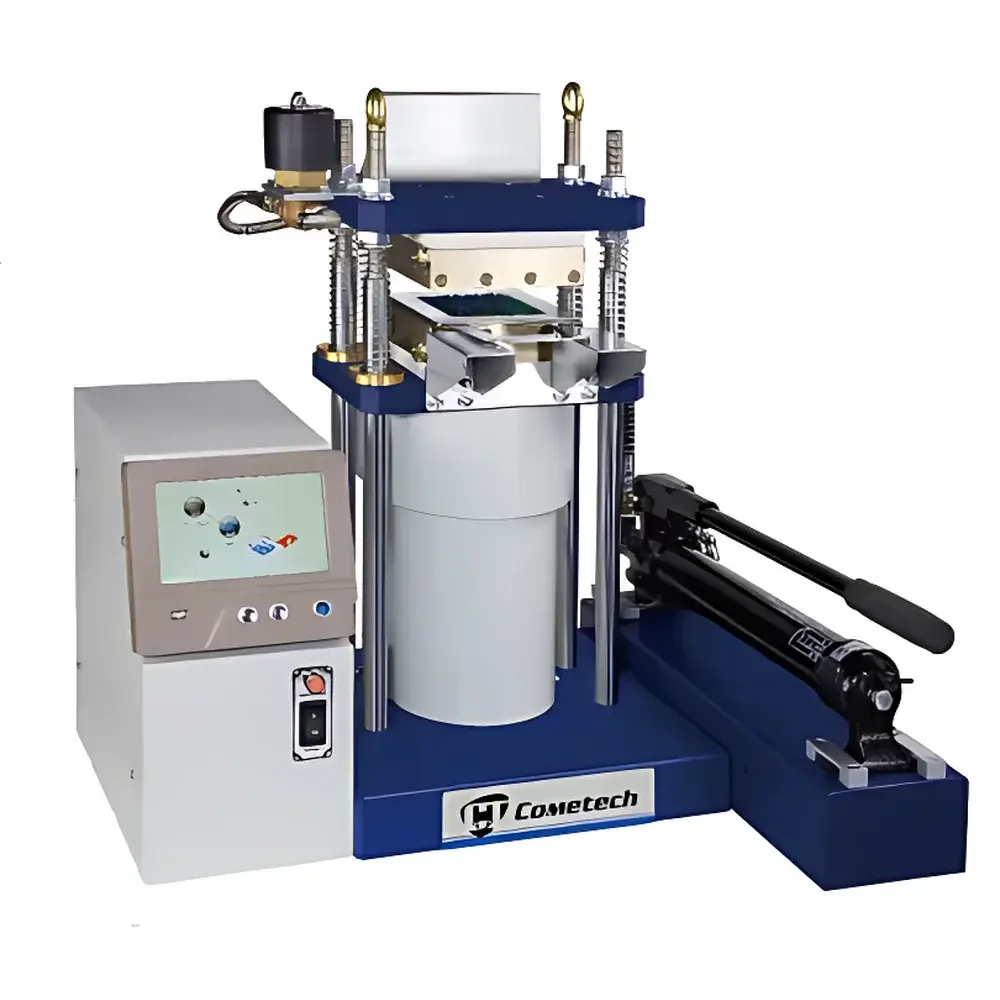
Cometech QC-677T Manual Benchtop Hot Press Forming Machine
| Brand | Cometech |
|---|---|
| Origin | Taiwan |
| Model | QC-677T |
| Type | Manual Benchtop Hot Press |
| Application | Vulcanization Sample Preparation |
| Heating Method | Electric Resistance Heating |
| Pressure Actuation | Manual Hydraulic Lever System |
| Max Operating Temperature | 200 °C |
| Platen Size | 150 mm × 150 mm |
| Pressure Range | 0–15 MPa (adjustable via calibrated lever force) |
| Temperature Control Accuracy | ±1 °C |
| Platen Parallelism Tolerance | ≤0.02 mm/m |
| Construction | Cast Iron Frame with Hard-Chrome-Plated Steel Platens |
Overview
The Cometech QC-677T Manual Benchtop Hot Press Forming Machine is a precision-engineered thermal compression system designed specifically for sample preparation in rubber and thermoplastic compound development, quality control, and vulcanization testing laboratories. It operates on the principle of controlled heat transfer and uniaxial mechanical compression to produce standardized test specimens—such as dumbbell-shaped tensile bars, disk-shaped rheometric samples, or thin sheets—for subsequent evaluation in tensile testers, rheometers, hardness testers, and vulcanizers. Unlike automated hydraulic or servo-controlled presses, the QC-677T employs a manually actuated hydraulic lever mechanism, offering deterministic force application without electronic feedback loops—ideal for ISO 34-1, ASTM D412, ASTM D3182, and GB/T 6038 compliant specimen fabrication where repeatability relies on operator training and mechanical calibration rather than software-driven cycles.
Key Features
- Robust cast iron frame with vibration-damped base ensures long-term dimensional stability and minimizes thermal drift during extended heating cycles.
- Hard-chrome-plated steel platens (150 mm × 150 mm active area) provide uniform surface hardness (≥60 HRC), resistance to oxidation up to 200 °C, and low coefficient of thermal expansion for consistent thickness control.
- Manually operated hydraulic lever system delivers repeatable pressure application across the full 0–15 MPa range; force calibration traceable to NIST-traceable load cells via optional verification kit.
- Digital PID temperature controller with dual-sensor redundancy (upper/lower platen) maintains setpoint accuracy within ±1 °C over the operational range of ambient to 200 °C.
- Integrated safety interlock prevents heating activation unless platens are fully closed and lever is engaged—compliant with EN 61000-6-2 electromagnetic compatibility and EN 61000-6-4 emission standards.
- Benchtop footprint (W420 × D480 × H520 mm) enables integration into fume hood environments or shared lab workstations without dedicated floor space.
Sample Compatibility & Compliance
The QC-677T accommodates uncured rubber compounds (NR, SBR, EPDM, CR), thermoplastic elastomers (TPE, TPU), and filled polymer blends requiring pre-vulcanization sheeting or mold cavity pre-forming. It supports standard specimen geometries defined in ISO 37 (tensile strength), ISO 48-4 (Shore A hardness), ASTM D6202 (disk preparation for Mooney viscometry), and ASTM D5590 (accelerated aging sample conditioning). All thermal and mechanical parameters adhere to GLP documentation requirements: temperature logs, pressure application timestamps, and operator ID fields can be manually recorded per batch in accordance with 21 CFR Part 11 Annex 11 audit trail expectations when used in regulated QC workflows.
Software & Data Management
As a manual benchtop instrument, the QC-677T does not incorporate embedded firmware or digital connectivity. However, its operational parameters—including temperature setpoint, dwell time, and lever engagement sequence—are fully documentable within laboratory information management systems (LIMS) or electronic lab notebooks (ELN) such as LabWare LIMS or Benchling. Optional RS-232 interface modules (sold separately) enable analog output of real-time platen temperature to external data loggers compliant with ASTM E2877 for thermal validation mapping. Calibration certificates for temperature sensors and pressure verification kits are supplied with NIST-traceable documentation upon request.
Applications
- Preparation of ASTM D412 Type I/II tensile specimens from raw rubber stock prior to vulcanization.
- Production of uniform-thickness sheets (0.5–2.0 mm) for hardness, tear, and abrasion testing per ISO 48, ISO 34-1, and DIN 53516.
- Pre-forming of curable compound disks for oscillating disk curemeter (ODR) and moving die rheometer (MDR) analysis per ASTM D5289 and ISO 6502.
- Thermal compression of thermoplastic pellets into plaques for melt flow index (MFI) pre-conditioning per ASTM D1238.
- Controlled degassing of high-viscosity elastomer compounds under elevated temperature and moderate pressure prior to molding.
FAQ
Is the QC-677T suitable for producing ASTM D5289-compliant ODR test disks?
Yes—the 150 mm × 150 mm platens allow precise alignment of standard 40 mm diameter disk molds; temperature uniformity and pressure repeatability meet the ±0.5 °C and ±0.2 MPa tolerances specified in ASTM D5289 Annex A1.
Can the machine be used with silicone rubber compounds cured above 180 °C?
Yes—its 200 °C maximum operating temperature and hard-chrome platen finish support short-duration curing cycles for high-temperature silicones, provided appropriate release agents and cooling protocols are applied post-pressing.
Does the QC-677T include pressure calibration documentation?
Standard delivery includes a factory calibration report for temperature sensors; pressure calibration requires periodic verification using a traceable hydraulic load cell—Cometech provides a recommended verification procedure and compatible third-party calibration service partners in North America and EU.
What maintenance intervals are recommended for long-term platen parallelism?
Annual verification of platen flatness and parallelism (≤0.02 mm/m) is advised using optical interferometry or precision granite surface plate inspection; re-lapping of platen surfaces is available through authorized Cometech service centers.
Is CE marking applicable to this instrument?
The QC-677T complies with the Machinery Directive 2006/42/EC and Low Voltage Directive 2014/35/EU; CE marking is affixed to units shipped to EEA markets, accompanied by an EC Declaration of Conformity and technical file.






