
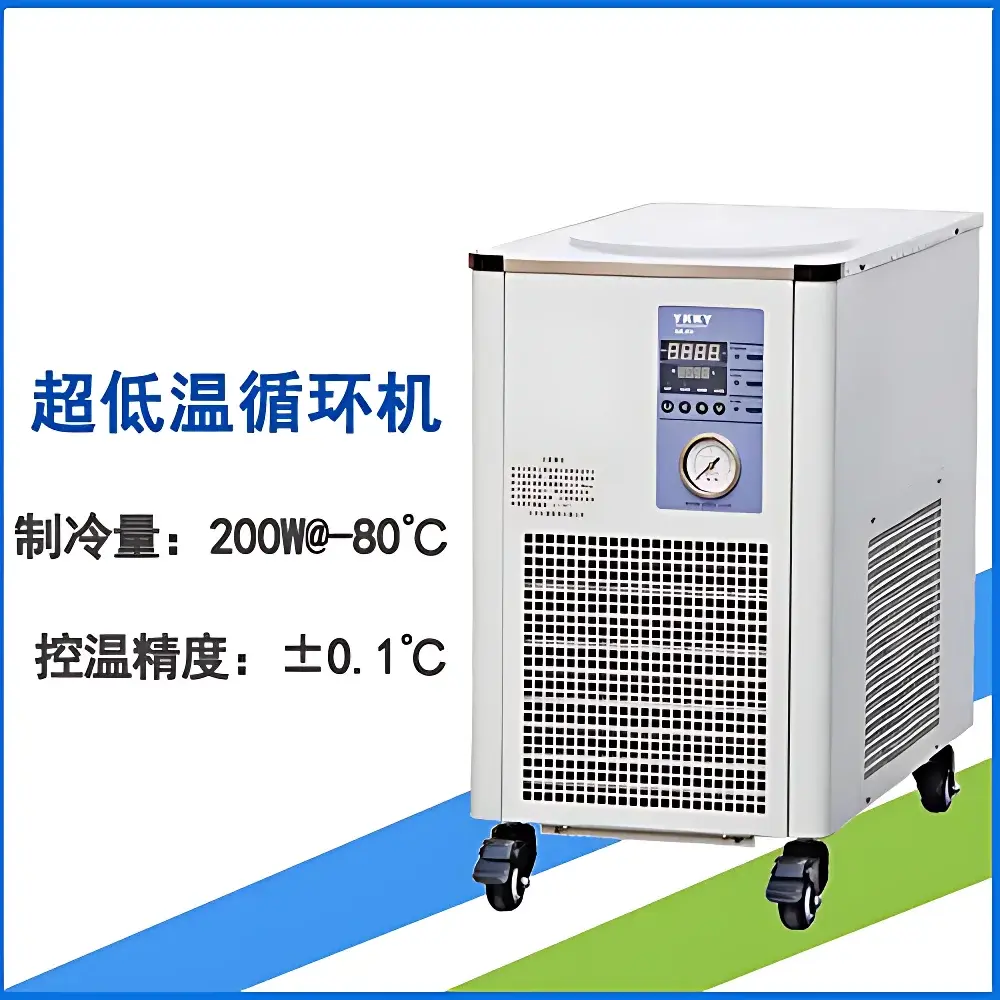
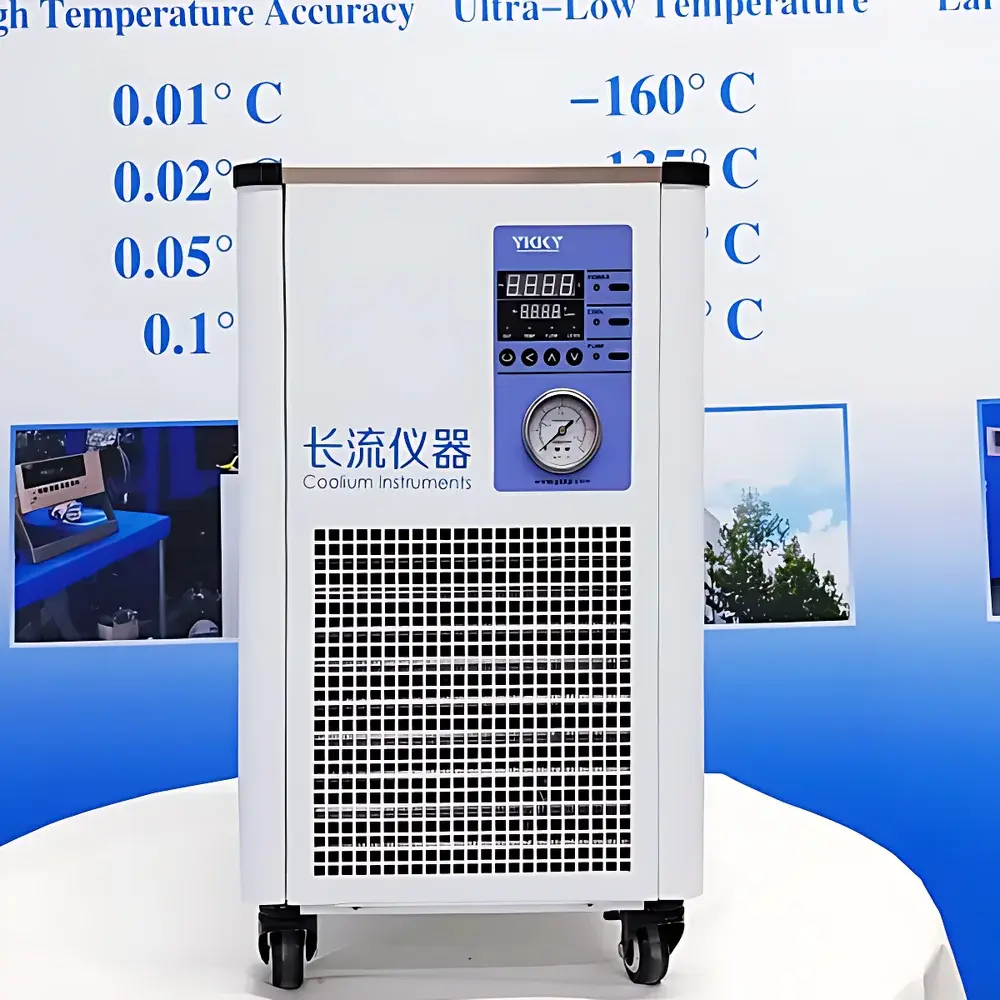
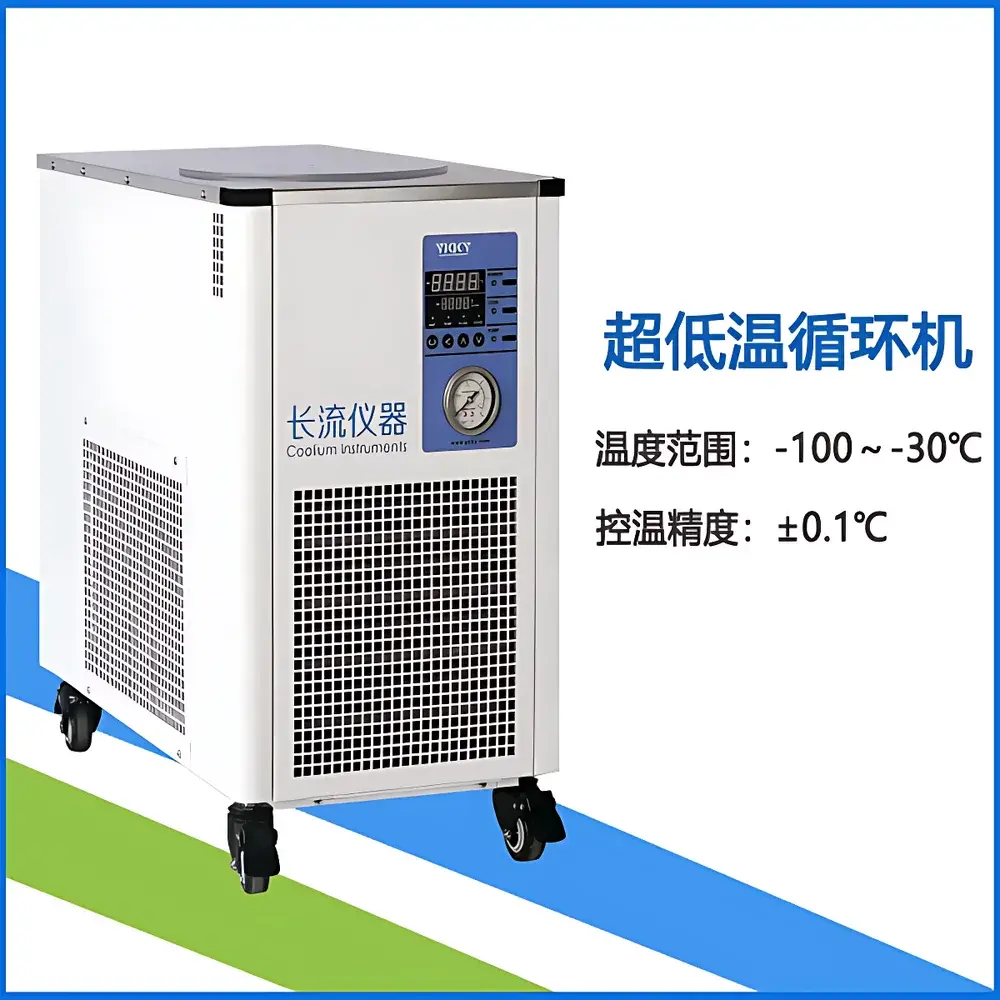
Coolium DX-80A1000H Cryogenic Circulating Chiller
| Brand | Coolium |
|---|---|
| Origin | Beijing, China |
| Model | DX-80A1000H |
| Temperature Range | −80 °C to +80 °C |
| Temperature Uniformity | ±0.2 °C |
| Minimum Operating Temperature | −80 °C |
| Bath Opening | Φ300 × 300 mm |
| Heating Capacity | 80 °C (heating function) |
| Bath Volume | 20 L |
| External Dimensions | 580 × 750 × 1580 mm (W × D × H) |
| Net Weight | 162 kg |
| Circulation Pressure | 1.2 bar |
| Flow Rate | 15 L/min |
| External Port | Rc1/2″ (female thread) |
| Cooling Medium | Deionized Water |
| Refrigerant | Eco-friendly, non-CFC/HFC blend (R507/R23 cascade system) |
| Control System | Microprocessor-based PID controller with RS485 optional |
Overview
The Coolium DX-80A1000H is a high-performance vertical cryogenic circulating chiller engineered for precision temperature control in demanding laboratory and pilot-scale applications. Utilizing a dual-stage cascade refrigeration architecture with R507 and R23 refrigerants, it achieves stable operation at −80 °C while maintaining full thermal capacity—delivering 1000 W of cooling power at this extreme low temperature. Unlike single-stage chillers limited by thermodynamic constraints, the DX-80A1000H’s cascade design enables efficient heat rejection across wide ambient conditions and ensures consistent performance during extended duty cycles. Its closed-loop stainless-steel circulation system is optimized for compatibility with external equipment—including jacketed reactors (5–100 L), spectroscopic cells, calorimeters, and cryogenic test rigs—providing reliable sub-zero heat removal without solvent evaporation or contamination risk.
Key Features
- Microprocessor-controlled PID temperature regulation with ±0.2 °C setpoint accuracy and real-time deviation monitoring.
- Cascade refrigeration system using environmentally compliant R507/R23 refrigerants, fully compliant with Montreal Protocol phase-out schedules and EU F-Gas Regulation (EU No 517/2014).
- Stainless-steel bath tank (SUS304) and fluid pathways resistant to corrosion from deionized water and common aqueous coolant additives.
- Low-temperature optimized magnetic-drive circulation pump rated for continuous operation at −80 °C without cavitation, seal leakage, or motor stall.
- Integrated safety protections: high/low pressure cut-off, oil pressure monitoring, phase failure detection, overcurrent protection, and overheat shutdown.
- Configurable cooling mode: air-cooled standard; optional water-cooled condenser available for high-ambient or noise-sensitive environments.
- Optional RS485 Modbus RTU interface supports integration into centralized lab management systems for remote parameter setting, alarm logging, and audit-trail generation per FDA 21 CFR Part 11 requirements.
Sample Compatibility & Compliance
The DX-80A1000H is designed for use with external process equipment requiring precise, stable, and contaminant-free thermal transfer. It is compatible with jacketed glass and stainless-steel reactors (5–100 L), cryostats, vacuum chamber cold traps, and analytical instrumentation requiring auxiliary cooling (e.g., NMR precooling circuits, FTIR detector housings). As a Class II laboratory chiller under IEC 61010-1:2010, it meets electrical safety requirements for measurement, control, and laboratory use. Its closed-loop architecture minimizes coolant loss and eliminates exposure to volatile organic carriers—supporting GLP-compliant workflows where traceability and environmental control are critical. The unit conforms to ISO/IEC 17025 calibration traceability frameworks when operated with certified reference thermometers and validated temperature mapping protocols.
Software & Data Management
While the base configuration features an intuitive front-panel LCD interface with numeric keypad and real-time trend display, the optional RS485 communication module enables bidirectional data exchange with supervisory software platforms (e.g., LabVIEW, SCADA, or custom LIMS integrations). Logged parameters—including bath temperature, setpoint, flow rate, compressor discharge pressure, and fault codes—are timestamped and stored locally for ≥30 days. When configured with electronic signature capability and user-access-level controls, the system supports ALCOA+ data integrity principles required under GMP Annex 11 and FDA guidance for computerized systems. Audit trails include operator ID, time/date stamp, parameter change history, and reason-for-change fields—fully exportable in CSV or XML format.
Applications
- Low-temperature chemical synthesis: exothermic reaction quenching, cryogenic Grignard or organolithium reactions, and controlled crystallization below −40 °C.
- Biopharmaceutical process support: cold-stage conditioning for chromatography columns, low-temperature buffer preparation, and stability testing per ICH Q5C guidelines.
- Materials science: thermal cycling of polymers and composites, cryo-mechanical testing, and superconductivity characterization setups.
- Instrument cooling: sustained thermal management for mass spectrometer ion sources, CCD detectors, and laser diode mounts.
- Food & agriculture R&D: accelerated shelf-life studies, freeze-thaw cycle simulation, and low-temperature enzyme activity assays.
FAQ
What is the minimum achievable temperature with full cooling capacity?
The unit delivers its rated 1000 W cooling power at −80 °C, verified per ISO 5151 test conditions (ambient 25 °C, 60% RH). Performance degrades gradually below this point; operation below −80 °C is not recommended.
Can deionized water be replaced with ethylene glycol solutions?
No. The system is engineered exclusively for deionized or distilled water. Glycol-based fluids increase viscosity at low temperatures, impairing pump performance and risking ice formation in narrow passages.
Is external temperature mapping required for qualification?
Yes. Per ASTM E2251-22 and EU GMP Annex 15, users must perform installation qualification (IQ), operational qualification (OQ), and performance qualification (PQ) including spatial temperature uniformity mapping across the bath volume and at external load interfaces.
Does the chiller meet noise emission standards for ISO Class 5 cleanrooms?
In air-cooled mode, sound pressure level is ≤68 dB(A) at 1 m distance. For cleanroom deployment, water-cooled condenser configuration reduces acoustic output to ≤52 dB(A) and eliminates localized heat exhaust.
What maintenance intervals are recommended for long-term reliability?
Compressor oil analysis every 2000 operating hours; refrigerant leak check annually; filter dryer replacement every 18 months; full system performance verification every 24 months per manufacturer’s service protocol.



