
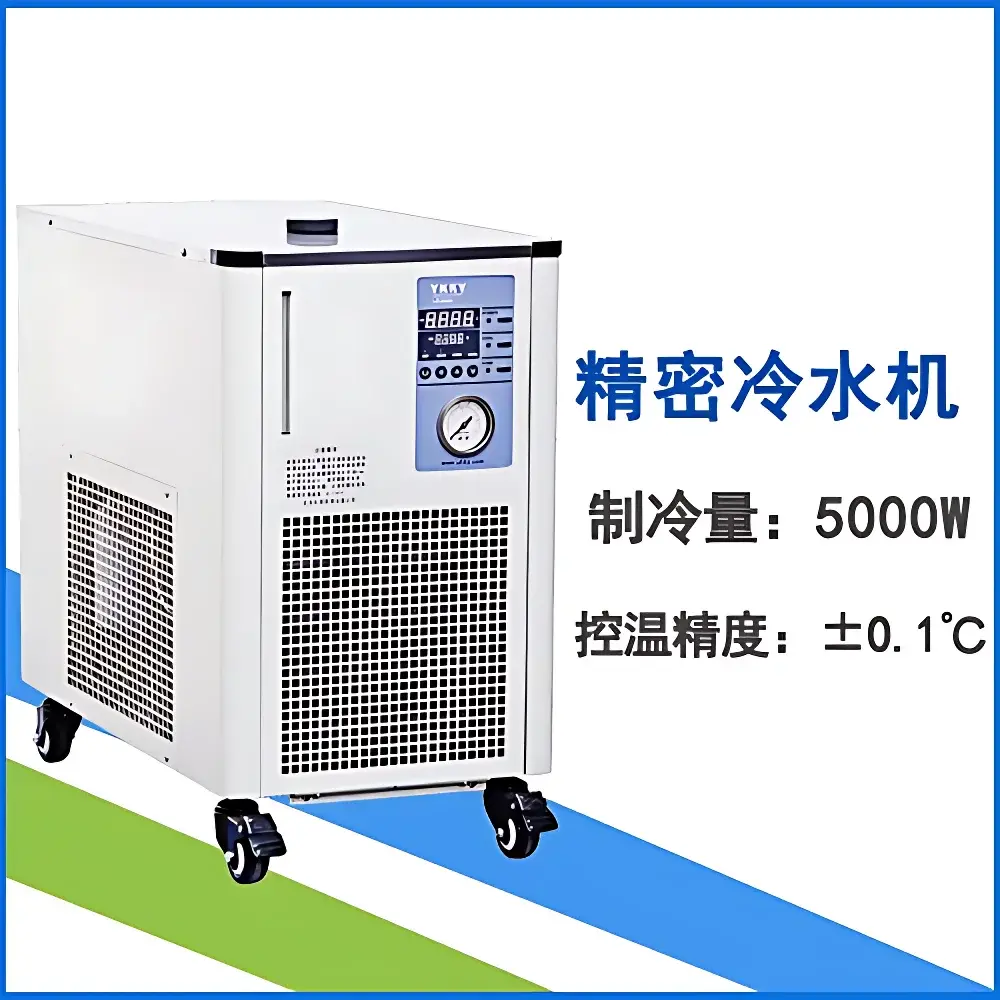
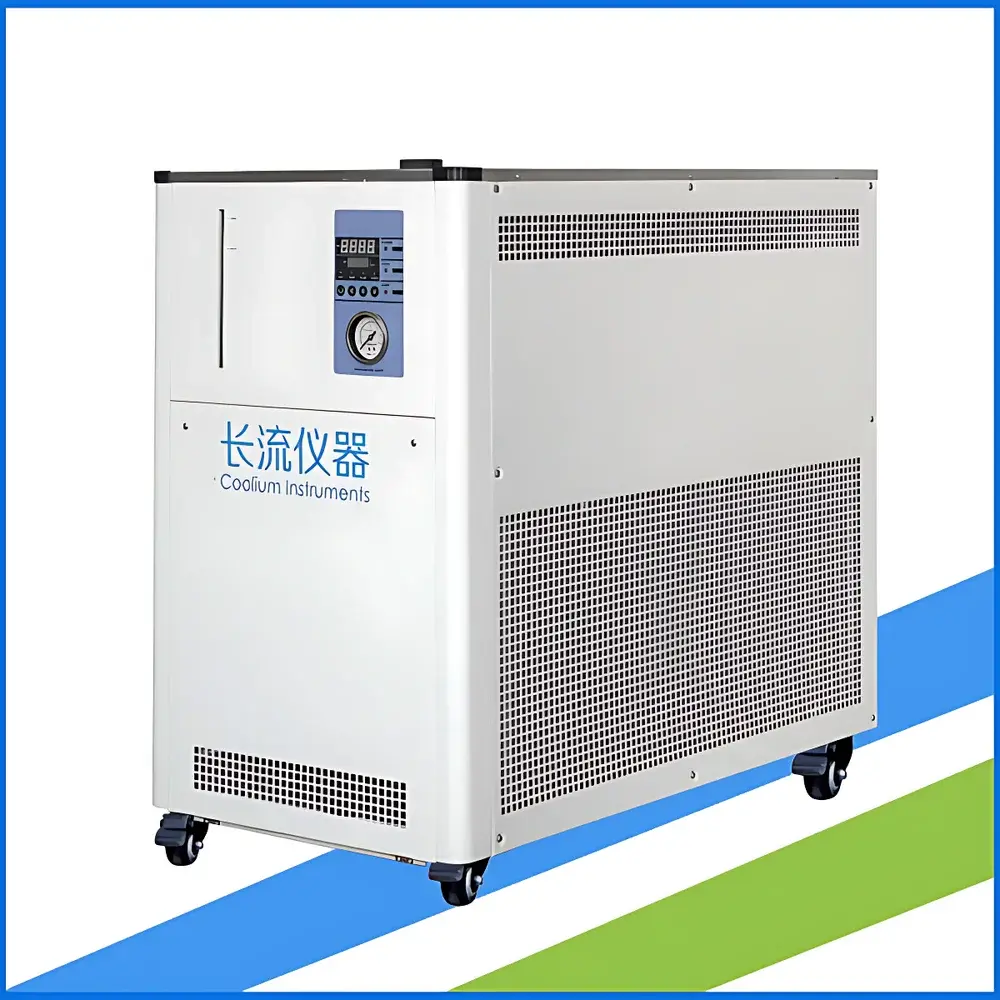
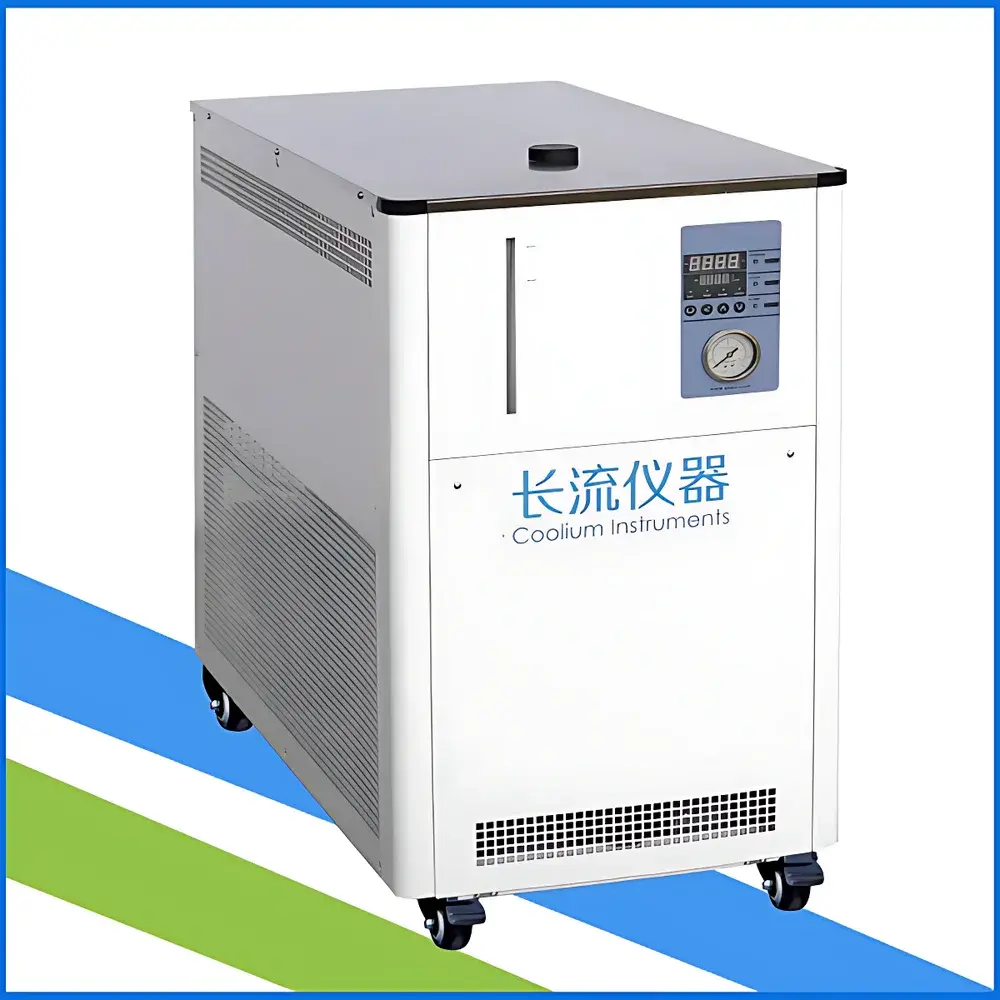
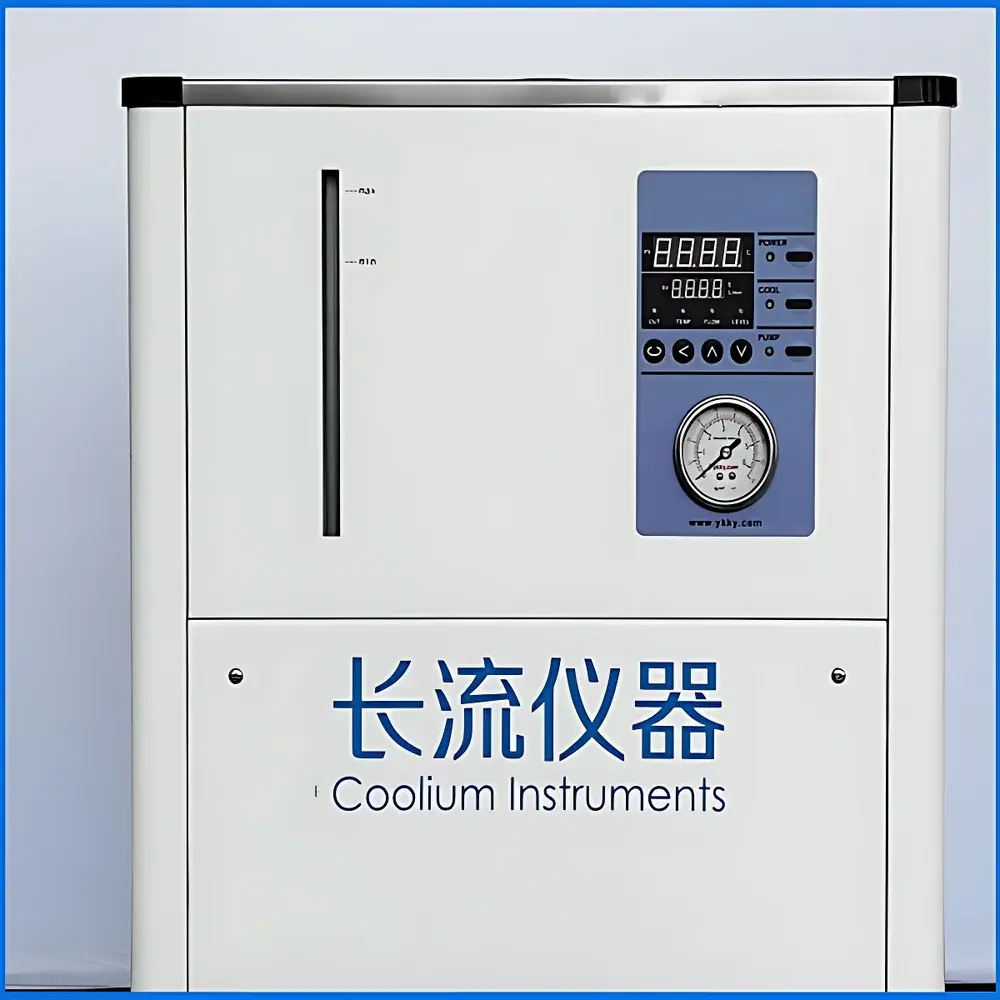
Coolium LX-5000 Air-Cooled Circulating Chiller
| Brand | Coolium |
|---|---|
| Origin | Beijing, China |
| Model | LX-5000 |
| Cooling Method | Air-Cooled |
| Temperature Range | 5–35 °C |
| Temperature Stability | ±0.1 °C |
| Refrigeration Capacity | 5000 W (at 20 °C) |
| Reservoir Volume | 40 L |
| Circulation Pressure | 0–3.7 bar |
| Flow Rate | 0–45 L/min |
| Power Supply | AC 220 V / 50 Hz / 16 A |
| External Port | Rc 1/2″ (female) |
| Dimensions (W×D×H) | 465 × 855 × 805 mm |
| Weight | 109 kg |
| Operation Mode | Continuous |
Overview
The Coolium LX-5000 is a high-capacity, air-cooled circulating chiller engineered for precision thermal management in demanding laboratory and industrial applications. Designed around a non-cycling refrigeration architecture—eliminating compressor on/off cycling—the system delivers continuous, stable cooling without thermal overshoot or recovery delays. Its core thermodynamic control relies on a PID-regulated dual-loop system: one loop governs refrigerant expansion valve actuation and condenser fan speed; the second manages recirculating fluid temperature via real-time feedback from a calibrated Pt100 sensor immersed directly in the reservoir sump. This architecture ensures rapid thermal equilibration (<15 min from ambient to setpoint at full load) and sustained stability within ±0.1 °C under dynamic heat loads—critical for applications such as laser cavity cooling, NMR magnet shimming, HPLC column ovens, and electron microscopy specimen stages. The unit operates continuously across its full 5–35 °C range, supporting both open-loop heat exchanger interfaces and closed-loop circulation with external equipment.
Key Features
- Non-cycling refrigeration system with variable-speed scroll compressor and adaptive condenser airflow—minimizes thermal inertia and extends component service life
- PID-controlled dual-sensor architecture: primary Pt100 immersion probe in reservoir + optional secondary external probe input for process-coupled control
- Digitally adjustable circulation pump offering linear pressure regulation (0–3.7 bar) and flow rate control (0–45 L/min), with stainless-steel wetted parts and ceramic shaft bearings
- 40 L insulated reservoir with level monitoring, anti-corrosion coating, and integrated particle filter (5 µm nominal rating)
- Front-panel LCD interface with real-time display of temperature, pressure, flow (optional), reservoir level, and system status codes
- Configurable safety interlocks: high-temperature cutoff, low-flow alarm, dry-run protection, and overpressure shutdown
- RS485 Modbus RTU interface standard; supports integration into centralized lab monitoring systems (e.g., LabArchives, DeltaV, or custom SCADA)
- Compliance-ready firmware with optional audit trail logging and user-access levels aligned with GLP/GMP documentation requirements
Sample Compatibility & Compliance
The LX-5000 is compatible with a broad spectrum of heat-generating analytical instruments requiring stable, low-noise coolant delivery—including but not limited to mass spectrometers (Q-TOF, Orbitrap), X-ray diffractometers, plasma etch tools, and high-power LED test fixtures. Its stainless-steel Rc 1/2″ female ports accept industry-standard compression fittings and fluoropolymer-reinforced hoses (recommended inner diameter: 10–16 mm). All fluid-path materials meet USP Class VI biocompatibility standards. The unit complies with IEC 61000-6-3 (EMC emission limits) and IEC 61000-6-2 (immunity), and conforms to CE marking directives for machinery and low-voltage equipment. Optional factory calibration includes NIST-traceable verification of temperature accuracy (±0.05 °C at 25 °C) and flow meter linearity (±2% FS).
Software & Data Management
The embedded controller supports local parameter configuration and real-time diagnostics via the front-panel interface. For remote supervision, the RS485 port enables bidirectional communication using standard Modbus RTU protocol—allowing readout of 20+ operational parameters (e.g., suction/suction superheat, evaporator delta-T, cumulative runtime) and write access to setpoints, pump curves, and alarm thresholds. When connected to a host PC or PLC, data can be logged at user-defined intervals (1–600 s) and exported in CSV format. Audit trail functionality (optional firmware upgrade) records all parameter changes, login events, and alarm activations with timestamps and operator IDs—fully compliant with FDA 21 CFR Part 11 requirements for electronic records and signatures when deployed in regulated environments.
Applications
- Cooling of high-power lasers (CO₂, fiber, diode) where thermal lensing must be minimized
- Stabilization of superconducting magnet cryocooler reject heat in NMR and MRI systems
- Temperature control of chromatographic columns, detectors, and autosampler trays in regulated QC labs
- Heat extraction from vacuum chamber feedthroughs and RF amplifiers in semiconductor metrology tools
- Support of calorimetry cells and rheometer Peltier stages requiring sub-0.1 °C thermal uniformity
- Integration into pilot-scale chemical reactors with jacketed cooling loops
FAQ
What is the minimum ambient temperature for reliable operation?
The LX-5000 is rated for ambient operation between 10 °C and 35 °C. Below 10 °C, condenser airflow must be restricted via optional baffle kit to prevent low-head pressure faults.
Can the unit maintain 5 °C with full 5000 W heat load?
Yes—performance data confirms stable 5 °C setpoint retention at 5000 W dissipation when inlet coolant temperature does not exceed 32 °C and ambient remains ≤30 °C.
Is distilled water sufficient as coolant, or is inhibited glycol required?
For pure water operation below 20 °C, deionized water with 0.2 µS/cm resistivity and biocide dosing (e.g., benzisothiazolinone) is recommended. For sub-zero applications or extended idle periods, 20–30% propylene glycol/water mix with corrosion inhibitor is mandatory.
Does the RS485 interface support Ethernet gateway bridging?
Yes—third-party Modbus TCP-to-RTU gateways (e.g., Moxa EDS-G205A) are fully interoperable; Coolium provides register mapping documentation and sample Python scripts for data ingestion.
What maintenance intervals are specified for long-term reliability?
Compressor oil and refrigerant charge require verification every 24 months; condenser coil cleaning is recommended quarterly in dusty environments; reservoir filter replacement every 6 months or per particulate load assessment.



