
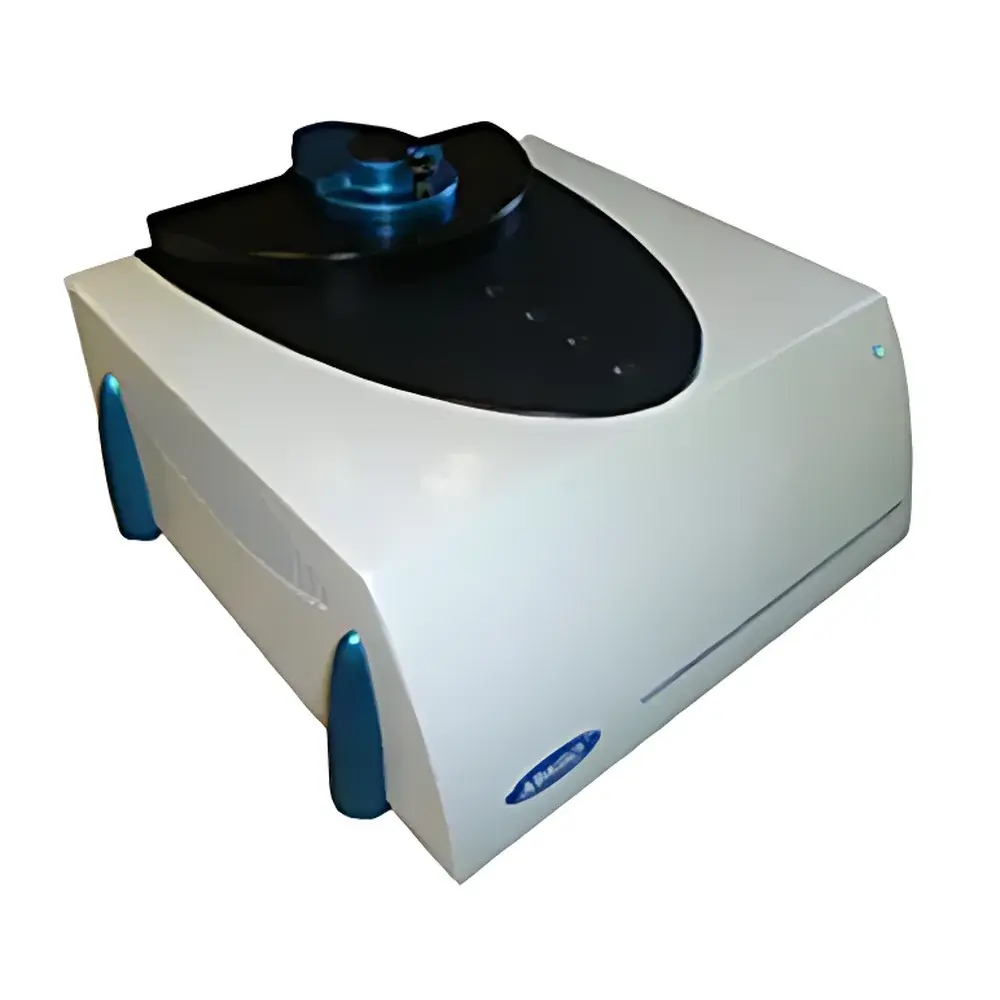
Cordouan Arago ε Precision Digital Refractometer
| Origin | France |
|---|---|
| Manufacturer Type | Authorized Distributor |
| Origin Category | Imported |
| Model | Arago ε |
| Quotation | Upon Request |
| Measurement Principle | Critical Angle Determination via Total Internal Reflection |
| Measuring Range (nD) | 1.25–1.51 or 1.51–1.75 |
| Resolution (nD) | ±0.00001 |
| Accuracy (nD) | ±0.0001 |
| Temperature Control | Peltier-Regulated, Ambient to 65 °C |
| Prism Material | BK7 Optical Glass |
| Wavelength | 635 nm |
| Light Source | Stabilized Laser Diode with Integrated Peltier Thermal Management |
| Sample Cell Material Options | 316 Stainless Steel or Inconel Alloy |
| Interface | USB (Bidirectional PC Communication) |
| Power Supply | 100–240 V AC, 50/60 Hz, 10–50 W |
| Dimensions | 10 × 24 × 27 cm |
| Weight | 8 kg |
| Software Language | English or French |
| Compliance | Designed for GLP/GMP environments |
Overview
The Cordouan Arago ε Precision Digital Refractometer is an advanced critical-angle refractometer engineered for high-accuracy, traceable refractive index (nD) measurements of liquid and semi-liquid samples across demanding industrial and research laboratories. Based on the fundamental optical principle of total internal reflection at the prism–sample interface, the instrument precisely determines the critical angle of incidence—converted in real time to refractive index using Snell’s law and calibrated dispersion models. Unlike traditional Abbe-type instruments, the Arago ε employs a stabilized 635 nm laser diode with integrated Peltier thermal regulation to maintain source wavelength stability within ±0.05 nm over operating temperature ranges. This ensures metrological consistency essential for compliance-driven workflows in food safety, petrochemical QA/QC, pharmaceutical excipient verification, and fragrance authenticity testing.
Key Features
- Patented optical architecture minimizing Fresnel approximation error—near-zero angular deviation at critical incidence enables sub-microrefractive resolution
- Peltier-controlled prism block (15–65 °C) with ±0.01 °C thermal stability, eliminating external water baths and enabling rapid equilibration
- Modular sample cell options: electropolished 316 stainless steel or corrosion-resistant Inconel alloy—optimized for aggressive solvents, viscous oils, and volatile organics
- Integrated eye-safety system: automatic laser shutdown during lid opening or abnormal ambient light detection, compliant with IEC 60825-1 Class 1 requirements
- Touchscreen HMI (10.1″ capacitive display) with optional PC-based control via USB 2.0—supports remote operation, script-driven batch measurement, and real-time parameter adjustment
- Zero-cross contamination design: smooth, crevice-free wetted surfaces and tool-free prism access facilitate rapid cleaning between high-value samples (e.g., essential oils, API intermediates)
- Compact footprint (10 × 24 × 27 cm) and low power draw (max 50 W) suitable for benchtop deployment in ISO 17025-accredited labs or mobile QC units
Sample Compatibility & Compliance
The Arago ε accommodates opaque, deeply colored, and highly scattering liquids—including crude oil fractions, dark syrups, spent catalyst slurries, and aromatic distillates—without signal attenuation or measurement drift. Its extended dynamic range (nD 1.25–1.75, selectable dual-range optics) eliminates the need for manual prism swapping or dilution protocols common in legacy instruments. All firmware and calibration routines adhere to ISO 17025:2017 clause 7.7 (measurement traceability), with factory NIST-traceable certificates provided for primary refractive index standards (SRM 1791, SRM 1792). When operated with Cordouan’s validated RefraSoft v4.2 platform, the system meets FDA 21 CFR Part 11 requirements for electronic records and signatures—including role-based access control, immutable audit trails, and electronic signature capture.
Software & Data Management
RefraSoft v4.2 (English/French localized) provides full instrument orchestration: automated temperature ramping, multi-point calibration validation, statistical process control (SPC) charting, and export to CSV, PDF, or LIMS-compatible XML formats. The software implements ASTM D1218 and ISO 28721-1 workflows for petroleum products, while supporting custom sugar content (°Brix) and solid content (% w/w) conversion tables per USP and AOAC 932.12. Raw angular data and temperature logs are stored with timestamped metadata (operator ID, sample ID, environmental conditions), enabling retrospective uncertainty analysis per GUM (JCGM 100:2008). USB bidirectional communication allows firmware updates, method import/export, and synchronized backup to network drives.
Applications
- Petrochemical QA: nD verification of gasoline fractions, jet fuels (ASTM D1298), benzene/toluene/xylene purity, and hydrocarbon solvent blends per IP 271
- Edible Oil Authentication: Detection of adulteration in olive, palm, and sesame oils via refractive index deviation from Codex Alimentarius STAN 210–1999 reference values
- Pharmaceutical Excipients: Identity testing of glycerin, propylene glycol, and polyethylene glycols per USP , including lot-to-lot consistency monitoring
- Fruit & Honey Grading: °Brix quantification (0–95%, ±0.002% repeatability) for harvest timing optimization and honey floral origin certification (AOAC 985.24)
- Fragrance & Flavor QC: Rapid purity assessment of terpenes, esters, and aldehydes using nD–composition correlation libraries
- Industrial Fluids: Monitoring glycol concentration in heat transfer fluids, brake fluid hygroscopicity, and cutting oil degradation
FAQ
Does the Arago ε require annual recalibration by the manufacturer?
No—users may perform in-house calibration using certified refractive index standards (e.g., distilled water, bromonaphthalene) with traceability documentation. Cordouan recommends biannual verification against NIST-traceable references.
Can it measure samples with suspended solids or particulates?
Yes—its robust optical path design tolerates particles up to 50 µm without clogging or signal noise, provided the sample is homogenized prior to loading.
Is temperature compensation applied automatically during measurement?
Yes—the Peltier-regulated prism block maintains setpoint temperature within ±0.01 °C, and all nD values are reported at the user-defined reference temperature (15–65 °C) with built-in thermal expansion correction per CIPM-2007.
What is the minimum sample volume required?
Just 0.5 mL for standard operation; optional micro-cell kits reduce this to 0.15 mL for high-value fragrances or clinical specimens.
Does the system support LIMS integration?
Yes—via configurable ASCII/CSV export, HL7-compliant message templates, or direct ODBC connectivity to major laboratory information management systems.





