
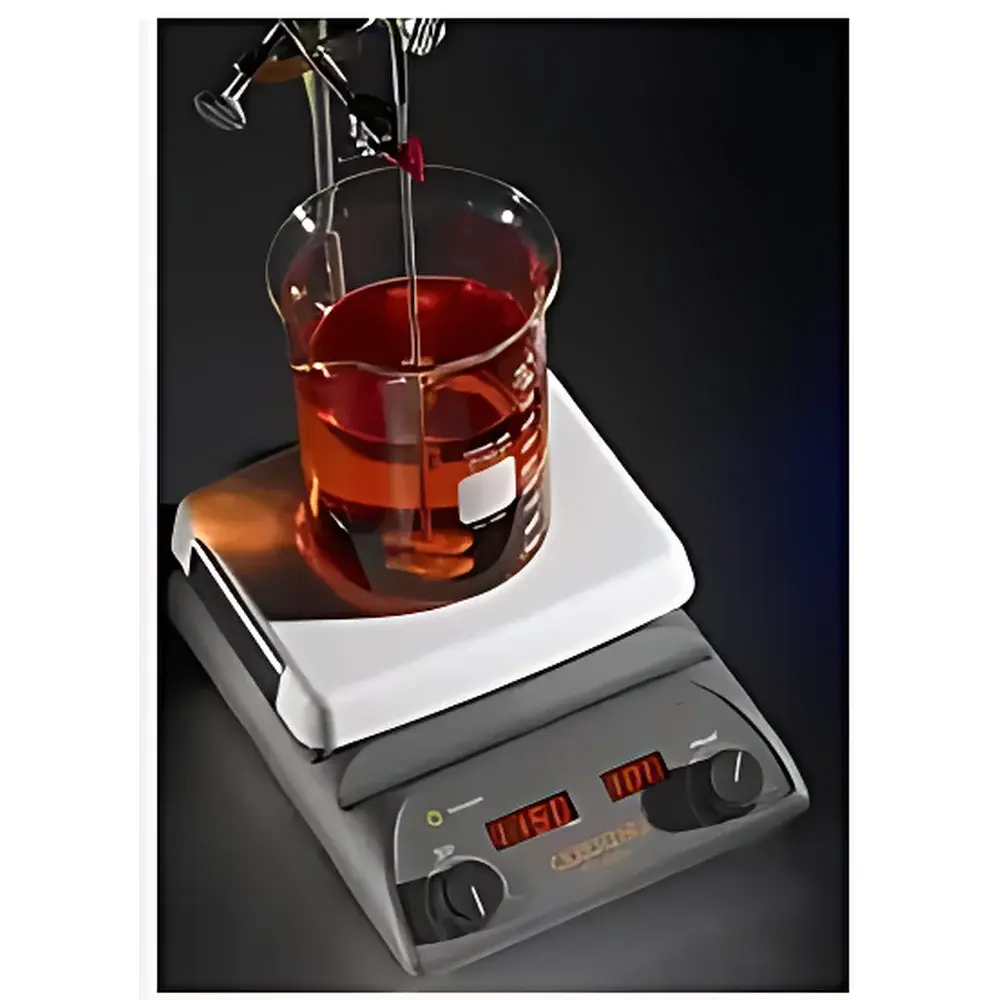
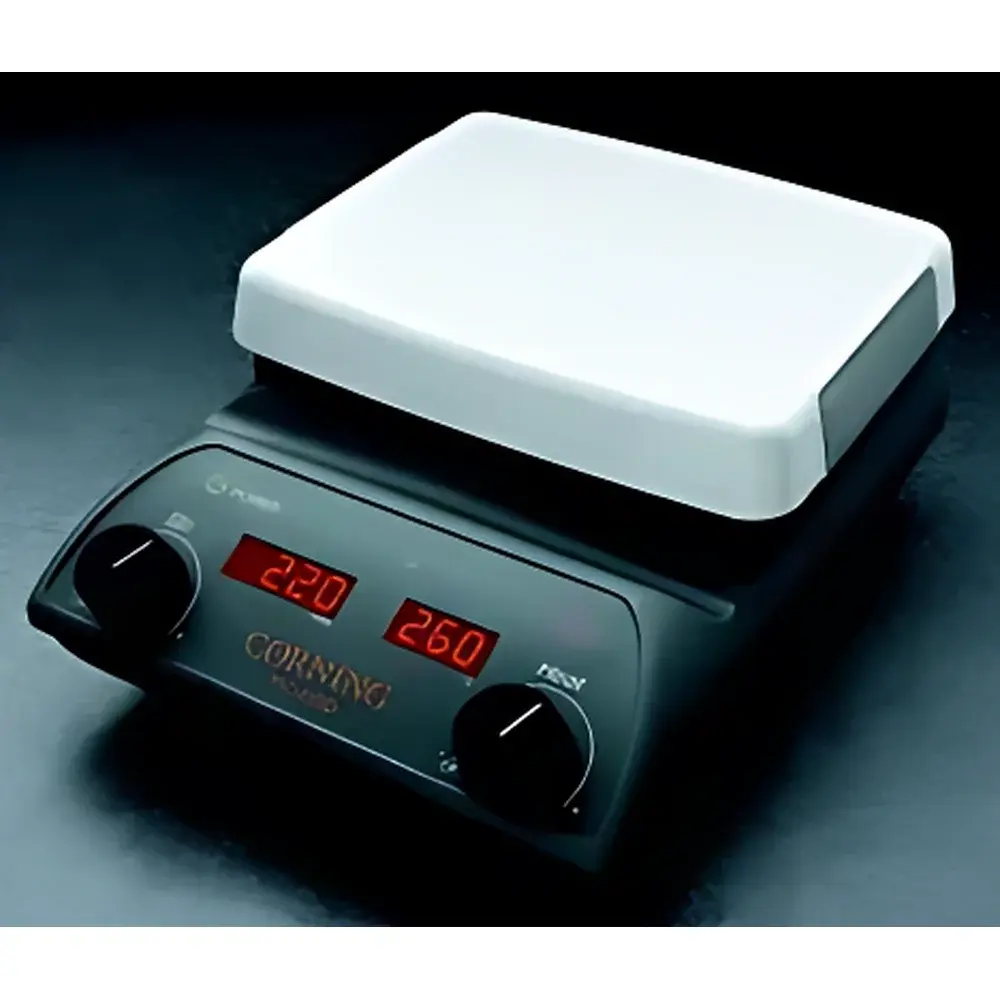
Corning PC-420D Digital Magnetic Hotplate Stirrer for SPME Applications
| Brand | Corning |
|---|---|
| Origin | USA |
| Model | PC-420D |
| Stirring Capacity | 1000 mL |
| Speed Range | 60–1150 rpm |
| Temperature Range | 5–550 °C |
| Heating Plate Dimensions | 12.7 × 17.8 cm (5″ × 7″) |
| Power | 698 W |
| Weight | 3.2 kg |
| Dimensions | 27.7 × 19.8 × 11.2 cm (10.9″ × 7.8″ × 4.4″) |
| Compliance | CE, UL Listed |
| Optional External Temperature Controller | Cat. No. 6795PR (enables internal vessel temperature monitoring and control |
Overview
The Corning PC-420D Digital Magnetic Hotplate Stirrer is an engineered laboratory instrument designed for precise thermal and mechanical control during sample preparation workflows—particularly those demanding reproducible, low-vibration heating and stirring under defined thermal gradients. Operating on the principle of electromagnetic induction, the unit employs a rare-earth magnet-driven stir bar rotation system coupled with a high-stability ceramic-glass heating surface. Its core architecture integrates a microprocessor-controlled PID temperature regulation system with real-time LED display feedback, enabling stable setpoint maintenance across the full 5–550 °C range. Unlike analog alternatives, the PC-420D features a closed-loop rotary encoder for intuitive, tactile speed and temperature adjustment—critical for method-sensitive protocols such as Solid-Phase Microextraction (SPME), where consistent thermal equilibration and agitation kinetics directly impact fiber coating adsorption efficiency and analyte partitioning.
Key Features
- Digital PID temperature control with ±1 °C accuracy over the 5–550 °C operating range; optional external probe controller (Cat. No. 6795PR) enables direct vessel temperature feedback and closed-loop regulation
- Smooth, brushless DC motor drive delivering stable rotational speeds from 60 to 1150 rpm with minimal torque fluctuation—essential for uniform mixing of viscous or heterogeneous SPME matrices
- White ceramic-glass top plate (12.7 × 17.8 cm) offering rapid thermal response, chemical resistance, and easy decontamination—compatible with glass, stainless steel, and PTFE-coated vessels
- Integrated LED display with dual-parameter readout (temperature and speed), eliminating ambiguity during multi-step extraction protocols
- Compact footprint (27.7 × 19.8 × 11.2 cm) and lightweight design (3.2 kg) optimized for benchtop deployment in regulated QC labs, forensic units, and academic research environments
- UL- and CE-certified electrical architecture with over-temperature cutoff and auto-shutdown safeguards compliant with IEC 61010-1 safety standards
Sample Compatibility & Compliance
The PC-420D supports standard SPME vial formats—including 4 mL and 15 mL headspace vials—when used with Corning-recommended accessories such as SPME sampling platforms (PK14, PK15) and high-temperature septa (PK2512, PK2513). Its thermal uniformity profile (±3 °C across the plate surface at 200 °C) meets ASTM D7042 and ISO 13320 requirements for controlled-heating sample conditioning. For GLP/GMP-regulated laboratories, the unit’s repeatable performance supports documented method validation per USP and FDA 21 CFR Part 11 when paired with validated external temperature probes and electronic lab notebook (ELN) integration. It is routinely deployed in environmental testing labs accredited to ISO/IEC 17025 for VOC analysis and clinical toxicology labs performing quantitative drug-in-biofluid extractions.
Software & Data Management
While the PC-420D operates as a standalone hardware platform without embedded connectivity, its analog-compatible output signals (0–5 V or 4–20 mA optional via external controller 6795PR) permit integration into centralized LIMS or SCADA systems for audit-trail generation. When used in conjunction with Supelco’s automated SPME autosamplers (e.g., PAL Systems), the unit functions as a synchronized thermal module—its setpoints logged alongside fiber exposure time, desorption parameters, and GC/MS acquisition metadata. All configuration changes are mechanically recorded via the encoder dial position, supporting manual logbook entries traceable to analyst ID and batch number—satisfying basic ALCOA+ data integrity principles in non-automated workflows.
Applications
- Solid-phase microextraction (SPME) for equilibrium-based headspace and direct-immersion sampling of volatile organic compounds (VOCs), sulfur species, pesticides, and residual solvents
- Controlled thermal desorption studies requiring precise ramp-and-hold profiles prior to GC injection
- Pre-concentration of trace analytes from aqueous matrices (e.g., wastewater, drinking water per EPA Method 524.3)
- Pharmaceutical stability testing involving accelerated degradation of APIs under heated agitation
- Forensic toxicology workflows extracting drugs and metabolites from blood, urine, and tissue homogenates
- Food and fragrance analysis targeting volatile flavor compounds and off-odor markers
FAQ
Is the PC-420D compatible with Supelco SPME autosamplers?
Yes—the unit’s physical dimensions, thermal response time, and external probe interface (via Cat. No. 6795PR) enable seamless integration with PAL-type SPME automation platforms.
Can the PC-420D maintain temperature stability during extended 24-hour SPME equilibration?
Under ambient conditions ≤25 °C and with proper vessel sealing, the unit sustains ±1.5 °C deviation over 24 h at setpoints up to 150 °C, verified per internal Corning test report TR-PC420D-2023-08.
Does it support calibration traceability to NIST standards?
Yes—when used with a NIST-traceable RTD probe (e.g., Fluke 720A) and documented calibration SOP, the system meets ISO/IEC 17025 clause 6.4.10 requirements for measurement equipment verification.
What is the maximum recommended load for continuous operation at 550 °C?
For sustained operation above 400 °C, use only borosilicate glass or quartz vessels; maximum safe volume is 500 mL to ensure thermal mass stability and prevent localized overheating.
Are replacement stir bars included with the unit?
No—Corning recommends PTFE-coated stir bars (Cat. No. 6879-STB-10) for SPME applications to avoid metal ion leaching; these are sold separately.



