
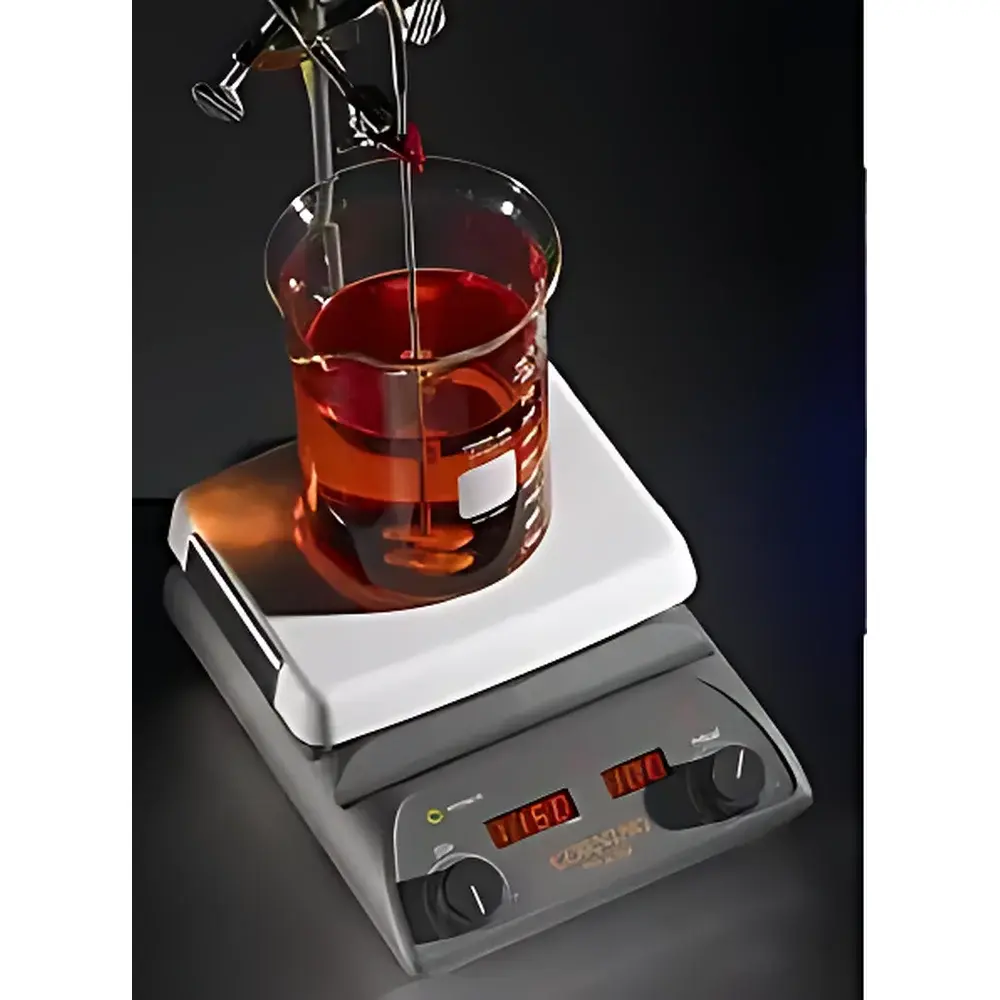
Corning® PC-420D Digital Magnetic Hotplate Stirrer
| Brand | Corning |
|---|---|
| Origin | USA |
| Model | PC-420D |
| Heating Plate Size | 5" × 7" (12.7 × 17.8 cm) |
| Temperature Range | 5–550 °C |
| Speed Range | 60–1150 rpm |
| Power Input | 230 V, 50 Hz, 698 W |
| Certifications | UL and cUL listed |
| Weight | 3.2 kg (7.0 lbs) |
| Dimensions (L×W×H) | 27.7 × 19.8 × 11.2 cm (10.9" × 7.8" × 4.4") |
| Warranty | 2 years |
| Instrument Type | Magnetic Hotplate Stirrer |
Overview
The Corning® PC-420D Digital Magnetic Hotplate Stirrer is an engineered laboratory instrument designed for precise, reproducible heating and mixing of liquid samples in research, quality control, and teaching laboratories. It operates on the principle of electromagnetic induction to drive a magnetic stir bar within a vessel while simultaneously delivering uniform thermal energy across its white ceramic-glass heating surface. This dual-function architecture eliminates the need for external mechanical agitators or separate hotplates—reducing contamination risk, improving spatial efficiency, and enhancing experimental consistency. The device is particularly suited for applications requiring controlled ramping, stable setpoint maintenance, and moderate throughput across aqueous, organic, and viscous media. Its robust construction, certified electrical safety, and intuitive digital interface support routine use under ISO/IEC 17025-compliant environments and GLP-regulated workflows.
Key Features
- Digital LED display with independent controls for temperature (±1 °C typical accuracy) and stirring speed (±10 rpm resolution), enabling simultaneous real-time monitoring and adjustment
- Ceramic-glass top plate (5″ × 7″) offering chemical resistance, rapid thermal response, and easy decontamination—compatible with common lab solvents and cleaning agents
- Wide operational range: temperature from 5 °C to 550 °C (with overshoot suppression algorithm); stirring speed from 60 rpm to 1150 rpm (adjustable in 10-rpm increments)
- UL and cUL certification ensures compliance with North American electrical safety standards (UL 61010-1), including protection against overtemperature, short-circuit, and ground-fault conditions
- Stable thermal uniformity (< ±5 °C across center 70% of plate surface at 300 °C), validated per ASTM E2748 for hotplate performance characterization
- Two-year limited warranty covering parts and labor, reflecting Corning’s commitment to long-term reliability and field serviceability
Sample Compatibility & Compliance
The PC-420D accommodates standard laboratory glassware—including beakers (up to 2 L), Erlenmeyer flasks, and round-bottom flasks—when used with appropriately sized magnetic stir bars (e.g., PTFE-coated, oval or cross-shaped designs). It supports both low-viscosity aqueous solutions and moderately viscous mixtures (up to ~500 mPa·s at 25 °C), provided adequate stir bar geometry and rotational inertia are selected. The unit meets general requirements for equipment used in USP compounding environments and aligns with FDA 21 CFR Part 11 data integrity principles when integrated into validated software-controlled workflows. While not intrinsically rated for hazardous locations, its sealed electronics and non-sparking operation make it suitable for general-purpose fume hood use.
Software & Data Management
The PC-420D operates as a standalone analog-digital hybrid instrument with no built-in data logging or computer interface. However, its stable analog control circuitry and repeatable setpoint behavior enable seamless integration with third-party data acquisition systems via optional analog voltage output modules (e.g., 0–5 V proportional to temperature or speed). When deployed in regulated settings, users may document operational parameters manually or through external electronic lab notebooks (ELNs) that comply with ALCOA+ principles (Attributable, Legible, Contemporaneous, Original, Accurate, Complete, Consistent, Enduring, Available). Audit trails for calibration, maintenance, and usage can be maintained in accordance with ISO/IEC 17025 clause 7.7 and GxP documentation expectations.
Applications
- Precipitation reactions and crystallization studies requiring precise thermal ramping and homogeneous nucleation
- Solution preparation for spectroscopy, titration, or chromatography—ensuring complete dissolution and homogenization prior to analysis
- Buffer and reagent conditioning in molecular biology workflows, including enzyme activation protocols and hybridization buffer equilibration
- Material synthesis (e.g., sol-gel processing, nanoparticle dispersion) where controlled heating and shear history influence final morphology
- Teaching laboratories for demonstrating Arrhenius kinetics, heat transfer fundamentals, and fluid dynamics principles
- QC testing of viscosity standards and reference materials under defined thermal-mechanical stress profiles
FAQ
Is the PC-420D compatible with corrosive or high-pH solutions?
Yes—the ceramic-glass surface resists attack from most common acids, bases, and organic solvents; however, prolonged exposure to hydrofluoric acid or molten alkali metals is not recommended.
Can the unit maintain temperature stability during extended overnight runs?
Yes; the PID-based temperature controller provides long-term stability (±2 °C over 12 h at 200 °C under static load), though ambient drafts or open-vessel evaporation may affect performance.
Does Corning provide calibration certificates or traceable documentation?
No factory-issued NIST-traceable calibration certificate is included, but the unit accepts third-party calibration using standard RTD probes and follows procedures outlined in ASTM E2748.
What stir bar size is optimal for the 5″ × 7″ plate?
A 30–40 mm PTFE-coated oval stir bar is recommended for vessels between 500 mL and 1.5 L; larger bars improve torque transmission in viscous media.
Is firmware upgrade capability available?
No—this is a fixed-function analog-digital instrument without upgradable firmware or embedded microprocessor memory.



