
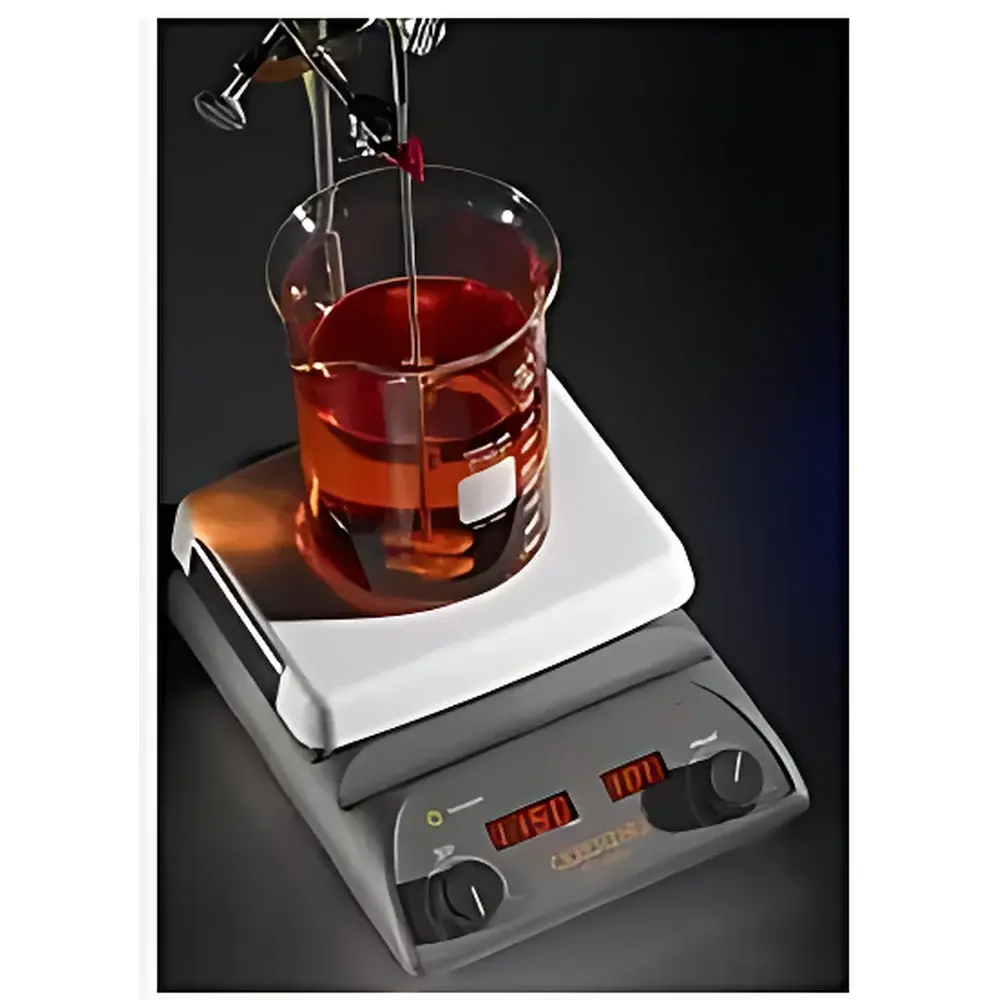
Corning PC-620D Digital Magnetic Hotplate Stirrer
| Brand | Corning |
|---|---|
| Origin | USA |
| Model | PC-620D |
| Maximum Stirring Volume | 2 L |
| Speed Range | 60–1150 rpm |
| Temperature Control Range | 5–550 °C |
| Plate Dimensions | 10" × 10" (25.4 × 25.4 cm) |
| Heating Surface Material | White Ceramic Glass |
| Power Supply | 230 V / 50 Hz |
| Unit Dimensions | 11.75 × 19.7 × 39.1 cm |
Overview
The Corning PC-620D Digital Magnetic Hotplate Stirrer is an engineered laboratory instrument designed for precise, reproducible heating and magnetic stirring of samples in analytical and preparative workflows. It operates on the principle of electromagnetic induction to rotate a PTFE-coated stir bar within a vessel while simultaneously delivering uniform, controllable thermal energy via a ceramic-glass heating surface. Its architecture integrates closed-loop temperature regulation with digital speed control—enabling stable operation across demanding applications such as solid-phase microextraction (SPME), solvent-assisted extraction, dissolution testing, and reaction kinetics studies. The unit complies with IEC 61010-1 safety standards for laboratory electrical equipment and is constructed to support GLP-compliant environments where traceability and operational consistency are required.
Key Features
- Digital LED display with independent dual-control interface for real-time monitoring and adjustment of both temperature (°C) and rotational speed (rpm)
- Ceramic-glass heating surface (25.4 × 25.4 cm) offering rapid thermal response, chemical resistance, and easy decontamination
- Wide temperature range: 5–550 °C, with optional external temperature probe (Cat. No. 6795PR) enabling direct vessel-temperature feedback and enhanced accuracy in critical protocols
- Precise speed control from 60 to 1150 rpm, optimized for low-shear mixing of viscous or sensitive samples
- Stirring capacity up to 2 L using standard laboratory glassware (e.g., beakers, round-bottom flasks, SPME vials)
- Robust aluminum housing with integrated heat dissipation design ensuring long-term operational stability under continuous load
- Compliance-ready configuration supporting audit trails when used in conjunction with validated SOPs and external data loggers
Sample Compatibility & Compliance
The PC-620D accommodates a broad range of sample containers—including 4 mL and 15 mL SPME vials, borosilicate glass beakers, and jacketed reactors—without compromising thermal homogeneity or mechanical coupling efficiency. Its flat, inert surface minimizes contamination risk and supports sterilization protocols. For regulated environments, the instrument meets essential requirements of ISO/IEC 17025 for equipment qualification and may be included in IQ/OQ documentation packages. While not inherently 21 CFR Part 11 compliant, its analog/digital interface allows integration with compliant LIMS or ELN systems when paired with timestamped external logging hardware.
Software & Data Management
The PC-620D operates as a standalone benchtop device without embedded firmware or network connectivity. All parameter settings are retained locally via non-volatile memory and displayed in real time. For laboratories requiring electronic record retention, optional accessories—including the external temperature probe (6795PR) and third-party USB data loggers—enable capture of time-stamped temperature and speed profiles. These logs can be imported into validated software platforms for review during internal audits or regulatory inspections. Corning provides full technical documentation, including electrical schematics, calibration guidelines, and maintenance procedures, facilitating user-led periodic verification per ASTM E2500.
Applications
- Solid-phase microextraction (SPME) sample preparation, particularly for volatile organic compound (VOC) enrichment in environmental water, clinical biofluids, and forensic evidence
- Controlled-temperature dissolution of polymers, pharmaceutical actives, and surfactants prior to HPLC or GC analysis
- Heating and agitation during derivatization reactions, catalyst activation, and buffer equilibration
- Standardized thermal conditioning of calibration standards and reference materials
- Method development for EPA Methods 502.2, 524.2, and USP <724> (Drug Release Testing), where defined heating/stirring parameters are critical
FAQ
What is the maximum recommended volume for consistent stirring performance?
For optimal vortex formation and thermal uniformity, Corning specifies a maximum working volume of 2 L in compatible vessels with diameters ≥8 cm.
Can the PC-620D be used with temperature probes from other manufacturers?
Only Corning-certified probes (e.g., Cat. No. 6795PR) are validated for use with this model; third-party probes may compromise closed-loop control accuracy and void warranty coverage.
Is the heating surface resistant to strong acids or halogenated solvents?
The white ceramic-glass surface resists common lab chemicals, including diluted HCl, HNO₃, and acetone; however, prolonged exposure to concentrated HF, molten alkalis, or brominated solvents is not advised.
Does the unit include a built-in timer or programmable ramp function?
No—the PC-620D does not feature time-based automation or multi-step temperature ramps; these functions require external programmable controllers or integrated lab automation systems.
How often should calibration verification be performed?
Corning recommends quarterly verification using NIST-traceable thermometers and tachometers, aligned with institutional quality management system requirements (e.g., ISO 17025 Clause 6.5).



