
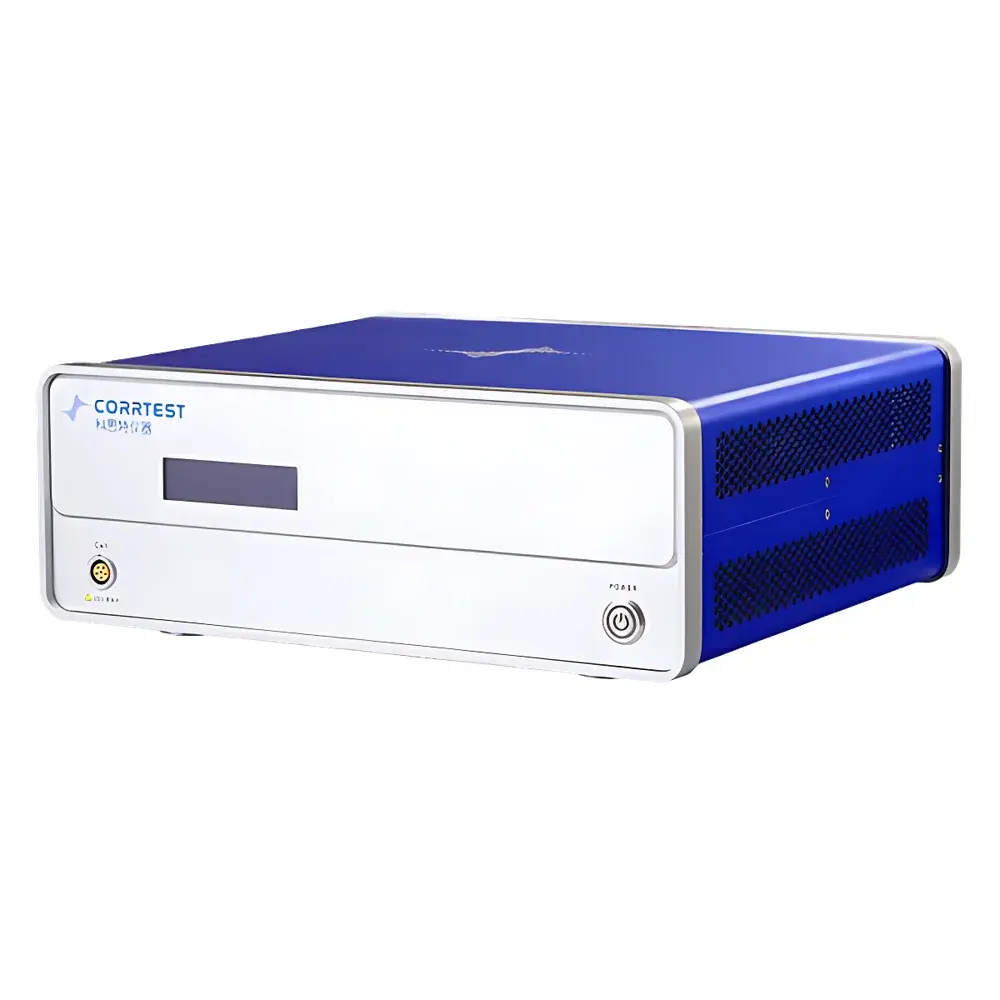
CorrTest CS310M Electrochemical Workstation
| Brand | CorrTest |
|---|---|
| Origin | Hubei, China |
| Model | CS310M |
| Current Range | ±2.0 A |
| Current Accuracy | 0.1% of full-scale reading |
| Potential Accuracy | 0.1% of full-scale reading ±1 mV |
| Potentiostatic Range | ±10 V |
| EIS Frequency Range | 10 µHz to 1 MHz |
| Potential Resolution | 3 mV (<10 Hz), 10 mV (>100 Hz) |
| Current Sensitivity | 1 pA |
| Rise Time | <1 ms (<10 mA), <10 ms (<2 A) |
| Reference Electrode Input Impedance | 10¹² Ω |
| Current Ranges | 2 nA–2 A (10 decades) |
| Compliance Voltage | ±21 V |
| CV/LSV Scan Rate | 0.001 mV/s to 10 V/s |
| CA/CC Pulse Width | 0.0001–65,000 s |
| AD Acquisition | 16-bit @ 1 MHz, 20-bit @ 1 kHz |
| DA Resolution | 16-bit, settling time: 1 µs |
| EIS Signal Generator | Sine/triangle/square wave |
| AC Amplitude | 1–2500 mV RMS |
| DC Bias | −10 to +10 V |
| Bandwidth | 8 programmable settings |
| Interface | USB 2.0 |
| Software | CorrTest CS Studio v4.x with GLP-compliant audit trail, method validation, and CFR Part 11–ready user access control |
Overview
The CorrTest CS310M Electrochemical Workstation is a high-performance, modular potentiostat/galvanostat engineered for rigorous electrochemical research and industrial testing in academic laboratories, materials development centers, and corrosion engineering departments. It operates on classical three-electrode potentiostatic/galvanostatic control principles, enabling precise application of potential or current stimuli while simultaneously measuring the resulting electrochemical response. Its architecture supports both steady-state and transient measurements—including cyclic voltammetry (CV), linear sweep voltammetry (LSV), chronoamperometry (CA), chronopotentiometry (CP), electrochemical impedance spectroscopy (EIS), and corrosion-specific protocols such as Tafel analysis, electrochemical noise (EN), zero-resistance ammetry (ZRA), and electrochemical potentiokinetic reactivation (EPR). Designed for reproducibility and long-term stability, the CS310M meets fundamental requirements for method validation under ISO/IEC 17025, ASTM G5/G59/G102, and USP guidelines for analytical instrument qualification.
Key Features
- Wide dynamic current range (2 nA–2 A, 10 decades) with 1 pA sensitivity and <0.1% full-scale accuracy ensures reliable detection of ultra-low Faradaic currents and robust handling of high-current battery cycling or electrodeposition.
- Potentiostatic control up to ±10 V with ±1 mV offset tolerance and <1 ms rise time enables fast transient studies including pulse techniques (DPV, SWV, NPV) and rapid EIS acquisition across 10 µHz–1 MHz.
- Integrated low-pass filtering (8-stage programmable bandwidth) and real-time IR compensation support accurate measurements in high-resistivity media (e.g., concrete pore solution, soil electrolytes, or non-aqueous battery electrolytes).
- Dual high-resolution ADCs (16-bit @ 1 MHz, 20-bit @ 1 kHz) and synchronized 16-bit DACs ensure fidelity in both fast-scan CV and low-frequency impedance mapping.
- USB 2.0 interface with deterministic latency and driver-level compatibility with Windows 10/11 ensures stable communication during extended automated experiments (e.g., 72-h corrosion monitoring or multi-step battery aging protocols).
- Hardware-triggered synchronization capability allows integration with external devices—such as rotating disk electrodes (RDE), temperature controllers, or optical spectrometers—for coupled physicochemical characterization.
Sample Compatibility & Compliance
The CS310M accommodates standard three-electrode configurations (working, counter, reference) and supports specialized cells including microelectrodes, coated metal coupons, embedded sensors, and flow-through electrochemical cells. It is routinely deployed in ASTM D1141-98 synthetic seawater, ASTM G102-89 electrolyte solutions, and custom-defined media per ISO 9223 for atmospheric corrosion assessment. All measurement methods—including LPR, EIS, and CPP—are implemented in accordance with ASTM G59, G106, and G199 for quantitative polarization resistance and corrosion rate derivation. The system complies with GLP documentation standards through CorrTest CS Studio’s electronic signature, audit trail, and method locking features—fully aligned with FDA 21 CFR Part 11 requirements for regulated environments.
Software & Data Management
CorrTest CS Studio v4.x serves as the unified control, acquisition, and analysis platform. It provides validated method templates for battery cycling (GITT/PITT), corrosion mapping (EPR, ZRA, EN), and advanced voltammetry (SHACV, FTACV, IPAD). Each experiment generates timestamped, metadata-embedded binary files (.csd) with checksum integrity verification. Raw data export supports CSV, TXT, and MATLAB-compatible formats. Built-in statistical tools enable batch processing of EIS spectra (Bode/Nyquist fitting), Tafel slope extraction, and diffusion coefficient calculation via Randles–Sevcik analysis. Audit logs record user login, parameter changes, calibration events, and file exports—retained for ≥36 months with configurable backup to network drives or NAS systems.
Applications
- Energy Materials: In situ EIS tracking of SEI evolution in Li-ion half-cells; galvanostatic intermittent titration (GITT) for Li⁺ diffusion coefficient quantification; CV hysteresis analysis in solid-state battery interfaces.
- Corrosion Science: Long-term OCP monitoring of reinforced concrete specimens; EIS-based pore resistance modeling in cementitious systems; EPR testing of sensitized stainless steels per ASTM A763.
- Sensor Development: Amperometric detection limits determination for enzymatic biosensors; DPV optimization of DNA hybridization signals on screen-printed electrodes.
- Electrosynthesis & Coating: Controlled-potential electrodeposition of Ni–Mo alloys; anodization kinetics of TiO₂ nanotube arrays; hydrogen permeation testing (HDT) per ASTM F1113 using Devanathan–Stachurski dual-cell configuration.
- Environmental Electrochemistry: Quantitative heavy metal speciation (Cd²⁺, Pb²⁺) via ASV in river sediment extracts; redox behavior of organic pollutants (e.g., nitrobenzene) in anaerobic groundwater simulants.
FAQ
Does the CS310M support true bipotentiostatic operation for rotating ring-disk electrode (RRDE) experiments?
No—the CS310M is a single-channel potentiostat. RRDE functionality requires optional coupling with the CS1002 bipotentiostat module or standalone CS2350 dual-potentiostat.
Is firmware upgrade supported in-field, and does it require recalibration?
Yes—firmware updates are delivered via CS Studio and preserve all factory calibration coefficients; no user recalibration is needed unless hardware modifications occur.
Can EIS data be acquired under potentiostatic control while simultaneously applying a DC bias sweep (Mott–Schottky mode)?
Yes—CS Studio implements EIS-potential sweep mode with user-defined step size, dwell time, and frequency list per step, compliant with ASTM F2553 for semiconductor/electrolyte interface characterization.
What level of cybersecurity compliance does CS Studio meet for network-connected deployments?
CS Studio supports Windows-native group policy enforcement, TLS 1.2 encrypted remote backups, and role-based access control (RBAC) with password complexity rules—aligned with NIST SP 800-53 Rev. 5 IA-5 and IA-7 controls.
How is traceability maintained for calibration certificates and instrument performance verification?
Each CS310M ships with a NIST-traceable calibration report (including gain/offset verification at 5 current/potential ranges); CS Studio logs all subsequent verification runs with operator ID, date, and pass/fail status per ISO/IEC 17025 Clause 6.5.
Related Products




