
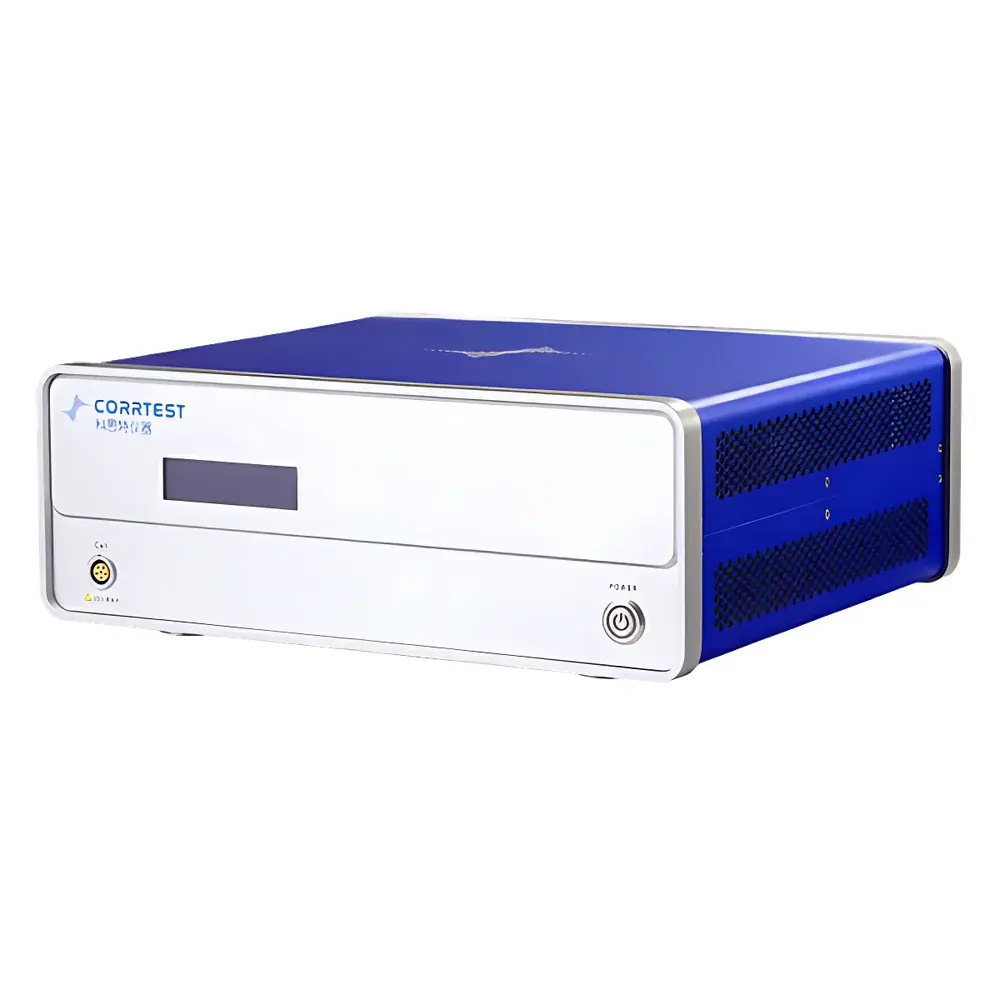
CorrTest CS350M Electrochemical Workstation
| Brand | CorrTest |
|---|---|
| Origin | Hubei, China |
| Model | CS350M |
| Current Range | ±2.0 A |
| Current Accuracy | 0.1% of full-scale reading |
| Potential Accuracy | 0.1% of full-scale reading ±1 mV |
| Potentiostatic Range | ±10 V |
| EIS Frequency Range | 10 µHz to 1 MHz |
| ADC Resolution | 16-bit @ 1 MHz, 20-bit @ 1 kHz |
| DAC Resolution | 16-bit |
| Input Impedance (Reference Electrode) | 10¹² Ω |
| Minimum Current Sensitivity | 1 pA |
| CV/LSV Scan Rate | 0.001 mV/s to 10 V/s |
| Pulse Width (CA/CC) | 0.0001 s to 65,000 s |
| EIS Signal Amplitude | 1–2500 mV RMS |
| DC Bias Range | –10 V to +10 V |
| Communication Interface | USB 2.0 |
| Low-Pass Filter | 8 programmable bandwidth settings |
Overview
The CorrTest CS350M Electrochemical Workstation is a high-precision, dual-channel potentiostat/galvanostat engineered for rigorous electrochemical research and industrial testing environments. It operates on the fundamental principles of controlled-potential and controlled-current electrochemistry, enabling quantitative measurement of interfacial charge transfer kinetics, mass transport behavior, and electrode/electrolyte interface properties. Designed for reproducible, low-noise operation across wide dynamic ranges, the CS350M supports both steady-state and transient electrochemical techniques—including cyclic voltammetry (CV), chronoamperometry (CA), electrochemical impedance spectroscopy (EIS), and corrosion-specific protocols such as electrochemical noise (EN) and electrochemical potentiokinetic reactivation (EPR). Its architecture complies with core requirements for GLP-compliant laboratories and meets functional alignment with ASTM G102, ASTM G59, ISO 17475, and EN 13509 standards for corrosion evaluation and battery electrochemistry.
Key Features
- Wide current range from ±2 nA to ±2.0 A with 10 auto-ranging decades and 1 pA minimum sensitivity—enabling high-resolution detection in ultra-low-current applications such as biosensor characterization and single-molecule electron transfer studies.
- Precise potential control over ±10 V with accuracy of 0.1% of full scale ±1 mV; fast potential step response (<1 ms for <10 mA loads, <10 ms for full 2 A output) ensures fidelity in transient measurements.
- High-fidelity EIS capability spanning 10 µHz to 1 MHz with 0.005% frequency accuracy, programmable AC amplitude (1–2500 mV RMS), and integrated DC bias compensation (–10 V to +10 V).
- Dual independent channels support simultaneous two-electrode or three-electrode experiments, including rotating disk electrode (RDE) speed control up to 10,000 rpm via optional motor interface.
- Integrated IR-drop compensation with real-time solution resistance measurement and positive feedback correction—critical for accurate kinetic analysis in resistive electrolytes (e.g., concrete pore solutions, soil extracts).
- 16-bit DAC with 1 µs settling time and 16-bit/20-bit selectable ADC (1 MHz / 1 kHz sampling)—optimized for high-speed CV acquisition and long-duration EIS time-series monitoring.
Sample Compatibility & Compliance
The CS350M accommodates standard three-electrode configurations (working, reference, counter) and supports specialized cell geometries including microelectrodes, gas-diffusion electrodes, coated metal coupons, and solid-state battery half-cells. It is routinely deployed in ASTM-compliant corrosion testing (G5, G102, G59), battery cycling per IEEE 1188 and IEC 62660-1, and sensor validation under ISO 13843. The instrument’s analog front-end design minimizes electromagnetic interference, ensuring stable performance in shared lab environments. All hardware and firmware adhere to CE marking directives (EMC 2014/30/EU, LVD 2014/35/EU), and software architecture supports audit trails required for FDA 21 CFR Part 11 compliance when configured with user authentication and electronic signature modules.
Software & Data Management
CorrTest Measurement & Control Software v4.x provides an integrated environment for experiment design, real-time visualization, post-processing, and report generation. It includes over 40 preconfigured electrochemical methods—spanning classical techniques (Tafel analysis, Mott-Schottky plots) and advanced modalities (FTACV, SHACV, DNPV, IPAD). Data files are stored in open-format HDF5 containers with embedded metadata (timestamp, parameter set, calibration history), facilitating interoperability with MATLAB, Python (via h5py), and commercial data analysis platforms. Batch processing, scripting (Python API), and automated sequence execution enable unattended multi-sample testing. Software updates are delivered via secure HTTPS channel, and version-controlled release notes document traceable changes per ISO/IEC 17025 clause 5.9.2.
Applications
- Energy Materials: In-situ and operando characterization of Li-ion cathodes/anodes, solid-electrolyte interphase (SEI) formation, redox flow battery electrolytes, and proton exchange membrane fuel cell catalyst layers.
- Corrosion Science: Quantitative assessment of passive film stability, localized corrosion susceptibility (pitting, crevice, intergranular), cathodic protection efficiency, and inhibitor performance in aqueous, concrete, and atmospheric exposure conditions.
- Electroanalytical Chemistry: Development and validation of amperometric, impedimetric, and potentiometric biosensors; detection limits down to sub-picomolar concentrations in enzymatic and immunosensing assays.
- Materials Synthesis: Controlled electrodeposition of nanomaterials (e.g., NiFe LDH, Cu₂O), electropolymerization of conductive polymers, and anodization of Al/Ti alloys for nanostructured oxide fabrication.
- Environmental Electrochemistry: Monitoring heavy metal speciation (As, Pb, Cd) via anodic stripping voltammetry (ASV); evaluating electrocatalytic degradation pathways of organic pollutants (e.g., phenol, nitrobenzene).
FAQ
Does the CS350M support true two-channel independent operation?
Yes—it features fully isolated dual potentiostat/galvanostat circuits, allowing concurrent experiments on separate working electrodes within one cell or independent cells.
Is EIS data acquisition compatible with Kramers-Kronig validation?
Yes—the software includes built-in K-K transform tools and supports export of raw complex impedance data for external validation using Thales or EC-Lab.
Can the system perform galvanostatic intermittent titration technique (GITT)?
Yes—GITT and potentiostatic intermittent titration technique (PITT) are implemented as native methods with configurable pulse duration, relaxation periods, and capacity integration.
What level of cybersecurity is implemented for network-connected operation?
The CS350M communicates exclusively via USB 2.0; no network interface is present by default. Optional Ethernet-to-USB bridges require local firewall configuration and are not supported out-of-the-box.
Is third-party software integration possible?
Yes—CorrTest SDK provides documented C/C++ and Python APIs for custom automation, including trigger synchronization with external equipment (e.g., temperature controllers, RDE motors).
Related Products




