
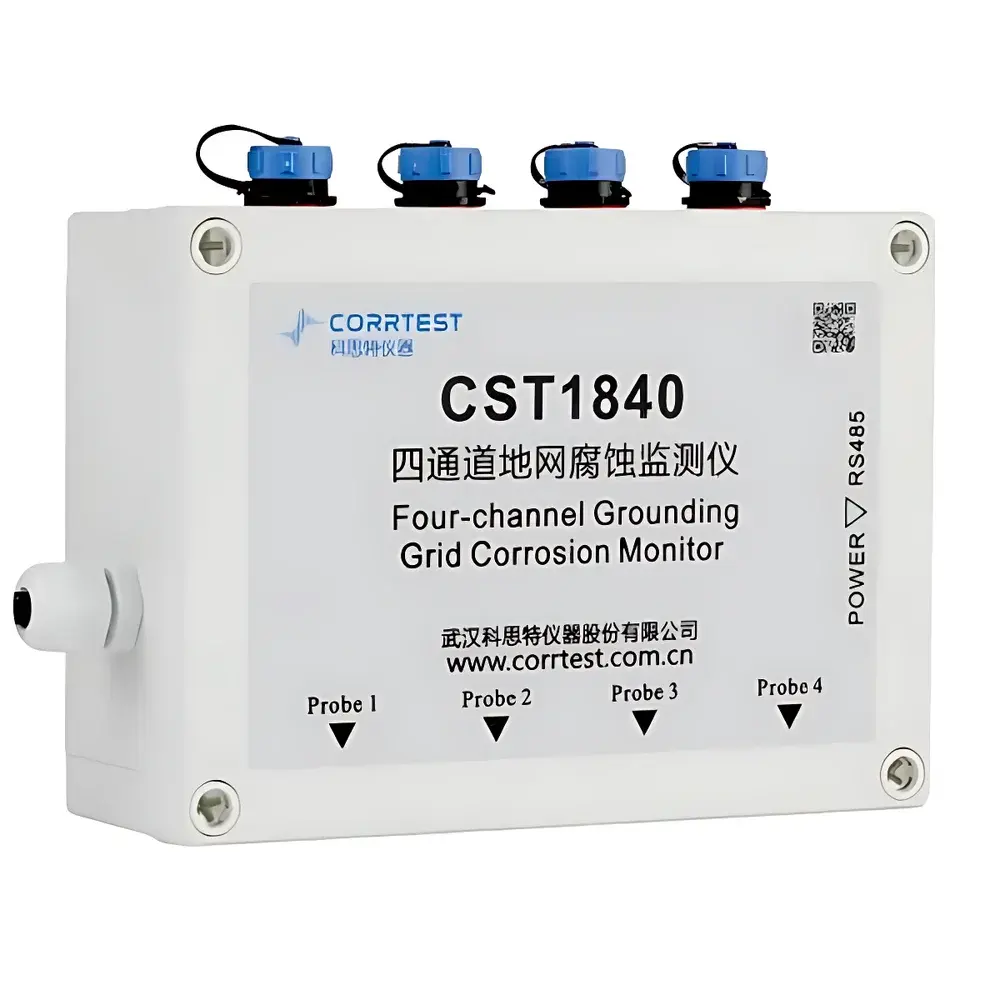
CorrTest CST1840 Four-Channel Grounding Grid Corrosion Monitor
| Brand | CorrTest |
|---|---|
| Origin | Hubei, China |
| Manufacturer Type | Authorized Distributor |
| Country of Origin | China |
| Model | CST1840 |
| Measurement Principle | Electrochemical Impedance Spectroscopy (EIS) & Current-Constraint Method |
| Channels | 4 |
| Input Impedance | 10¹¹ Ω |
| Corrosion Rate Range | 0.001–10 mm/a |
| Open-Circuit Potential Range | −2.5 V to +2.5 V vs. reference electrode |
| Soil Resistivity Range | 10 Ω to 100 kΩ |
| Accuracy | ±1% of reading |
| Timing Interval | 1–255 hours |
| Real-Time Clock Drift | <1 min/month |
| Onboard Storage | 16 MB Flash (≥5,000 measurement sets) |
| Communication | RS-485, Modbus RTU protocol |
| Power Supply | DC 12 V |
| Dimensions | 180 × 130 × 60 mm |
| Weight | 1.0 kg |
| Operating Temperature | −20 °C to +60 °C |
| Relative Humidity | ≤80% RH (non-condensing) |
Overview
The CorrTest CST1840 Four-Channel Grounding Grid Corrosion Monitor is an electrochemical field instrument engineered for long-term, in-situ assessment of metallic grounding infrastructure buried in soil or concrete environments. It operates on the dual principles of Electrochemical Impedance Spectroscopy (EIS) and current-constraint-based polarization resistance (Rp) measurement—providing quantitative corrosion rate data with higher immunity to environmental electrical noise and improved reproducibility compared to conventional Linear Polarization Resistance (LPR) techniques. By simultaneously resolving solution resistance (Rs) and polarization resistance (Rp) via high-impedance potentiostatic excitation, the CST1840 calculates instantaneous corrosion rates using the Stern-Geary equation, calibrated for typical carbon steel and copper grounding materials. Its design targets low-conductivity media where traditional DC methods suffer from unstable baseline potentials and poor signal-to-noise ratios—making it particularly suitable for rural substations, wind farm earthing systems, and cathodically protected pipeline grounding grids.
Key Features
- Four independent, galvanically isolated measurement channels enabling concurrent monitoring of multiple grounding electrodes or spatially distributed sensor locations
- High-input-impedance (>10¹¹ Ω) analog front-end optimized for stable open-circuit potential (OCP) acquisition and low-current EIS perturbation
- Integrated real-time clock with <1 minute/month drift, supporting autonomous scheduled measurements without external time synchronization
- Onboard 16 MB flash memory storing ≥5,000 timestamped datasets—including corrosion rate (mm/a), cumulative corrosion depth (mm), soil resistivity (Ω·m), and redox potential (mV)
- RS-485 interface compliant with Modbus RTU protocol for seamless integration into SCADA, PLC, or centralized corrosion management platforms
- Ruggedized aluminum enclosure rated for outdoor deployment (IP65 equivalent), operating continuously across −20 °C to +60 °C and ≤80% RH non-condensing conditions
Sample Compatibility & Compliance
The CST1840 is designed for use with standardized embedded corrosion sensors such as the CP-83 grounding grid monitor—comprising dual-element steel/copper working electrodes, Ag/AgCl reference, and auxiliary counter electrode configured for representative soil-electrode interface simulation. It supports compliance with ASTM G102 (calculation of corrosion rates from electrochemical data), ASTM G59 (potentiostatic polarization testing), and ISO 9223 (corrosivity classification of atmospheres). While not a certified medical or pharmaceutical device, its data logging architecture meets foundational requirements for GLP-aligned field studies, including immutable timestamps, parameter traceability, and non-volatile storage. When deployed in utility-scale infrastructure, the system facilitates adherence to IEC 62305-3 (lightning protection – physical damage to structures) and IEEE Std 80 (guide for safety in AC substation grounding) by providing empirical corrosion kinetics for risk-informed maintenance scheduling.
Software & Data Management
The included CSkit Corrosion Analysis Software provides post-processing, visualization, and report generation for downloaded CST1840 datasets. It enables spectral fitting of EIS Nyquist/Bode plots, Rp trend analysis over time, and cross-channel correlation of corrosion rate versus soil resistivity or redox potential. Raw data exports are available in CSV and Excel-compatible formats, preserving all metadata (timestamp, channel ID, measurement mode, ambient temperature if logged externally). For networked deployments, the CST1840 interfaces with the CST610 wireless gateway to transmit Modbus frames over LoRaWAN or cellular backhaul to cloud-hosted dashboards. All remote access adheres to TLS 1.2 encryption; user authentication follows role-based access control (RBAC) principles. Audit trails record configuration changes, firmware updates, and data retrieval events—supporting internal QA review and regulatory readiness under ISO/IEC 17025 clause 7.7 (reporting results).
Applications
- Continuous corrosion health monitoring of grounding grids in high-voltage substations and renewable energy sites
- Performance evaluation of sacrificial anodes and impressed current cathodic protection (ICCP) systems in soil
- Long-term validation of corrosion inhibitors or backfill material effectiveness in earthing enhancement projects
- Baseline corrosion mapping during commissioning of new transmission infrastructure
- Supporting predictive maintenance programs by correlating electrochemical metrics with seasonal soil moisture and chloride ingress trends
- Field calibration and verification of computational corrosion models used in asset integrity management systems (AIMS)
FAQ
Can the CST1840 operate unattended for extended periods?
Yes—the built-in RTC and programmable wake-up intervals (1–255 hours) enable fully autonomous operation for months without manual intervention.
Is sensor calibration required before each measurement?
No routine recalibration is needed; the CP-83 sensor is factory-characterized and maintains stability over 2+ years in typical soils. Field verification against a known reference electrode is recommended annually.
Does the instrument support third-party SCADA integration?
Yes—Modbus RTU over RS-485 allows direct integration with most industrial automation systems without proprietary middleware.
How is data security handled in remote monitoring configurations?
All wireless telemetry via CST610 uses AES-128 encryption; cloud API endpoints enforce OAuth 2.0 authentication and session timeouts.
What maintenance does the CST1840 require in harsh outdoor environments?
Annual visual inspection of cable glands and sensor junction boxes is advised; no internal consumables or periodic recalibration are specified in the maintenance schedule.
Related Products





